

Top 10 Reasons Worcester Homeowners Are Switching to Heat Pumps
Introduction
Worcester, Massachusetts winters are no joke. Temperatures regularly plunge below 20°F, and residents have historically relied on expensive heating oil, propane, or aging gas furnaces to survive the season. But something is changing fast across Worcester’s neighborhoods — from the triple-deckers of Main South to the colonials of Tatnuck and the Craftsman homes of Burncoat. Homeowners are swapping out their old HVAC equipment for mini-split heat pump systems at a record pace.
In 2023 and 2024, Massachusetts saw a surge in heat pump installations driven by Mass Save rebates reaching up to $10,000, federal tax credits under the Inflation Reduction Act, and dramatic improvements in cold-climate heat pump technology. The question Worcester homeowners are now asking isn’t whether to switch — it’s when.
Whether you’re heating a 19th-century Victorian, a 1970s split-level, or a modern condo, this guide covers the top 10 reasons Worcester homeowners are making the switch to heat pumps — and why this could be the best home improvement decision you make this decade.
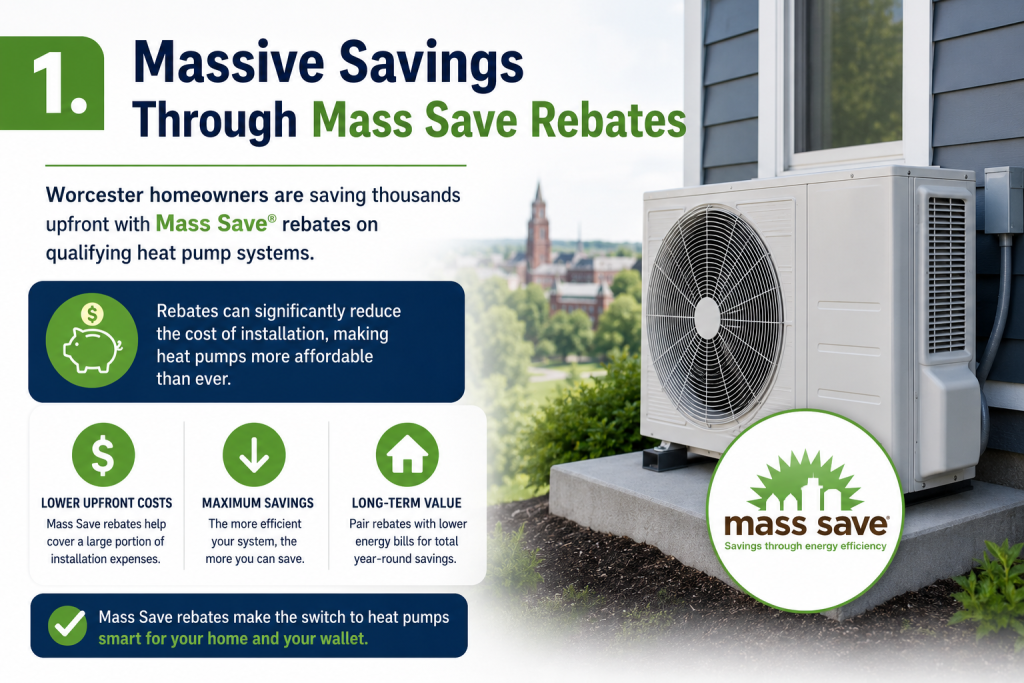
1. Massive Savings Through Mass Save Rebates
The single biggest financial driver of heat pump adoption in Worcester is the Mass Save rebate program. Massachusetts ratepayers benefit from one of the most generous heat pump incentive programs in the country, offering rebates of up to $10,000 for qualifying cold-climate heat pump installations.
Here’s what you can typically access through Mass Save:
- Up to $2,500 per qualifying indoor unit (with a combined cap)
- 0% interest HEAT Loans for up to 7 years to cover remaining costs
- Enhanced rebates for income-qualified households — sometimes covering 100% of costs
- Free home energy audits that identify additional savings opportunities
On top of state rebates, the Inflation Reduction Act provides a federal tax credit of 30% of installed costs (up to $2,000 per year) for qualifying heat pump systems. Stacking state and federal incentives, many Worcester homeowners reduce their out-of-pocket installation cost by 40–60%.
Ready to see what you qualify for? Contact EddyTech for a free rebate assessment — we handle all Mass Save paperwork on your behalf.
2. Dramatic Reduction in Heating Bills
Worcester homeowners paying for fuel oil or propane are paying some of the highest heating costs in the Northeast. Heat oil prices have averaged $4–$5 per gallon in recent winters, and a typical Worcester home can burn 800–1,000 gallons annually — that’s $3,200–$5,000 just for winter heat.
Heat pumps operate on a fundamentally different principle. Rather than burning fuel to create heat, they move heat from outdoor air into your home, achieving efficiencies of 200–400%. For every $1 of electricity consumed, a modern heat pump delivers $2–$4 worth of heat. The U.S. Department of Energy confirms that heat pumps can reduce heating costs by 30–50% compared to electric resistance heating, and even more compared to fuel oil.
Worcester homeowners typically save $1,200–$2,500 per year by switching from oil to a heat pump. Visit our savings calculator page to estimate your personal savings.
3. Year-Round Comfort: Heating AND Cooling in One System
Many Worcester homes with oil or gas heat lack central air conditioning entirely, relying on window units that are inefficient, noisy, and unsightly. A ductless mini-split heat pump solves both problems with a single system.
In summer, mini-splits operate as highly efficient air conditioners, outperforming most window units with:
- SEER2 ratings of 16–30+ (window units typically achieve 8–12 SEER)
- Quiet operation at 19–32 dB for indoor units
- Precise dehumidification for Worcester’s muggy July and August
- No need to haul heavy window units in and out each season
In winter, the same system provides efficient heat down to -13°F, covering even the harshest Worcester cold snaps. The American Council for an Energy-Efficient Economy (ACEEE) rates cold-climate heat pumps among the most cost-effective all-season HVAC solutions for New England homeowners.
4. Cold-Climate Technology Built for Worcester Winters
A common misconception is that heat pumps don’t work in cold climates. That may have been partially true a decade ago, but today’s cold-climate heat pumps are engineered for New England winters.
Brands like Mitsubishi Electric, Daikin, and Fujitsu offer systems that maintain full heating capacity at 5°F and continue operating at -13°F — well below Worcester’s typical winter lows. Inverter-driven variable-speed compressors modulate output continuously, unlike older on/off systems, delivering even temperatures without the temperature swings of traditional forced-air heating.
EddyTech only installs cold-climate certified mini-split systems that carry the Mass Save cold-climate designation, ensuring maximum rebate eligibility and genuine winter performance.
5. Eliminating Oil Tank and Combustion Risks
Thousands of Worcester homes still have underground or above-ground oil tanks — and with them come real risks: leaks, contamination, costly removal, and the ever-present dangers of combustion equipment. Each year, the U.S. Consumer Product Safety Commission reports hundreds of carbon monoxide incidents related to malfunctioning heating equipment.
Switching to a heat pump eliminates:
- Carbon monoxide risk (no combustion)
- Oil tank liability and potential environmental cleanup costs
- Chimney maintenance and inspection requirements
- Risk of furnace or boiler failure during a polar vortex
For peace of mind and home safety, learn more about our ductless heating solutions for Worcester homes.
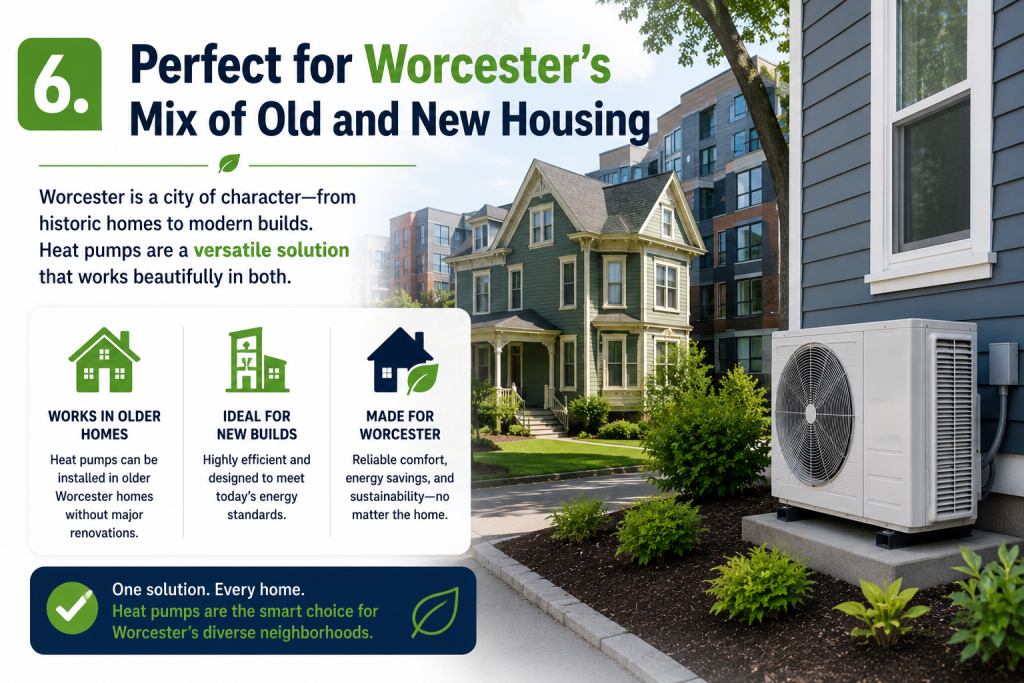
6. Perfect for Worcester’s Mix of Old and New Housing
Worcester’s housing stock is diverse — three-deckers, Colonials, Capes, ranch homes, and new condos. Many older homes lack ductwork entirely, making traditional central HVAC prohibitively expensive to retrofit. Ductless mini-splits are the ideal solution because:
- Installation requires only a 3-inch hole through an exterior wall
- No ductwork planning, installation, or sealing required
- Systems can be sized per apartment or unit in multi-family buildings
- Historical homes preserve their character without bulky duct modifications
The Massachusetts Department of Energy Resources (DOER) actively promotes ductless heat pump adoption as a key pathway to decarbonizing the state’s residential building stock. Worcester’s 3-deckers and older homes are at the top of that priority list.
Browse our Worcester service area coverage to see if your neighborhood qualifies for fast installation scheduling.
7. Improved Indoor Air Quality and Comfort
Fuel-burning heating systems introduce combustion byproducts, dust, and pathogens through duct systems. Heat pumps operate on a sealed refrigerant circuit with no combustion and include multi-stage air filtration, removing:
- Dust and particulate matter
- Pollen and allergens (critical for Worcester’s high spring pollen counts)
- Mold spores and bacteria
- Odors and VOCs in some advanced filter models
The EPA’s Indoor Air Quality (IAQ) guidance notes that indoor air can be 2–5x more polluted than outdoor air. Heat pump filtration significantly reduces this gap, making a noticeable difference for asthma and allergy sufferers — a particularly important benefit in Worcester, which consistently ranks among New England cities with higher respiratory health challenges.
8. Quiet, Unobtrusive Operation
Old oil boilers clank, forced-air furnaces roar, and window AC units rattle. Modern mini-split heat pumps are whisper-quiet — indoor units typically operate at 19–32 dB, quieter than a library. Outdoor units operate at 50–60 dB at normal load — comparable to a quiet conversation.
This makes mini-splits ideal for bedrooms, home offices (critical for Worcester’s growing remote-work population), and home studios. No more sleeping through furnace cycles or being startled by AC compressor kickons.
See our gallery of Worcester installations to see how cleanly indoor units integrate into real Worcester homes.
9. Supporting Massachusetts’ Clean Energy Goals — and Your Own
Massachusetts has committed to net-zero greenhouse gas emissions by 2050. Buildings account for roughly 30% of the state’s emissions, and home heating is the largest component. Switching from oil or gas to a heat pump powered by the Massachusetts grid — which is adding solar and wind capacity rapidly — dramatically reduces a home’s carbon footprint.
According to the Massachusetts Clean Energy Center (MassCEC), a typical single-family home switching from oil to a heat pump reduces annual CO2 emissions by 3–5 metric tons. Pairing a heat pump with rooftop solar can approach net-zero heating emissions.
For Worcester homeowners who care about sustainability, choosing a heat pump is one of the highest-impact decisions available. Check out our blog for the latest on heat pumps and clean energy in Massachusetts.
10. Increased Home Value and Market Appeal
Real estate research consistently shows that energy-efficient upgrades increase home resale value and reduce days on market. A study by the Lawrence Berkeley National Laboratory found that energy-efficient homes command a premium at resale, and a modern heat pump system is increasingly a selling point for Worcester buyers who are cost-conscious and environmentally aware.
In Massachusetts’s competitive real estate market, homes with efficient, modern HVAC systems — particularly those already paired with solar or other green upgrades — consistently outperform comparable homes at sale. Buyers in their 30s and 40s, who make up a large share of Worcester’s buyer pool, actively seek homes that won’t burden them with high energy bills or deferred maintenance on aging oil systems.
When you’re ready to make the switch, request your free EddyTech consultation today.
| Ready to Switch? EddyTech Mini Splits Solutions serves Worcester and surrounding communities — Shrewsbury, Millbury, Auburn, Grafton, and more. We handle your Mass Save rebate paperwork, permits, and installation from start to finish. Visit eddytechminisplits.com/contact or call us today for your FREE estimate. |
Conclusion
The shift to heat pumps in Worcester is not a trend — it’s a transformation. Driven by unprecedented financial incentives, improved cold-climate technology, and a growing awareness of energy costs and environmental impact, Worcester homeowners are making a smart, long-term investment in their comfort, health, and financial wellbeing.
From the Mass Save-rebate-eligible installations EddyTech completes across Worcester County to the federal tax credits available through the Inflation Reduction Act, the financial case has never been stronger. And with today’s cold-climate heat pumps engineered to thrive in New England winters, the performance case is equally compelling.
If you’re ready to explore making the switch, contact EddyTech Mini Splits Solutions for a free, no-obligation consultation. We’ll assess your home, calculate your savings, identify your rebate eligibility, and give you a clear picture of what switching to a heat pump looks like for your specific Worcester home.
Frequently Asked Questions (FAQ)
100 questions Worcester homeowners ask about heat pumps — answered by the experts at EddyTech Mini Splits Solutions.
1. What is a heat pump?
A heat pump is a highly energy-efficient HVAC system that moves heat rather than generating it, providing both heating and cooling for your home.
2. How does a heat pump work in cold weather?
Modern cold-climate heat pumps can extract heat from outdoor air even at temperatures as low as -13°F (-25°C), making them well-suited for Worcester winters.
3. Are heat pumps effective in Worcester, MA?
Yes. Worcester’s climate is well within the operational range of modern cold-climate heat pumps. Many homeowners see significant efficiency gains year-round.
4. What is a mini-split heat pump?
A mini-split (ductless) heat pump consists of an outdoor compressor unit and one or more indoor air handlers, requiring no ductwork.
5. How much does a heat pump cost in Worcester?
Installed costs typically range from $3,000–$12,000+ depending on system size and complexity. Mini-splits for single zones start lower.
6. What rebates are available for heat pumps in Massachusetts?
Mass Save offers rebates up to $10,000 for cold-climate heat pumps. Federal tax credits under the Inflation Reduction Act add up to 30% (max $2,000/year).
7. What is Mass Save?
Mass Save is an energy efficiency program run by Massachusetts utilities that provides rebates, incentives, and no-interest loans for efficient HVAC upgrades.
8. Do heat pumps replace my furnace?
In many cases, yes. Cold-climate heat pumps can serve as the primary heating and cooling system, though some homeowners keep a backup furnace for extreme cold snaps.
9. Can a heat pump cool my home in summer?
Absolutely. Heat pumps provide efficient air conditioning in summer by running the refrigeration cycle in reverse.
10. What is COP and why does it matter?
COP (Coefficient of Performance) measures efficiency. A heat pump with a COP of 3 delivers 3 units of heat for every 1 unit of electricity consumed.
11. How does a heat pump compare to oil heat?
Heat pumps are 2–4x more efficient than oil boilers and eliminate fuel oil costs and delivery schedules.
12. Can I keep my existing heating system?
Yes. Many Worcester homeowners install a heat pump as a primary system and keep oil or gas as a backup, called a dual-fuel system.
13. How noisy are mini-split heat pumps?
Indoor units typically operate at 19–32 dB — quieter than a whisper — making them ideal for bedrooms and living areas.
14. Do heat pumps work with solar panels?
Yes! Heat pumps pair exceptionally well with solar PV systems, allowing you to heat and cool your home using free solar electricity.
15. How long do heat pumps last?
Most heat pumps last 15–20 years with proper maintenance, comparable to or longer than traditional HVAC equipment.
16. What maintenance do heat pumps require?
Clean or replace filters monthly, clear debris from the outdoor unit, and schedule annual professional service. Requirements are minimal compared to combustion systems.
17. Is a heat pump good for allergy sufferers?
Yes. Heat pumps include multi-stage filtration that removes dust, pollen, and particulates more effectively than many traditional systems.
18. Does a heat pump dehumidify?
Yes. In cooling mode, heat pumps remove moisture from the air, improving indoor comfort during humid Worcester summers.
19. Can I install a heat pump myself?
DIY installation is not recommended. Proper sizing, refrigerant handling, and electrical connections require licensed HVAC professionals.
20. How many zones can a mini-split cover?
A single outdoor unit can power 2–8 indoor handlers (multi-split), allowing independent temperature control for different rooms or zones.
21. What SEER rating should I look for?
Look for a SEER2 rating of at least 16–18. Higher SEER means greater cooling efficiency and lower operating costs.
22. What HSPF rating should I look for?
Look for HSPF2 of 8.5 or higher for heating efficiency. Cold-climate units often exceed 10 HSPF2.
23. What brands are most reliable?
Mitsubishi, Daikin, Fujitsu, and LG are top-rated cold-climate mini-split brands with proven performance in Massachusetts.
24. How is a heat pump sized for my home?
Sizing is based on Manual J load calculations considering square footage, insulation, windows, and climate data for Worcester.
25. Can a heat pump heat a whole house?
Yes, with proper multi-zone installation, a heat pump system can efficiently heat and cool an entire home.
26. What is a cold-climate heat pump?
A cold-climate heat pump is specifically engineered to operate efficiently at very low outdoor temperatures, down to -13°F or lower.
27. Will my electric bill go up?
Your electric bill will increase, but total energy costs typically decrease because heat pumps replace expensive oil, propane, or electric resistance heat.
28. Are heat pumps environmentally friendly?
Yes. Heat pumps produce zero direct emissions and, when powered by renewable electricity, have a very low carbon footprint.
29. What is the MassSave HEAT Loan?
Mass Save’s 0% interest HEAT Loan program allows eligible homeowners to finance efficient heating upgrades with no interest for up to 7 years.
30. Do I need to upgrade my electrical panel for a heat pump?
Sometimes. Many installations require a 240V circuit and occasionally a panel upgrade. Your installer will assess this during the site visit.
31. How quickly can a heat pump heat a room?
Mini-splits heat or cool spaces quickly, often reaching set temperature within 10–15 minutes due to their variable-speed inverter compressors.
32. What is inverter technology in heat pumps?
Inverter compressors modulate speed continuously rather than cycling on/off, improving efficiency, comfort, and equipment longevity.
33. Are there heat pump water heaters too?
Yes. Heat pump water heaters (HPWHs) are another efficient upgrade available through Mass Save rebates.
34. Can heat pumps be used in older Worcester homes?
Yes. Ductless mini-splits are ideal for older homes without ductwork, including triple-deckers and Victorian-era properties.
35. What is the payback period for a heat pump?
Most Worcester homeowners see a payback period of 4–8 years after rebates and tax credits, depending on current fuel costs.
36. Does Worcester have any local heat pump incentives?
Beyond Mass Save and federal programs, check with your utility (Eversource or National Grid) for additional rebates and rate programs.
37. What is the federal heat pump tax credit?
Under the Inflation Reduction Act, homeowners can claim a 30% tax credit (up to $2,000/year) for qualifying heat pump installations.
38. Can I get both the federal credit and Mass Save rebate?
Yes. Federal tax credits and Mass Save rebates can be stacked for maximum savings.
39. Are heat pumps safe?
Yes. Heat pumps use sealed refrigerant circuits with no combustion, eliminating risks of carbon monoxide, gas leaks, or chimney fires.
40. What happens during a power outage?
Like any electric HVAC system, heat pumps do not operate during a power outage unless you have a backup generator.
41. Do heat pumps work in multi-family homes?
Yes. Mini-split systems are popular in multi-family and multi-unit buildings where individual unit control is important.
42. How do I choose the right contractor?
Choose a Mass Save-approved installer with NATE certification, strong local reviews, and experience with cold-climate systems in Worcester.
43. What is the installation timeline?
A typical mini-split installation takes 1–2 days. Whole-home systems may take 2–5 days depending on complexity.
44. Will a heat pump increase my home value?
Studies show energy-efficient upgrades, including heat pumps, increase home resale value and appeal to buyers.
45. What refrigerant do modern heat pumps use?
Most modern systems use R-410A or the newer R-32 and R-454B refrigerants, which have lower environmental impact.
46. Do heat pumps need a thermostat upgrade?
Smart thermostats are recommended and often compatible with mini-split systems for improved scheduling and energy management.
47. Can I control my heat pump remotely?
Yes. Most modern mini-splits include WiFi connectivity for remote control via smartphone apps.
48. What is the difference between a heat pump and a central AC?
A heat pump provides both heating and cooling, while central AC provides only cooling and requires a separate heating system.
49. Are there cold-snap backup options?
Yes. Dual-fuel systems pair a heat pump with a gas furnace backup that activates during extreme cold events.
50. What is a geothermal heat pump?
Geothermal heat pumps use the stable temperature of the earth rather than outdoor air, offering very high efficiency but higher installation costs.
51. Can I finance a heat pump installation?
Yes. Options include Mass Save HEAT Loans (0% interest), utility on-bill financing, and contractor financing plans.
52. What is a PTAC unit vs a mini-split?
PTACs are self-contained wall units common in hotels. Mini-splits are more efficient, quieter, and better suited for residential use.
53. Do heat pumps work well in humid climates?
Yes. Heat pumps dehumidify in cooling mode, which is beneficial during Worcester’s humid summers.
54. How do I maintain my outdoor unit in winter?
Keep the unit clear of snow and ice. Most systems have defrost cycles. Ensure clearance of at least 18–24 inches around the unit.
55. Can I add a heat pump to supplement my existing system?
Yes. Adding a ductless mini-split as a supplemental unit for a specific zone is a common and cost-effective approach.
56. What are the signs my HVAC system needs replacement?
Frequent repairs, uneven temperatures, rising energy bills, system age over 15 years, and use of R-22 refrigerant are key signs.
57. What is R-22 and why should I replace my system?
R-22 (Freon) is a phased-out refrigerant that is no longer manufactured and is very expensive to service. Systems using R-22 should be replaced.
58. How does a heat pump handle defrost?
Heat pumps automatically run defrost cycles when ice forms on the outdoor coil, briefly switching to cooling mode to melt accumulation.
59. What is sensible vs latent heat?
Sensible heat refers to temperature change; latent heat refers to humidity removal. Heat pumps handle both, unlike some older systems.
60. Are mini-splits aesthetically acceptable?
Modern indoor units are sleek and low-profile. Cassette and concealed duct units offer even less visible options for design-conscious homeowners.
61. What is the warranty on a heat pump?
Most manufacturers offer 5–12 year parts warranties. Extended warranties of up to 12 years are available on registered equipment.
62. Do Worcester winters stress heat pump warranties?
No. Cold-climate systems are designed and warranted for operation in New England conditions.
63. Can I install a heat pump in a garage?
Yes. Mini-splits are an excellent solution for heating and cooling garages, workshops, and bonus rooms.
64. What is the best time of year to install a heat pump?
Fall or spring installations avoid peak demand, often resulting in faster scheduling and better installer availability.
65. Are heat pumps loud outside?
Outdoor units typically run at 50–60 dB at normal operation — similar to a quiet conversation — and are quieter at low loads.
66. What is the difference between ducted and ductless heat pumps?
Ducted systems use existing ductwork to distribute conditioned air. Ductless mini-splits deliver air directly to each zone without ducts.
67. Can I use a heat pump with radiant floor heating?
High-temperature heat pumps (hydronic) can work with radiant systems, though traditional mini-splits are not compatible with hydronic systems.
68. How does EddyTech size a system for my home?
EddyTech performs a detailed Manual J load calculation, considering your home’s insulation, windows, orientation, and occupancy to right-size your system.
69. What happens if my heat pump breaks in winter?
EddyTech offers priority service for existing customers. Dual-fuel backup ensures you always have heat even during a service call.
70. Why choose EddyTech for my heat pump installation?
EddyTech Mini Splits Solutions specializes in cold-climate mini-split systems in Worcester and the surrounding region, with deep expertise in Mass Save rebate navigation.
71. Does EddyTech offer free estimates?
Yes. EddyTech provides free on-site consultations and system assessments for Worcester homeowners.
72. What areas does EddyTech serve?
EddyTech serves Worcester and surrounding communities including Shrewsbury, Millbury, Auburn, Grafton, Northborough, Westborough, and others.
73. What is a multi-zone mini-split?
A multi-zone system has one outdoor unit connected to multiple indoor handlers, each independently controlled for different rooms.
74. Is a heat pump eligible for green energy certificates in MA?
Yes. Installing a qualifying heat pump may make you eligible for Alternative Energy Credits (AECs) through DOER programs.
75. Can heat pumps cause condensation issues?
Properly installed heat pumps drain condensate outside. Indoor units have condensate drain lines that must be correctly routed.
76. Do I need permits for a heat pump installation in Worcester?
Yes. Heat pump installations in Worcester require building and electrical permits. Licensed contractors handle permit procurement.
77. How do I know if my home is suitable for a heat pump?
Almost all homes are suitable. An energy audit identifies insulation improvements that maximize heat pump performance.
78. What is an energy audit and do I need one?
A Mass Save energy audit (free for most homeowners) evaluates your home’s efficiency and recommends improvements before HVAC upgrades.
79. Can I get a Mass Save audit before installing a heat pump?
Yes and it is recommended. The audit identifies rebate opportunities and ensures your home is ready for efficient heat pump operation.
80. What is the difference between air-source and water-source heat pumps?
Air-source heat pumps exchange heat with outdoor air. Water-source (geothermal) units exchange heat with ground water, offering even higher efficiency.
81. Can a heat pump replace my window AC units?
Yes. A ductless mini-split provides far superior cooling performance, efficiency, and aesthetics compared to window AC units.
82. What is the impact of insulation on heat pump performance?
Good insulation dramatically reduces the load on a heat pump, lowering operating costs and allowing a smaller, less expensive system.
83. How do I apply for Mass Save rebates?
Your Mass Save-approved installer handles the rebate application on your behalf as part of the installation process.
84. What is the income-eligible rebate for heat pumps?
Low-to-moderate income (LMI) households may qualify for enhanced rebates covering up to 100% of installation costs through Mass Save programs.
85. Do heat pumps work in small apartments?
Yes. Single-zone mini-splits are ideal for apartments, condos, and small homes.
86. How does air quality compare to forced-air gas heat?
Heat pumps do not burn fuel, eliminating combustion byproducts and often improving indoor air quality significantly.
87. What is the grid readiness of heat pumps?
Heat pumps support demand response programs, allowing utilities to optimize grid loads during peak demand periods.
88. Can commercial buildings use heat pumps?
Yes. Commercial-grade heat pump systems are available for offices, retail spaces, and light commercial buildings.
89. What HVAC certifications should my installer have?
Look for NATE certification, EPA 608 refrigerant certification, and Mass Save trade ally status.
90. How do I register my heat pump for the warranty?
Register online with the manufacturer within 30–60 days of installation to activate the full warranty period.
91. What is the difference between a heat pump and a geothermal system in cost?
Air-source heat pumps typically cost $5,000–$15,000 installed. Geothermal systems cost $15,000–$40,000 but offer higher efficiency.
92. How has heat pump technology improved in recent years?
Inverter compressor technology, variable-speed fans, enhanced refrigerants, and advanced defrost algorithms have dramatically improved cold-weather performance since 2015.
93. Are there smart home integrations for heat pumps?
Yes. Many mini-splits integrate with Amazon Alexa, Google Home, Apple HomeKit, and other smart home platforms.
94. What is the impact of a heat pump on my carbon footprint?
Switching from oil heat to a heat pump on Massachusetts’s current electric grid can reduce home heating emissions by 50–70%.
95. Does EddyTech offer maintenance plans?
Yes. EddyTech offers annual maintenance agreements to keep your system running at peak efficiency and protect your warranty.
96. What should I do before my heat pump installation appointment?
Clear the area around planned indoor unit locations, ensure outdoor unit placement is accessible, and confirm electrical panel access with your installer.
97. How do I compare heat pump quotes?
Compare total installed cost, system SEER2/HSPF2 ratings, warranty terms, contractor certifications, and included rebate assistance.
98. What is the projected energy savings for Worcester homeowners?
Worcester homeowners switching from oil to a heat pump typically save $1,200–$2,500 per year depending on home size and fuel prices.
About EddyTech Mini Splits Solutions: Worcester’s trusted mini-split heat pump specialists. Visit our website | Request a free estimate | Service areas
© 2026 EddyTech Mini Splits Solutions LLC, Worcester, MA | eddytechminisplits.com