Eddytech Mini Splits Solutions LLC

Author name: Hasibul Hasan

Heat Pump Efficiency Ratings: HSPF vs. SEER vs. EER Explained
Uncategorized

Heat Pump Efficiency Ratings: HSPF vs. SEER vs. EER Explained

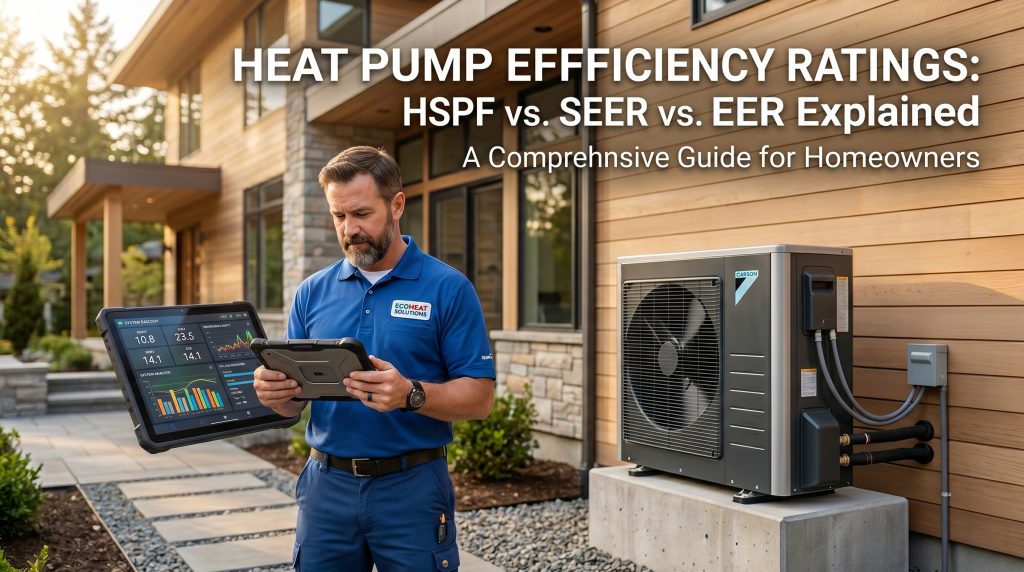
Heat Pump Efficiency Ratings: HSPF vs. SEER vs. EER Explained If you’ve started shopping for a new heating and cooling system, you’ve probably run into a wall of acronyms: SEER, SEER2, HSPF, HSPF2, EER, EER2, and sometimes COP. These ratings can look intimidating, but they’re actually one of the most useful tools you have for comparing heat pumps before you buy. Understanding what each rating measures — and which ones matter most for a Worcester, Massachusetts home — can help you avoid overpaying for efficiency you won’t use, or underbuying a system that struggles through a New England winter. In this guide, we’ll break down HSPF, SEER, and EER (plus their newer “2” versions), explain how the U.S. Department of Energy uses them, and show you how to apply these numbers to a real-world ductless mini split heat pump installation in Worcester. What Is SEER (Seasonal Energy Efficiency Ratio)? SEER stands for Seasonal Energy Efficiency Ratio, and it measures the cooling efficiency of an air conditioner or heat pump over an entire cooling season. As one HVAC resource explains, SEER is calculated by taking the system’s total cooling output over a typical cooling season and dividing it by the total energy consumed. The higher the SEER number, the more cooling you get per unit of electricity. According to one 2026 efficiency guide, SEER ratings typically range from about 13 to 26, with higher numbers representing more efficient equipment. For context, a SEER 16 unit produces 16 BTUs of cooling for every watt-hour of electricity it uses — the higher that number, the lower your cooling costs tend to be over the life of the system. It’s worth noting that SEER only applies to cooling. As one source points out, SEER ratings don’t have anything to do with heating, which is why they don’t apply to furnaces. For a heat pump, which both heats and cools, SEER tells you only half the story. What Is HSPF (Heating Seasonal Performance Factor)? HSPF stands for Heating Seasonal Performance Factor, and it’s essentially the heating-mode counterpart to SEER. As one industry overview puts it, HSPF measures how efficiently a heat pump warms your home over a typical heating season, and just like SEER, a higher number means greater efficiency. HSPF is calculated by dividing the total heat output delivered over the heating season by the total electricity consumed to produce it. The same source notes that an HSPF rating of 8 or higher is generally considered efficient, and a high HSPF translates directly into lower winter electric bills — which matters a great deal in a cold-climate market like Worcester. For Massachusetts homeowners, HSPF is arguably the most important of the three ratings, because our heating season is long and our winters are demanding. A heat pump with strong cooling efficiency but a weak HSPF could end up costing more to run overall once you factor in five or six months of New England heating. What Is EER (Energy Efficiency Ratio)? EER stands for Energy Efficiency Ratio, and unlike SEER, it isn’t a seasonal average — it’s a snapshot. One technical overview explains that EER is mainly used by technicians to get real-time performance data without accounting for seasonal temperature changes, and the higher the EER, the less energy the system consumes at that specific test condition. Specifically, EER measures cooling efficiency at a fixed outdoor temperature, typically 95°F. As one HVAC company describes it, EER measures cooling efficiency at a specific outdoor temperature and is particularly useful in regions where extreme heat is common, since it shows exactly how the system performs on the hottest days of the year. For most Worcester homeowners, EER is a secondary consideration — useful for comparing peak-day performance between similar systems, but less impactful than SEER2 and HSPF2 for our climate, where extended cooling at 95°F+ is far less common than in the Southwest or Southeast. SEER2, HSPF2, and EER2: What Changed in 2023? If you’ve seen ratings with a “2” attached — SEER2, HSPF2, EER2 — that’s not a typo or a marketing gimmick. As one HVAC resource explains, the Department of Energy changed the rating system from SEER, EER, and HSPF to SEER2, EER2, and HSPF2 to better reflect real-world performance. The change came down to testing methodology. According to one regulatory overview, the new M1 test procedure uses external static pressures up to five times higher than the older test method, which more accurately mirrors how a system performs once it’s connected to real ductwork, filters, and registers — not a lab bench. Because the new test is more demanding, SEER2 and HSPF2 numbers are generally lower than the old SEER and HSPF numbers for equivalent equipment. As of January 1, 2023, every newly manufactured system sold in the U.S. must be rated using SEER2, EER2, and HSPF2 — the older ratings are now effectively legacy figures used mainly for comparing against older installed equipment. Old vs. New Rating Comparison Old Rating (Pre-2023) New Rating (2023+) What It Measures SEER SEER2 Seasonal cooling efficiency HSPF HSPF2 Seasonal heating efficiency EER EER2 Peak-condition cooling efficiency (95°F) 14.0 SEER / 8.0 HSPF (split system minimum) 13.4 SEER2 / 6.7 HSPF2 Approximate equivalent minimums 15.0 SEER / 8.8 HSPF (split heat pump minimum, all regions) 14.3 SEER2 / 7.5 HSPF2 Current national minimum for split heat pumps These figures reflect the national minimums described in current industry resources, including one overview noting that all split-system heat pumps must now achieve at least 14.3 SEER2 and 7.5 HSPF2, equivalent to roughly 15.0 SEER and 8.8 HSPF under the old test method. Regional minimums can vary slightly, and the Southwest region carries an additional EER2 requirement that doesn’t apply in Massachusetts. Why These Ratings Matter for Worcester, MA Homeowners Worcester sits squarely in the DOE’s “North” climate region, which is defined by long, cold winters and moderate summers. That has a direct impact on which rating should carry the most weight in your decision: For a deeper look

Mini Split vs. Heat Pump: What's the Difference and Which Is Right for Your Home?
Uncategorized

Mini Split vs. Heat Pump: What’s the Difference and Which Is Right for Your Home?

Mini Split vs. Heat Pump: What’s the Difference and Which Is Right for Your Home? If you’ve been researching new heating and cooling options, you’ve likely run into two terms that seem to overlap: mini-split and heat pump. Are they the same thing? Different things? Which one should you actually choose for your home? It’s a fair source of confusion, because the relationship between these two terms isn’t quite a simple either-or comparison. In this guide, we’ll clear up exactly how mini-splits and heat pumps relate to each other, walk through the practical differences between ducted and ductless systems, and help you think through which option makes the most sense for a Massachusetts home – whether you’re starting from scratch, replacing an aging system, or adding comfort to a specific space. If you’d like a professional opinion tailored to your home, contact our team at EddyTech Mini Splits Solutions for a no-pressure consultation covering both ducted and ductless options. The Short Answer: A Mini-Split Is a Type of Heat Pump Here’s the key fact that resolves most of the confusion: a mini-split is a heat pump. Specifically, it’s a ductless heat pump. ‘Heat pump’ is the broader category of technology – any HVAC system that uses a refrigeration cycle and a reversing valve to both heat and cool a space by transferring heat rather than generating it. Within that broader category, heat pumps come in two main delivery formats: ducted (central) systems that distribute air through ductwork, just like a traditional furnace and air conditioner, and ductless (mini-split) systems that deliver conditioned air directly into rooms through individual indoor units, with no ductwork involved. So the real question most homeowners are actually asking isn’t ‘mini-split or heat pump’ – it’s ‘ducted heat pump or ductless heat pump (mini-split)?’ That’s the comparison this guide focuses on, since it’s the decision that actually affects your installation, your comfort, and your costs. How Both Systems Work: The Shared Technology Whether ducted or ductless, heat pumps rely on the same basic refrigeration cycle. A compressor, condenser coil, expansion valve, and evaporator coil work together with refrigerant to move heat from one place to another. In winter, the system extracts heat from outdoor air – even cold air contains usable thermal energy – and moves it indoors. In summer, a reversing valve flips the cycle, pulling heat out of your indoor air and releasing it outside, just like a standard air conditioner. This is true for both a central ducted heat pump and a ductless mini-split; the underlying mechanism is identical. The difference lies entirely in what happens after the heat is moved: a ducted system pushes conditioned air through ductwork and out through vents and registers, while a ductless mini-split delivers that conditioned air directly into the room through a wall-, ceiling-, or floor-mounted indoor unit. Ducted Heat Pumps: How They Work and Where They Shine A ducted (central) heat pump looks and functions much like a traditional central air conditioner combined with a furnace, except it can both heat and cool using the same equipment. It connects to your home’s existing duct system, distributing air through the same vents and registers you’re likely already familiar with. Ducted heat pumps tend to make the most sense for homes that already have ductwork in good condition. In these cases, replacing an aging furnace and AC combo with a single ducted heat pump can be a relatively straightforward swap, often integrating with a familiar central thermostat setup. The tradeoff is that the system’s performance is tied to the condition of your ductwork. Leaky, undersized, or poorly insulated ducts – especially those running through unconditioned attics, crawlspaces, or garages – can meaningfully reduce the efficiency the system actually delivers compared to its rated performance. Ductless Mini-Splits: How They Work and Where They Shine A ductless mini-split consists of an outdoor compressor/condenser unit connected to one or more indoor air-handling units, joined by refrigerant lines and electrical wiring run through a small wall penetration. There’s no ductwork involved at any point – each indoor unit conditions the room it’s installed in directly. This makes mini-splits especially well-suited to: Because mini-splits skip ductwork entirely, they also avoid the energy losses that come with it, which is one reason ductless systems often carry higher efficiency ratings than comparable ducted equipment. If you’re exploring whether a mini-split makes sense for your Worcester-area home, our team can walk through your space and goals. Zoning: One of the Biggest Practical Differences One of the most significant day-to-day differences between ducted heat pumps and mini-splits is zoning – the ability to heat or cool different areas of your home to different temperatures at the same time. A standard ducted heat pump, like a traditional central system, generally conditions the whole home to a single thermostat setting unless paired with additional zoning dampers and controls. A multi-zone mini-split system, by contrast, is inherently zoned: each indoor unit can be set to its own temperature, so a home office can run cooler while a bedroom stays warmer, without any extra equipment. For households where different family members have different comfort preferences, or where certain rooms (like a sunroom or finished attic) tend to run hotter or colder than the rest of the house, this built-in zoning capability is often one of the most appreciated features of a mini-split system. Efficiency Comparison: Mini-Splits vs. Ducted Heat Pumps Both system types use the same core heat pump technology, and both can achieve high efficiency ratings (measured in SEER2 for cooling and HSPF2 for heating). However, mini-splits often have a structural efficiency advantage because they don’t lose energy to ductwork. In a ducted system, conditioned air travels through ducts before reaching your living space – and any leaks, poor insulation, or heat transfer along the way represent lost efficiency, even if the equipment itself is highly rated. A mini-split delivers conditioned air directly to the room, eliminating this loss entirely. That said, a well-designed ducted system with properly

Why Worcester Contractors Recommend Heat Pumps Over Boilers in 2026
Uncategorized

Why Worcester Contractors Recommend Heat Pumps Over Boilers in 2026

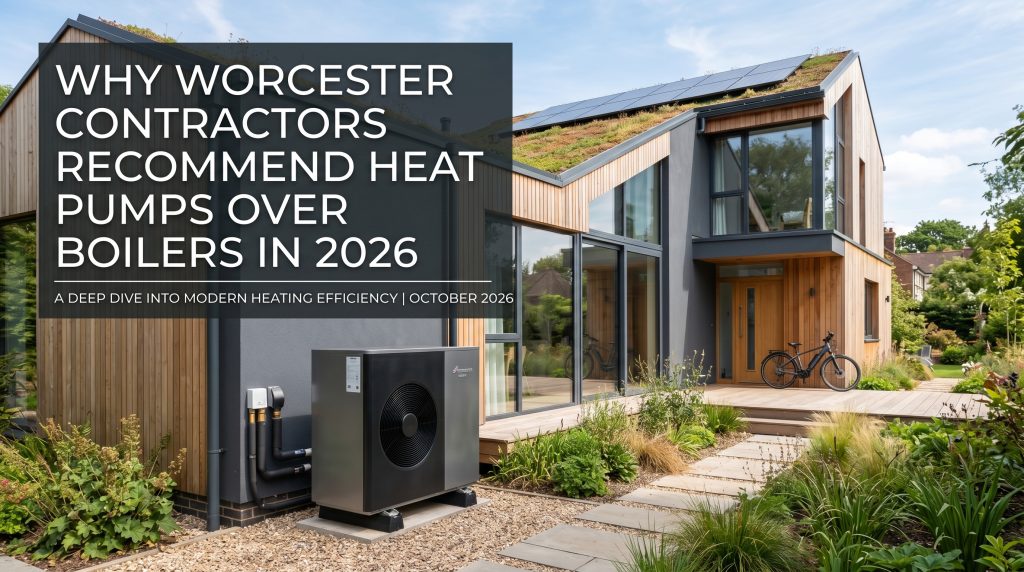
Why Worcester Contractors Recommend Heat Pumps Over Boilers in 2026 If you’ve talked to an HVAC contractor in Worcester recently about replacing an aging boiler, there’s a good chance the conversation steered toward heat pumps. This isn’t a sales gimmick or a passing trend – it reflects a real shift in the heating and cooling landscape for Massachusetts homeowners, driven by a combination of improved technology, substantial state incentives, and the practical limitations of boiler-only heating in 2026. In this guide, we’ll walk through exactly why heat pumps have become the recommendation of choice for so many Worcester-area contractors this year – covering the technology improvements that changed the cold-climate conversation, the Mass Save incentive programs reshaping the cost equation, and the practical tradeoffs homeowners should understand before making a decision. If you’re considering a heating system change for your Worcester home, contact our team at EddyTech Mini Splits Solutions for a personalized assessment of your options. The Boiler’s Long History in Worcester Homes Boilers have been a fixture of New England heating for generations, and for good reason – they’re a familiar, time-tested technology for distributing heat through radiators, baseboards, or radiant flooring. Many Worcester homes, particularly older housing stock, were built around boiler-based heating systems, often fueled by oil. That history is part of why the shift toward heat pumps feels notable. It’s not that boilers have suddenly become unreliable or unsafe – properly maintained boilers can serve a home for many years. Rather, the calculus around cost, efficiency, and available alternatives has changed significantly, especially heading into 2026. Why 2026 Is a Turning Point Several factors are converging in 2026 that have shifted the recommendation calculus for Worcester contractors: Taken together, these factors mean that for many homeowners, the financial and practical case for choosing a heat pump over a boiler replacement is stronger in 2026 than it’s been in previous years – which is reflected directly in what contractors are recommending. Heat Pumps Do What Boilers Can’t: Heat AND Cool Perhaps the single most cited reason contractors bring up heat pumps in boiler-replacement conversations is simple: a heat pump provides both heating and cooling from one system, while a boiler provides heating only. For homeowners who currently rely on window units, older central air, or no cooling at all, a heat pump conversion – whether a ducted system or a ductless mini-split – effectively solves two problems with one investment. Compare that to a like-for-like boiler replacement, which addresses heating only and leaves cooling as a separate consideration and expense. This dual-function capability is especially relevant for Massachusetts, where summers have become noticeably warmer and more humid in recent years, making reliable cooling something more homeowners are prioritizing rather than treating as optional. The Mass Save Incentive Landscape for 2026 Massachusetts has built one of the most generous heat pump incentive structures in the country, and 2026’s program continues that trend with a tiered approach designed to fit different homeowner situations: On top of these base tiers, additional bonuses are available – including a $500 weatherization bonus for completing a Home Energy Assessment and recommended improvements, and a $500 sizing bonus for partial-home installations that include a proper Manual J load calculation. Households at or below 60% of the Area Median Income may even qualify for a complete heat pump system at no cost. Because these programs are structured by tiers and bonuses – and because program budgets can be allocated and exhausted within a given year – working with a contractor who understands the current Mass Save landscape is essential to capturing the full value available. You can review official program details directly through Mass Save’s residential heat pump page. The Refrigerant Shift: Why R-410A Systems Are Out One important technical detail that’s shaping 2026 recommendations: as of January 1, 2026, systems using R-410A refrigerant were removed from the Mass Save Qualified Products List. Only equipment using next-generation refrigerants – such as R-32 or R-454B – now qualifies for rebates. This matters because it affects which specific heat pump models contractors can recommend if rebate eligibility is part of the plan. It’s also a reminder that the heat pump landscape continues to evolve, and equipment that may have been a strong recommendation a couple of years ago might not align with current program requirements – another reason working with a contractor who stays current on these changes matters. Cost Comparison: What Homeowners Are Actually Seeing Upfront cost is often the first question homeowners ask when comparing a boiler replacement to a heat pump system. While a like-for-like boiler swap might fall in a lower initial price range, a whole-home heat pump system installation often starts at a meaningfully higher upfront figure before incentives are applied. That gap narrows substantially once Mass Save rebates (up to $8,500) and 0% HEAT Loan financing are factored in. For many homeowners, the after-rebate cost difference becomes much smaller – and when you add in the value of gaining cooling capability (which would otherwise require a separate AC purchase) and the discounted electric rates now available to heat pump households, the overall financial picture often favors the heat pump option more than the sticker prices alone would suggest. Every home is different, though, and the only way to get an accurate comparison is through a proposal based on your specific home’s heating load, current system condition, and the rebate tier you’d qualify for. Reach out to our team for a personalized cost breakdown. Cold-Climate Performance: Addressing the Biggest Hesitation For years, the most common objection to heat pumps in New England was a reasonable one: “Will it actually keep my house warm during a real Massachusetts winter?” Older heat pump technology genuinely struggled with this, which is part of why boilers remained the default recommendation for so long. That objection has lost much of its force with modern cold-climate heat pumps. ENERGY STAR Cold Climate certified equipment – the standard required for Mass Save’s 2026 rebate-eligible products – is

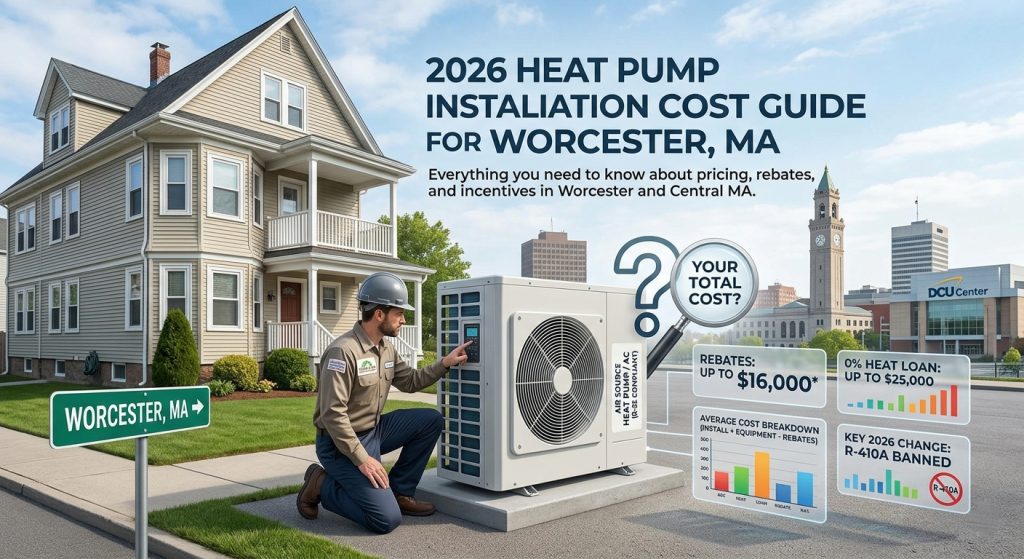
2026 Heat Pump Installation Cost Guide for Worcester, MA
Uncategorized

2026 Heat Pump Installation Cost Guide for Worcester, MA

2026 Heat Pump Installation Cost Guide for Worcester, MA If you are a homeowner in Worcester, Massachusetts, planning to upgrade your heating and cooling system in 2026, understanding heat pump installation costs is the first step toward making a smart, budget-friendly decision. With rising fuel prices, harsh New England winters, and growing interest in energy-efficient comfort solutions, more Worcester residents are switching from oil, propane, and electric resistance heating to modern cold-climate heat pumps. This comprehensive guide breaks down everything you need to know about heat pump installation costs in Worcester, MA for 2026, including average pricing by system type, the factors that influence your final quote, available Mass Save rebates, financing options, and how to choose the right local HVAC contractor. Whether you are considering a single-zone ductless mini split for one room or a whole-home ducted system, this guide will help you budget accurately and avoid costly surprises. Contact Eddytech Mini Splits & Heat Pump Solutions to get your installation today Average Heat Pump Installation Costs in Worcester, MA (2026) Heat pump installation costs in Worcester, MA generally range between $3,500 and $26,000 depending on the system type, home size, and complexity of the project. Most Worcester homeowners installing a standard ductless mini split system for one or two rooms can expect to pay between $3,500 and $7,500 per zone, including equipment and labor. Multi-zone ductless systems covering an entire home typically cost between $12,000 and $22,000 before any rebates are applied. For homeowners considering a full ducted, whole-home heat pump replacement, the project cost generally falls between $16,000 and $26,000, especially when existing ductwork needs modification or an electrical panel upgrade is required. These figures reflect 2026 pricing trends across Massachusetts and are consistent with what EddyTech Mini Splits Solutions has seen on recent installations throughout Worcester County. 2026 Cost Breakdown by System Type The table below summarizes typical 2026 installation costs by system type for Worcester homeowners. These are total project estimates before Mass Save rebates are applied, and actual pricing will vary based on your home’s specific needs. System Type Average Installed Cost (2026) Typical Net Cost After Mass Save Rebate Single-Zone Ductless Mini Split $3,500 – $7,500 $2,000 – $6,000 Multi-Zone Ductless Mini Split (Whole Home) $12,000 – $22,000 $4,000 – $14,000 Ducted Whole-Home Heat Pump (Equipment Swap) $16,000 – $26,000 $8,000 – $18,000 Heat Pump Water Heater $3,500 – $7,500 $2,750 – $6,750 Electrical Panel Upgrade (if required) $2,000 – $4,500 Not eligible for Mass Save rebate Ductwork Modifications (if required) $2,000 – $8,000 Not eligible for Mass Save rebate For a deeper breakdown of pricing by system size, visit our detailed page on How Much Does Heat Pump Installation Cost in Worcester, MA. 8 Factors That Affect Your Heat Pump Installation Cost Several factors influence the final price of your heat pump installation in Worcester. Understanding these variables will help you compare quotes accurately and avoid being overcharged or underestimating your budget. 1. System Type: Ductless Mini Split vs. Ducted Central Heat Pump Ductless mini split systems are generally more affordable to install because they do not require existing ductwork. A single-zone mini split is the most budget-friendly option, while multi-zone systems cost more due to additional indoor units and refrigerant lines. Ducted, whole-home systems cost more upfront but may be a better fit for homes that already have a forced-air duct network in good condition. 2. Home Size and Heating Load (Manual J Calculation) The size of your Worcester home directly determines how many BTUs of heating and cooling capacity you need. A licensed contractor should perform a Manual J load calculation to accurately size your system. Oversized or undersized systems lead to inefficiency, higher utility bills, and premature equipment wear, so proper sizing is one of the most important cost factors. 3. Electrical Panel Capacity Many older homes in Worcester, especially those built in the 1970s and 1980s, have 100-amp electrical panels. Multi-zone and whole-home heat pump systems often require a 200-amp service. If your panel needs an upgrade, expect this to add $2,000 to $4,500 to your total project cost. 4. Ductwork Condition and Modifications If you are converting from a furnace to a ducted heat pump, your existing ductwork must be evaluated. Leaky, undersized, or poorly designed ducts can reduce system efficiency by 20 percent or more. Duct modifications or replacements can add $2,000 to $8,000 to your project. 5. Equipment Brand and Efficiency Rating (SEER2/HSPF2) Higher SEER2 and HSPF2 ratings translate to greater energy savings but come with a higher upfront cost. Cold-climate rated heat pumps designed for New England winters, such as those from Mitsubishi, Daikin, Fujitsu, and Bosch, are recommended for Worcester’s climate, where winter temperatures regularly drop below 20°F. 6. Number of Zones and Indoor Units Each additional indoor unit (head) adds to material, refrigerant line, and labor costs. Homeowners should map out which rooms need independent temperature control versus rooms that can share a zone. 7. Installation Complexity and Line Set Length Homes with longer distances between the outdoor condenser and indoor units, tricky mounting locations, or the need for condensate pumps will see higher labor costs. Multi-story homes or finished basements can also add complexity. 8. Permits and Local Worcester Requirements Worcester requires permits for HVAC installations involving electrical and mechanical work. Permit fees in Massachusetts typically range from $40 to $500 depending on the scope of the project. A reputable local contractor will handle permitting as part of the installation process. Considering a ductless system? Learn more about our Ductless Mini Split Installation services in Worcester, MA, including brand options and zone planning for New England homes. 2026 Mass Save Rebates and Incentives for Worcester Homeowners One of the biggest factors that can dramatically reduce your out-of-pocket heat pump installation cost in Worcester is the Mass Save rebate program. For 2026, Mass Save offers substantial incentives for qualifying cold-climate heat pump installations. Important update for 2026: The federal Section 25C tax credit for heat pumps, which previously offered up to

How Much Does a Cold-Climate Heat Pump Cost in Massachusetts? (2026 Pricing Guide)
Uncategorized

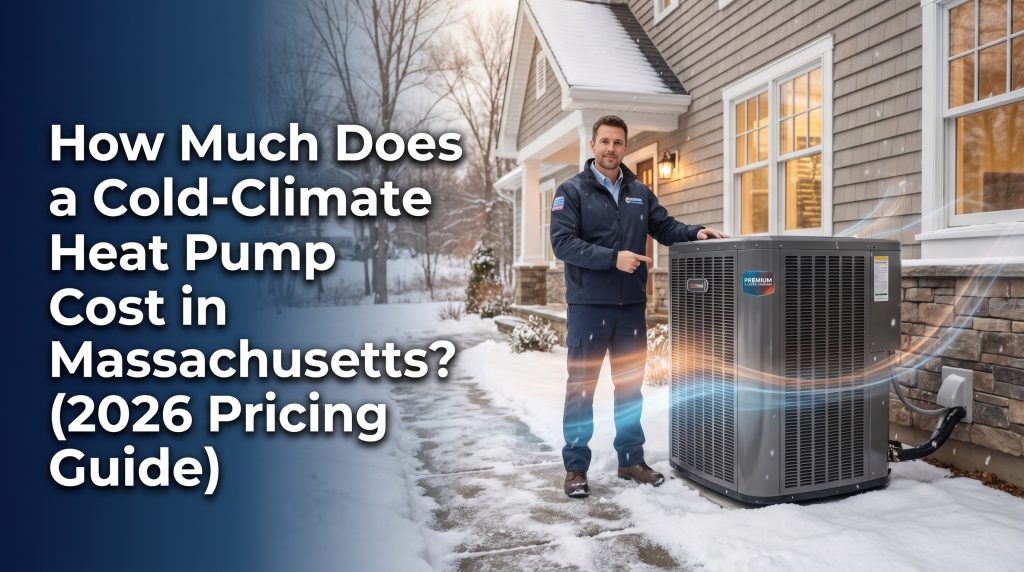
How Much Does a Cold-Climate Heat Pump Cost in Massachusetts? (2026 Pricing Guide)

How Much Does a Cold-Climate Heat Pump Cost in Massachusetts? (2026 Pricing Guide) If you’re a homeowner in Worcester, Shrewsbury, Westborough, or anywhere else in Central Massachusetts, you’ve probably heard the buzz: cold-climate heat pumps can heat your home through brutal New England winters while cutting your energy bills and qualifying for thousands of dollars in rebates. But the question every homeowner actually wants answered is simple — how much does a cold-climate heat pump actually cost in Massachusetts in 2026? In this guide, we break down real installation costs, what affects your final price, available Mass Save rebates and financing, and how to choose the right contractor for your home. What Is a Cold-Climate Heat Pump? A cold-climate heat pump (sometimes called a cold-climate ductless mini-split or cold-climate ASHP) is a heating and cooling system specifically engineered to deliver efficient heat even when outdoor temperatures drop well below freezing. Unlike older heat pump models that lost most of their heating capacity below 30°F, today’s cold-climate units — built by manufacturers like Mitsubishi, Daikin, LG, and Fujitsu — use variable-speed inverter compressors to maintain reliable heating output down to -13°F to -22°F. For Massachusetts homeowners, this matters because our winters routinely bring sub-zero wind chills, and an undersized or non-cold-climate system will leave you cold exactly when you need heat the most. To qualify for Mass Save rebates, a system must carry the ENERGY STAR Cold Climate certification (formerly listed under NEEP) and, as of 2026, use a low-GWP refrigerant such as R-32 or R-454B. If you’re not sure whether your current setup can support a cold-climate heat pump, our team can walk you through the basics on our mini-split installation page, where we explain how ductless systems work in older Massachusetts homes that lack existing ductwork. Average Cold-Climate Heat Pump Cost in Massachusetts (2026) Pricing varies significantly depending on system type, home size, and the complexity of installation. Below is a realistic breakdown of what Massachusetts homeowners are paying in 2026, based on current contractor data across the state. System Type Typical Installed Cost (Before Rebates) Notes Single-Zone Ductless Mini-Split $4,500 – $7,500 Ideal for one room, addition, or open-concept space Multi-Zone Ductless Mini-Split (2–4 zones) $10,000 – $20,000 Covers multiple rooms with one outdoor unit Whole-Home Ducted Air-Source Heat Pump $15,000 – $28,000 Replaces furnace/boiler as primary heat source Geothermal (Ground-Source) Heat Pump $20,000 – $45,000+ Highest efficiency; larger upfront investment These figures reflect equipment, labor, permits, and standard electrical work. They do not include items like electrical panel upgrades, oil tank removal, or ductwork modifications, which can add $1,000–$5,000 depending on your home’s condition. What Affects the Price of Your Heat Pump Installation? Several factors determine where your project falls within these ranges: Because of these variables, no contractor can give you an accurate number over the phone. A proper quote requires an in-home visit and load calculation — something our technicians provide as part of every free consultation. Learn more about how our process works on our Worcester mini-split installation page. Mass Save Rebates and Financing for 2026 Massachusetts remains one of the most generous states in the country for heat pump incentives, even after several rebate adjustments. Here’s what’s currently available: Important update: The federal Section 25C Energy Efficient Home Improvement Credit expired on December 31, 2025, and is no longer available for residential heat pump installations in 2026. Massachusetts homeowners should rely on Mass Save rebates and the 0% HEAT Loan as their primary incentive sources. Eligibility now also requires equipment using R-32 or R-454B refrigerant rather than R-410A, in line with EPA AIM Act phase-down rules. For full program details and to confirm current eligibility, visit the official Mass Save website. Example: Net Cost After Rebates Consider a Worcester homeowner installing a 3.5-ton whole-home ducted heat pump at a total project cost of $20,000. After applying the maximum $8,500 Mass Save whole-home rebate, the net out-of-pocket cost drops to roughly $11,500. If financed through the 0% HEAT Loan over 7 years, that works out to approximately $137 per month with zero interest — often comparable to or lower than what homeowners previously spent on oil or propane deliveries. Homeowners switching from oil or propane typically see the fastest payback, often within 3 to 4 years, while also gaining central air conditioning as a built-in benefit of the new system. Operating Costs: What Will You Pay to Run It? At current Eversource and National Grid rates, a properly sized cold-climate heat pump in a typical 2,500 sq ft Massachusetts home costs roughly $1,100–$1,400 per year to heat, compared to $1,400–$1,800 per year for a gas furnace and significantly more for oil or electric resistance heating. Homeowners switching from oil to a heat pump commonly save $1,500–$2,500 annually on heating costs. Many utilities, including Eversource and National Grid, also offer special winter electric rates for heat pump households that further reduce operating costs. Choosing the Right Cold-Climate Heat Pump for Your Massachusetts Home Not every heat pump marketed as ‘cold climate’ performs the same way. When evaluating options, look for: Mitsubishi and Fujitsu currently have the deepest contractor support networks in Massachusetts, which matters for long-term maintenance and warranty service. If you’d like help comparing brands and system types for your specific home, our team can walk you through options during a free in-home consultation — just contact us to schedule a visit. Why Work With a Local Worcester-Area Installer Cold-climate heat pump performance depends heavily on correct sizing, refrigerant line installation, and electrical work — all of which are easiest to get right with a local team that knows Massachusetts building stock, from historic triple-deckers on Worcester’s East Side to newer builds in Tatnuck and surrounding towns. At EddyTech Mini Splits Solutions, our certified technicians handle everything from the initial Manual J load calculation to Mass Save paperwork, so you get an accurate quote and a smooth rebate process from day one. We proudly serve homeowners throughout Worcester and the surrounding Massachusetts communities,

Heat Pump vs. Gas Furnace: The Complete 10-Year Cost Comparison for Worcester, MA Homeowners (2026 Guide)
Uncategorized

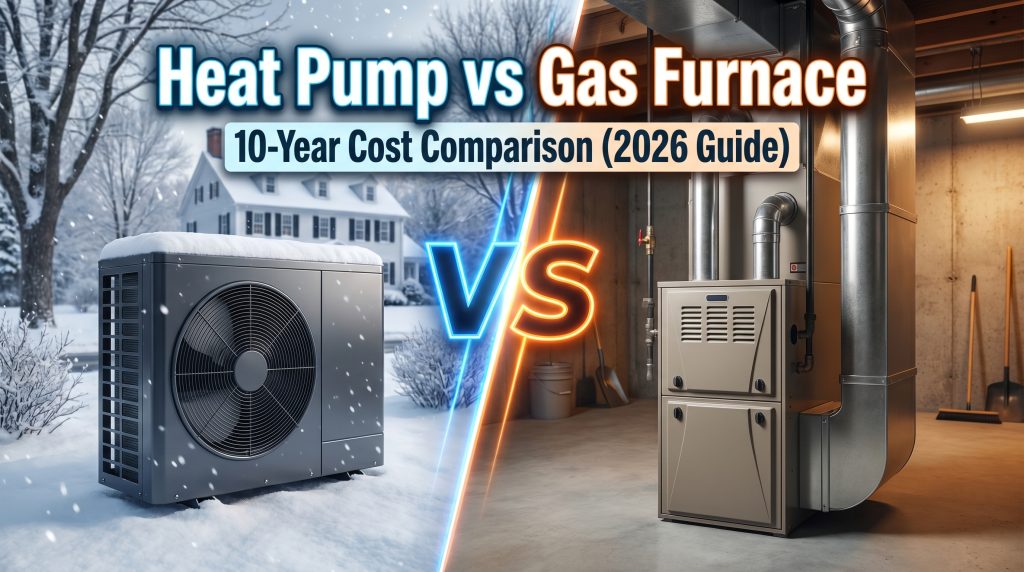
Heat Pump vs. Gas Furnace: The Complete 10-Year Cost Comparison for Worcester, MA Homeowners (2026 Guide)

Heat Pump vs. Gas Furnace: The Complete 10-Year Cost Comparison for Worcester, MA Homeowners (2026 Guide) If you’re a homeowner in Worcester, Massachusetts trying to decide between a heat pump and a gas furnace, you’re not alone. With Massachusetts electricity rates ranking among the highest in the nation and natural gas prices climbing steadily over the past decade, the heating decision you make today could mean a difference of thousands of dollars over the next ten years. This guide breaks down the real, Worcester-specific numbers: upfront installation costs, annual operating expenses, available Mass Save rebates, maintenance costs, and a full 10-year total cost of ownership comparison. Whether you’re upgrading an aging oil furnace, replacing central AC, or building a new home, this comparison will help you make a confident, financially sound decision. If you’d like a personalized quote for your Worcester home, contact EddyTech Mini Splits Solutions for a free consultation. Why Worcester Homeowners Are Rethinking Their Heating Systems in 2026 Worcester’s cold winters and aging housing stock (much of it built before 1980) make heating one of the largest line items in any household budget. Two major shifts have changed the math for 2026: Meanwhile, natural gas prices in the Boston-Worcester metro area have risen roughly 93% over the past decade, far outpacing the national average. Electricity prices have also climbed, but Mass Save’s Winter Heat Pump Rate programs help offset this for heat pump owners. Understanding both trends is essential before you commit to a 15-20 year heating investment. Upfront Installation Costs: Heat Pump vs. Gas Furnace in Worcester The starting price tag is often the first thing homeowners look at, but it only tells part of the story. Here’s what Worcester homeowners can typically expect to pay for installation in 2026: Cost Factor Heat Pump (Ductless Mini-Split) Gas Furnace + Central AC Average equipment + installation cost $8,000 – $18,000 (whole home, multi-zone) $6,500 – $12,000 (furnace + separate AC unit) Ductwork required? No (ductless) or uses existing ducts (ducted) Yes — new ductwork adds $5,000-$15,000 if absent Mass Save rebate available (2026) Up to $8,500 (whole-home, $1,125-$2,650/ton) Not eligible — rebates apply to heat pumps only Federal tax credit (2026) $0 — 25C credit expired Dec 31, 2025 $0 — never eligible for efficiency credits Estimated net upfront cost after rebate $2,000 – $10,000 $6,500 – $12,000 Provides both heating AND cooling? Yes, included No — requires separate AC system As the table shows, the net upfront cost of a heat pump after applying the 2026 Mass Save rebate is often comparable to — or even lower than — installing a new gas furnace, especially when you factor in that a heat pump also replaces your central air conditioning system in one piece of equipment. EddyTech specializes in ductless mini-split installation across Worcester County and can help you determine your exact rebate eligibility and net cost during a free in-home estimate. Annual Operating Costs: What You’ll Actually Pay Each Year Operating costs depend on your home’s size, insulation quality, and local utility rates. Using 2026 Massachusetts averages — electricity at approximately 30.5 cents per kWh and natural gas at approximately $2.50 per therm — here is a typical annual heating cost comparison for a 2,000 sq. ft. Worcester home: Annual Expense Cold-Climate Heat Pump Gas Furnace Estimated annual heating cost $900 – $1,400 $1,100 – $1,700 Cooling cost (summer) Included — no extra cost Separate central AC: $300 – $600/year Maintenance (annual tune-up) $100 – $200 $120 – $250 Combined annual total (heating + cooling + maintenance) $1,000 – $1,600 $1,520 – $2,550 Massachusetts utilities, including Eversource and National Grid, also offer discounted Winter Heat Pump electric rates for enrolled customers, which can lower the effective cost per kWh used for heating during the coldest months — further improving the heat pump’s annual cost advantage. 10-Year Total Cost of Ownership: The Full Comparison This is the number that matters most. The table below combines upfront net cost (after 2026 Mass Save rebates), 10 years of operating expenses, and typical maintenance/repair costs over a decade, using mid-range estimates for a 2,000 sq. ft. Worcester home. 10-Year Cost Category Heat Pump (Mini-Split) Gas Furnace + AC Net upfront cost (after rebate) $6,000 (avg.) $9,000 (avg.) 10 years of heating + cooling costs $13,000 (avg. $1,300/yr) $20,350 (avg. $2,035/yr) 10 years of maintenance $1,500 $1,850 Major repairs / part replacement (avg. over 10 yrs) $500 – $1,000 $800 – $1,800 (incl. AC compressor) Estimated 10-Year Total Cost $20,500 – $21,500 $32,000 – $33,000 Estimated 10-Year Savings with Heat Pump $10,500 – $12,000 — Based on these figures, a Worcester homeowner who switches from a gas furnace and separate AC system to a properly sized cold-climate heat pump can expect to save approximately $10,000-$12,000 over a 10-year period — even before accounting for potential gas price increases, which have historically outpaced electricity in Massachusetts. 5 Key Factors That Affect Your Personal Cost Comparison 1. Your Home’s Insulation and Age Older Worcester homes — particularly pre-1980 triple-deckers and colonials — often have inadequate insulation, which increases heating costs regardless of system type. A Mass Save Home Energy Assessment can identify weatherization opportunities that improve the performance and savings of either system. 2. Existing Ductwork Homes without ductwork favor ductless mini-split heat pumps, which avoid the $5,000-$15,000 cost of installing new ducts. Homes with existing ducts in good condition may consider a ducted heat pump or furnace with similar installation complexity. 3. System Sizing and Cold-Climate Performance Not all heat pumps are created equal. A properly sized, ENERGY STAR Cold Climate-certified heat pump maintains efficient output even at temperatures well below freezing — critical for Worcester’s winters. Oversized or undersized systems lead to higher operating costs and shorter equipment lifespan. 4. Rebate Timing Mass Save rebate amounts have decreased year over year, and the 2026 program runs through early 2027. Homeowners considering a switch should verify current eligibility on the Mass Save website and act before further reductions take effect. 5.

How Heat Pumps Work Below Freezing: Cold-Climate Technology Explained
Uncategorized

How Heat Pumps Work Below Freezing: Cold-Climate Technology Explained

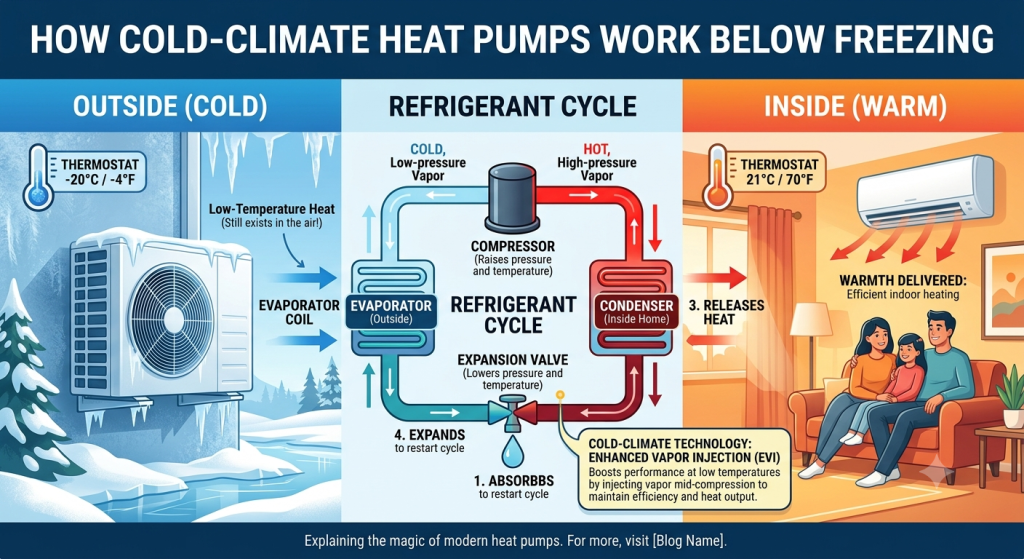
How Heat Pumps Work Below Freezing: Cold-Climate Technology Explained For a long time, the conventional wisdom in New England was simple: heat pumps are great for shoulder seasons, but you still need a furnace or boiler for the real cold. That assumption is now outdated. As one 2026 industry overview puts it, the idea that heat pumps stop working when temperatures hit freezing is a myth based on outdated technology. Modern cold-climate heat pumps are engineered specifically for places like Worcester, Massachusetts, where winter temperatures regularly drop into the teens, single digits, or below zero. In this guide, we’ll explain the science behind how heat pumps pull warmth out of cold outdoor air, what makes a “cold-climate” heat pump different from an older or standard model, and what Worcester homeowners should know before choosing a ductless mini split heat pump installation in Worcester. The Basic Physics: How Heat Pumps Move Heat, Not Create It The most important concept to understand is that a heat pump doesn’t generate heat the way a furnace does by burning fuel — it moves heat from one place to another. As one cold-climate equipment manufacturer explains, in winter, a heat pump takes heat energy from the outside air, draws it into the unit, and uses that energy to heat the air inside your home. This might sound impossible when it’s 10°F outside, but the key is that even very cold air still contains usable thermal energy. As one cold-climate technology resource puts it, air below freezing has nearly the same relative energy as air above freezing, and only at absolute zero (-273°C) is there no energy left to extract. A heat pump’s refrigerant is engineered to be colder than the outdoor air even on the coldest days, so heat naturally flows from the (relatively) warmer outdoor air into the (colder) refrigerant — the same basic principle that lets a kitchen refrigerator pull heat out of food that’s already cold. Inside the Refrigeration Cycle To understand cold-weather performance, it helps to walk through the refrigerant cycle itself. According to a technical patent description of heat pump operation, liquid refrigerant leaving the compressor at around 110°F is cooled to roughly 100°F as it heats the indoor air, then passes through an expansion valve where it vaporizes and drops to a much lower temperature. This cold, low-pressure refrigerant then travels to the outdoor coil, where heat from the outdoor air — even outdoor air in the 35°F to 60°F range — raises its temperature before it returns to the compressor to repeat the cycle. In a cold-climate system, this same basic cycle continues to function at much lower outdoor temperatures because of several engineering upgrades working together, which we’ll cover next. What Makes a Cold-Climate Heat Pump Different? 1. Variable-Speed Inverter Compressors The single biggest difference between an older heat pump and a modern cold-climate model is the compressor. Consumer Reports notes that the key feature in a cold-climate heat pump is a variable-speed compressor, powered by an inverter, built for the wide temperature swings the Northeast and Midwest see every winter. Older single-stage compressors were either fully on or fully off. A variable-speed inverter compressor, by contrast, can ramp its output up or down continuously to match the heating demand — running hard during a cold snap and idling efficiently during milder weather. This not only improves efficiency, it also allows the system to keep producing meaningful heat output even as outdoor temperatures plunge. 2. Enhanced Defrost Cycles One challenge unique to air-source heat pumps is frost buildup on the outdoor coil. As one HVAC manufacturer explains, coil surface temperatures can be much lower than the surrounding air, and combined with moisture, frost can form even when the weather feels mild. When this happens, the system briefly reverses into a defrost cycle. According to one HVAC resource, a defrost cycle typically takes 5 to 15 minutes, with cycles occurring roughly every 30 to 90 minutes during cold, damp weather, and the outdoor fan pauses during this process while the system briefly redirects warm refrigerant to melt accumulated ice. Cold-climate heat pumps use smarter, “demand-based” defrost logic that triggers only when needed, minimizing wasted energy compared to older time-based systems. 3. Two-Stage or Booster Compression Some cold-climate systems use a secondary, or “booster,” compressor to maintain heating capacity at very low temperatures. As described in technical documentation on cold-climate heat pump design, a booster compressor activates only when outdoor temperatures fall below a certain threshold, preventing the inefficiency of running an oversized primary compressor at mild temperatures. This staged approach allows one system to be efficient on a 40°F day and still powerful on a -5°F day. 4. Advanced Refrigerants and Heat Exchanger Design Cold-climate models also rely on refrigerant blends and expanded heat exchanger surface area designed specifically to capture heat from very cold air. As one cold-climate equipment resource notes, by using a refrigerant that remains far colder than the surrounding air even at -25°C, the system can still cause heat to transfer from the outdoor air into the refrigerant. Larger outdoor coils and optimized airflow paths further improve heat capture in frigid conditions. Real-World Cold-Climate Performance: What the Data Shows This isn’t just theory — it’s been tested extensively. According to one 2026 overview of the Department of Energy’s Cold Climate Heat Pump Challenge, modern cold-climate heat pumps operate efficiently even at -15°F, maintaining over 70% capacity while delivering 200-350% efficiency, equivalent to a COP of 2.0 to 3.5. The same program tested units across 23 sites in 10 U.S. states and 2 Canadian provinces. Manufacturers are pushing these limits even further. Trane has reported that its cold-climate heat pump prototype, developed for the DOE challenge, performed in temperatures as low as -23°F in lab testing, surpassing the DOE’s mandatory -20°F requirement, with field testing completed over two winters ahead of a planned 2026 residential rollout. On the consumer side, one HVAC resource notes that many high-performance models can deliver 100% of their heating

How a Heat Pump Replaces Both Your Furnace and AC
Uncategorized

How a Heat Pump Replaces Both Your Furnace and AC

How a Heat Pump Replaces Both Your Furnace and AC If you are a Massachusetts homeowner, you already know the drill: run the furnace all winter, switch to central AC all summer, and pay two sets of energy bills, two annual service contracts, and two replacement costs whenever the equipment gives out. It is an expensive, inefficient cycle — and it is completely avoidable. A modern heat pump replaces both systems with a single, all-electric unit that heats your home in winter and cools it in summer. Not as a compromise — as an upgrade. Today’s cold-climate heat pumps deliver 2–4 units of heat for every unit of electricity they consume, outperforming even the best gas furnaces. In cooling mode, they match or exceed the efficiency of premium central air conditioners. And they do it year-round, from one outdoor unit and one set of indoor air handlers. What makes this the perfect moment for Worcester homeowners to make the switch: Massachusetts’ MassSave program offers rebates of up to $10,000 on qualifying installations, the federal government provides a 30% tax credit under the Inflation Reduction Act, and Eddy Tech Mini Splits provides expert installation throughout Worcester and 11 surrounding cities — with free in-home estimates and full rebate assistance. This guide walks you through exactly how a heat pump replaces your furnace and AC, what types are available, how they perform in New England winters, what they cost after rebates, and everything else you need to make a confident decision for your home. What Is a Heat Pump? A heat pump is a heating and cooling system that moves heat energy rather than generating it. Unlike a gas furnace — which burns fuel to produce warmth — a heat pump extracts heat from outdoor air and transfers it inside your home. In summer, it reverses this process, pulling heat out of your living space and pushing it outside, functioning exactly like a central air conditioner. Think of it as a refrigerator running in both directions. A refrigerator pulls heat out of the cabinet and expels it into your kitchen. A heat pump applies that same thermodynamic principle on a whole-home scale — and it can run in reverse on demand. Because heat pumps move energy instead of creating it, they achieve efficiencies of 200–400%. According to the U.S. Department of Energy, heat pumps can reduce electricity use for heating by up to 65% compared to electric resistance heating, and they significantly outperform gas and oil systems on a cost-per-BTU basis. No combustion-based furnace can match this physics. The critical component that allows a heat pump to do both jobs is a reversing valve — a mechanism that switches the refrigerant circuit’s direction, flipping the system from heat delivery to heat removal at the touch of a button on your thermostat or smartphone app. → See our heat pump installation services in Worcester, MA for system options and pricing. How a Heat Pump Replaces Your Furnace A gas or oil furnace generates heat by combustion — burning fuel and blowing the resulting warm air through your ductwork. A heat pump replaces this process entirely using a refrigerant cycle that is more efficient, safer, and fully electric. The Heating Cycle — Step by Step This cycle requires no combustion, no gas line, and no flue pipe. There is zero carbon monoxide risk — a meaningful safety improvement for families with children or elderly members. Cold-climate heat pumps like the Mitsubishi Hyper-Heat and Fujitsu Halcyon — which Eddy Tech installs throughout Worcester — maintain full heating capacity down to −13°F. This covers the entire realistic temperature range of Massachusetts winters. The Northeast Energy Efficiency Partnerships (NEEP) independently verifies cold-climate performance and maintains an approved product list specifically for New England climates. → Explore our Mitsubishi mini split installation services for brand-specific options. How a Heat Pump Replaces Your Air Conditioner In cooling mode, a heat pump operates identically to a central air conditioner. The reversing valve switches the refrigerant circuit’s direction — now the indoor unit absorbs heat from your home’s air, the refrigerant carries that heat to the outdoor unit, and the outdoor unit expels it outside. The result is the same cool, dehumidified air you expect from a premium central AC system. Where heat pumps win in cooling: efficiency ratings. Central AC units are rated by SEER (Seasonal Energy Efficiency Ratio). The federal minimum is 14 SEER. Most modern ductless mini split heat pumps achieve SEER ratings of 20–30+, delivering substantially better cooling efficiency per dollar of electricity — which adds up fast during Worcester’s humid summers. According to Energy Star, certified heat pump models deliver cooling efficiencies up to 50% better than standard central AC units. Over the lifetime of the system, that translates to thousands of dollars in reduced electricity costs. → Learn more about ductless AC installation in Worcester, MA. Types of Heat Pumps That Replace Furnace + AC 1. Ductless Mini Split Heat Pumps The most popular choice for Worcester homeowners — especially those in older homes without central ductwork. A ductless mini split consists of one outdoor compressor connected to one or more wall-mounted indoor air handlers via a small refrigerant line set. No ductwork needed. Each indoor unit independently controls its zone, giving every room its own thermostat without heating or cooling empty spaces. → Mini split installation in Worcester, MA 2. Multi-Zone Mini Split Systems One outdoor unit powers 2–5 indoor air handlers, each independently controlled. This is the complete whole-home replacement for furnace + central AC without any ductwork. Most Eddy Tech whole-home installations use multi-zone systems. 3. Ducted Central Heat Pumps If your home already has ductwork from an existing forced-air system, a ducted heat pump connects directly and uses those ducts to distribute conditioned air. A direct drop-in replacement for your old furnace/AC combo — same ducts, dramatically better efficiency. 4. Cold-Climate Certified (CC-ASHP) Units All heat pumps Eddy Tech installs are on the NEEP Cold Climate Air Source Heat Pump

Heat Pump SEER Ratings Explained for Massachusetts Homeowners
Uncategorized

Heat Pump SEER Ratings Explained for Massachusetts Homeowners

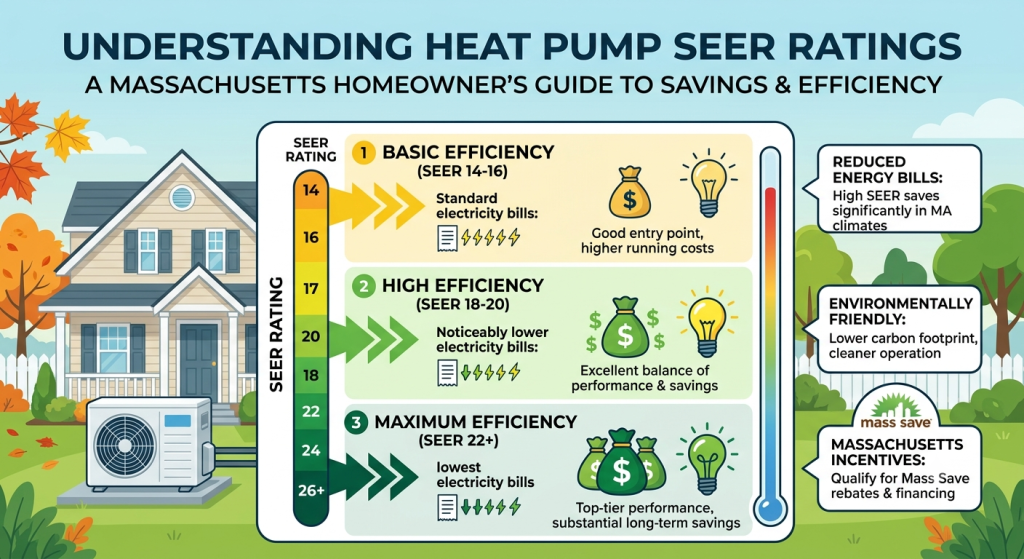
Heat Pump SEER Ratings Explained for Massachusetts Homeowners If you’ve started researching heat pumps for your Massachusetts home, you’ve probably run into a wall of acronyms: SEER, SEER2, HSPF, HSPF2, EER2, AFUE. It can feel overwhelming, especially when these numbers directly affect your monthly energy bills, your eligibility for Mass Save rebates, and the upfront price of your new system. The good news is that once you understand what SEER and SEER2 actually measure – and why Massachusetts homeowners need to pay attention to heating efficiency just as much as cooling efficiency – the whole topic becomes much easier to navigate. This guide breaks down everything you need to know in plain language, with specific guidance for homeowners in Worcester and the surrounding Massachusetts communities. If you’d like a personalized recommendation based on your home’s size, insulation, and heating history, reach out to our team at EddyTech Mini Splits Solutions for a no-pressure consultation. What Is SEER, Exactly? SEER stands for Seasonal Energy Efficiency Ratio. It’s a standardized rating that tells you how efficiently an air conditioner or heat pump cools your home over the course of a typical cooling season, expressed as a ratio of cooling output (in BTUs) to electricity consumed (in watt-hours). In simple terms: the higher the SEER number, the more cooling you get for every dollar of electricity you spend. A unit with a SEER rating of 16 produces 16 BTUs of cooling for every watt-hour of electricity it uses over a season – more efficient than a unit rated at 13 or 14. SEER has been used for decades to help homeowners compare cooling equipment, but as of 2023, it’s been largely replaced for regulatory purposes by an updated metric: SEER2. If you’re shopping for a new heat pump or mini-split system today, SEER2 is the number you’ll actually see on equipment labels and quotes. SEER vs. SEER2: What Changed and Why It Matters SEER2 was introduced by the Department of Energy to reflect more realistic testing conditions. The previous SEER testing method used relatively low static pressure inside the test equipment, which didn’t always represent how systems perform once installed in real ductwork with real airflow resistance. SEER2 testing uses higher static pressure that better simulates actual home installations. The practical result is that SEER2 numbers run lower than SEER numbers for equivalent equipment – typically by around 4.5%. So a system that would have been rated around 15 SEER under the old methodology might now be labeled closer to 14.3 SEER2. This matters for two reasons. First, if you’re comparing a quote that lists SEER2 against an older brochure or a neighbor’s system rated in plain SEER, you’re not comparing apples to apples – you’ll need to convert one number to the other. Second, SEER2 is now the figure used for determining whether equipment meets current minimum efficiency standards and, often, whether it qualifies for rebates. What SEER2 Rating Is Required in Massachusetts? Efficiency minimums in the United States are set by the Department of Energy according to three climate regions: North, Southeast, and Southwest. Massachusetts falls within the North region. These are floor requirements, not recommendations – most heat pumps installed in Massachusetts homes today, especially cold-climate mini-split systems, are rated well above these minimums. But knowing the baseline helps you recognize when a quoted system is at the bare minimum versus a meaningfully higher-efficiency option. HSPF2: The Other Number Massachusetts Homeowners Shouldn’t Ignore SEER2 gets a lot of attention because it’s the more familiar term, but for a state like Massachusetts – where the heating season is considerably longer than the cooling season – HSPF2 often has just as much, or more, impact on your annual energy costs. HSPF stands for Heating Seasonal Performance Factor, and HSPF2 is its updated counterpart using the same more-realistic testing approach as SEER2. It measures how efficiently a heat pump delivers heat over a typical heating season. The national minimum for split-system heat pumps is 7.5 HSPF2 (roughly equivalent to 8.8 HSPF under the old standard). When comparing heat pump options for a Massachusetts home, it’s worth asking your installer to walk through both the SEER2 and HSPF2 ratings together, rather than focusing on just one number. A system with an excellent SEER2 but only a minimum-compliant HSPF2 might not be the best fit for a home that relies on the heat pump as its primary winter heat source. How SEER2 Affects Your Energy Bills The relationship between SEER2 rating and energy costs isn’t always linear, but the general principle holds: higher SEER2 ratings translate into lower electricity consumption for the same amount of cooling output. Over the lifetime of a system – often 12 to 15 years or more – the difference between a minimum-efficiency unit and a high-efficiency unit can add up to a significant amount in cumulative energy costs. That said, the size of the savings depends heavily on your home’s specific situation: how much cooling and heating you actually need, your local electricity rates, how well-insulated and air-sealed your home is, and how the system is used day to day. A home with excellent insulation and modest cooling needs may see a smaller absolute difference between a 15 SEER2 and a 20 SEER2 system than a home with poor insulation and heavy AC use. This is why a one-size-fits-all answer to “what SEER rating should I get” doesn’t really exist. The right answer depends on your home, your budget, and how long you plan to stay – which is exactly the kind of assessment a professional in-home evaluation is designed to provide. SEER2 Ratings and Mass Save Rebates One of the most practical reasons to understand SEER2 and HSPF2 ratings is that Massachusetts homeowners have access to some of the strongest heat pump incentive programs in the country through Mass Save. Many of these programs use efficiency tiers – meaning the rebate amount you qualify for can depend directly on the SEER2 and HSPF2 ratings of the equipment you

How Heat Pumps Both Heat and Cool Your Home Year-Round
Uncategorized

How Heat Pumps Both Heat and Cool Your Home Year-Round

How Heat Pumps Both Heat and Cool Your Home Year-Round If you’re researching heating and cooling options for your home, you’ve probably come across the term “heat pump” more than once – and for good reason. Heat pumps have quickly become one of the most talked-about home comfort technologies, and for homeowners in Massachusetts and across New England, they represent a genuine shift in how a single system can manage both winter heating and summer cooling. Unlike traditional setups that rely on a furnace for heat and a separate air conditioner for cooling, a heat pump does both jobs using one piece of equipment. That means less hardware to maintain, often lower energy bills, and a more consistent comfort experience throughout the year. In this guide, we’ll break down exactly how heat pumps work, why they’re effective in both hot and cold weather, what it means for your home’s efficiency, and what to consider if you’re thinking about making the switch. If you’re located in the Worcester, MA area and want a professional assessment of whether a heat pump or ductless mini-split system is right for your home, our team at EddyTech Mini Splits Solutions can walk you through your options. What Is a Heat Pump, Exactly? A heat pump is an HVAC system that transfers heat from one place to another rather than generating heat through combustion or electric resistance. The core idea is simple: heat naturally moves from a warmer area to a cooler one, and a heat pump uses a small amount of energy – typically electricity – to move heat in the direction you want, even when that means moving it against its natural flow. In winter, a heat pump extracts heat from the outdoor air (yes, even cold air contains usable heat energy) and moves it indoors. In summer, it reverses this process, pulling heat out of your indoor air and releasing it outside – exactly how a traditional air conditioner works. This dual capability is why heat pumps are often described as “a furnace and an air conditioner in one.” The technology itself isn’t new – refrigerators and air conditioners have used similar refrigeration cycles for decades. What’s changed is the efficiency, reliability, and cold-climate performance of modern heat pump systems, particularly variable-speed (inverter-driven) mini-split heat pumps, which can now handle New England winters far better than older models could. The Science Behind Heating and Cooling With One System To understand how a single unit can both heat and cool, it helps to look at the basic refrigeration cycle that powers every heat pump. The system relies on four key components: a compressor, a condenser coil, an expansion valve, and an evaporator coil, all connected by refrigerant lines. How Heating Mode Works How Cooling Mode Works In cooling mode, a component called the reversing valve switches the direction of refrigerant flow, effectively flipping the entire cycle. Now the indoor coil absorbs heat from inside your home (cooling the air that’s circulated back into your rooms), while the outdoor coil releases that heat outside. This is the same basic process a standard air conditioner uses – the heat pump simply has the added ability to run this cycle in reverse for winter heating. This reversing valve is really the heart of what makes a heat pump different from either a standalone furnace or a standalone air conditioner. It’s a relatively simple mechanical addition that unlocks a dramatically more versatile system. Why Heat Pumps Are So Efficient One of the most compelling reasons homeowners choose heat pumps is efficiency. Traditional heating systems – whether gas furnaces, oil boilers, or electric resistance heaters – create heat by converting fuel or electricity directly into thermal energy. Even the most efficient combustion systems can’t exceed 100% efficiency, because they’re limited by the energy content of the fuel itself. Heat pumps work differently. Because they move existing heat rather than creating new heat, they can deliver more energy in heating or cooling output than they consume in electricity. This is measured using the Coefficient of Performance (COP) for heating and SEER (Seasonal Energy Efficiency Ratio) for cooling. A heat pump with a COP of 3, for example, delivers roughly three units of heat for every one unit of electricity used – an efficiency level that’s simply not possible with combustion-based heating. This efficiency translates directly into your energy bills. While the exact savings depend on your home’s insulation, your local electricity rates, and the fuel source you’re replacing, many homeowners switching from oil heat or electric resistance heating to a modern cold-climate heat pump see a meaningful reduction in their annual heating costs, on top of gaining cooling capability they may not have had before. Heat Pumps in Cold Climates: Do They Really Work in Massachusetts Winters? This is one of the most common questions homeowners ask, and it’s an important one. Older heat pump technology genuinely struggled in very cold temperatures, which gave rise to the persistent myth that heat pumps “don’t work” in places like Massachusetts. That’s no longer accurate for modern systems. Today’s cold-climate heat pumps use variable-speed compressors and advanced refrigerant management to maintain strong heating output even as outdoor temperatures drop well below freezing. Many cold-climate-rated mini-split systems are specifically engineered and tested for performance in sub-zero conditions, making them a practical year-round solution for Worcester County and the broader New England region. That said, not every heat pump on the market is built for extreme cold. If you’re considering a heat pump for a Massachusetts home, it’s important to choose a model that’s specifically rated for cold-climate performance – and to have it sized and installed by a team that understands local conditions. Our heat pump installation services focus specifically on cold-climate systems suited to the Worcester area’s winters. Ductless Mini-Splits: A Popular Way to Get Heat Pump Benefits When people talk about residential heat pumps today, they’re very often talking about ductless mini-split systems. A mini-split consists of an outdoor compressor unit

Scroll to Top