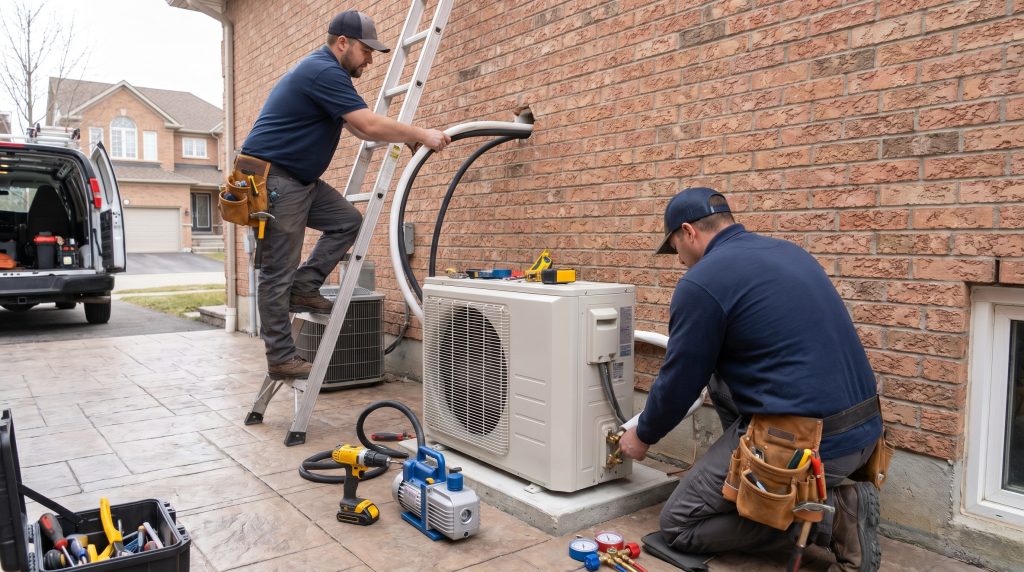


What Is a Heat Pump and How Does It Work?A Worcester Homeowner’s Guide
What Is a Heat Pump and How Does It Work?A Worcester Homeowner’s Guide Introduction: Why Worcester Homeowners Are Switching to Heat Pumps Worcester, MA homeowners face one of the toughest climate challenges in New England: winters that regularly drop below 10°F, humid summers pushing past 90°F, and energy bills that spike year-round. For generations, the default answer was a gas furnace for winter and a window AC for summer — two systems, two sets of maintenance, two energy bills. That equation is changing fast. With MassSave heat pump rebates of up to $10,000, the Federal 30% Tax Credit under the Inflation Reduction Act, and a new generation of cold-climate heat pumps that operate at full capacity down to −15°F, more Worcester homeowners are making the switch — and slashing their energy bills in the process. This guide covers everything you need to know: what a heat pump is, how it works, why it is perfect for Central Massachusetts, and how to get one installed. If you are ready to skip ahead and request a free quote, visit our heat pump installation page — we serve Worcester and 15 surrounding cities. What Is a Heat Pump? A heat pump is a highly efficient heating and cooling system that moves heat rather than generating it. Unlike a gas furnace — which burns fuel to create heat — a heat pump extracts thermal energy from the outdoor air and transfers it inside your home in winter, then reverses the process in summer to cool your home. Think of it like a refrigerator in reverse. Your refrigerator pulls heat out of the cold interior and releases it into your kitchen. A heat pump does the same thing on a much larger scale — and it can run in both directions. Because heat pumps move energy rather than create it, they can deliver 2–4 units of heat for every 1 unit of electricity consumed — an efficiency rating of 200–400%. According to the U.S. Department of Energy, heat pumps can reduce electricity use for heating by up to 65% compared to electric resistance heating. Even the best gas furnaces max out at 98% efficiency — not 300%. How Does a Heat Pump Work? Step-by-Step The science behind heat pumps is rooted in basic refrigeration principles. Here is how the cycle works inside a modern ductless mini split heat pump: Step 1 — Refrigerant Cycle A heat pump uses a refrigerant — a fluid that easily evaporates and condenses at low temperatures — to transfer heat between the outdoor unit and indoor air handler. The refrigerant continuously cycles between liquid and gas states to carry thermal energy. Step 2 — Heat Absorption (Heating Mode, Winter) Even when Worcester’s temperature drops to 10°F, outdoor air still contains heat energy. The outdoor unit’s refrigerant coil absorbs this latent heat, causing the refrigerant to evaporate into a low-pressure gas. Step 3 — Compression The refrigerant gas is compressed by the outdoor unit’s compressor, which dramatically raises its temperature. Modern variable-speed (inverter-driven) compressors continuously adjust output to match your home’s real-time demand — far more efficient than older on/off systems. Step 4 — Heat Release Indoors The hot, pressurized refrigerant travels to the indoor air handler, where it releases its heat into your living space. A whisper-quiet fan distributes the warmth throughout the room. Step 5 — Expansion and Reset After releasing its heat, the refrigerant expands through an expansion valve, cooling back down before cycling to the outdoor unit to absorb more heat. The cycle repeats continuously and silently. Step 6 — Cooling Mode (Summer) In summer, the cycle simply reverses: the indoor unit absorbs heat from your home and the outdoor unit expels it outside. One system replaces both your furnace and your air conditioner. See our ductless AC installation page for details on cooling performance in Worcester summers. Types of Heat Pumps Available in Worcester, MA Not all heat pumps are the same. Worcester homeowners have several options depending on their home type, existing infrastructure, and comfort goals. 1. Ductless Mini Split Heat Pumps The most popular option for Worcester homes — especially older triple-deckers, Colonials, and Capes built without ductwork. A ductless mini split consists of one outdoor compressor unit and one or more wall-mounted or ceiling-cassette indoor air handlers. Each zone is independently controlled. Ductless mini splits are ideal for: → Learn more: Ductless Mini Split Installation Worcester MA 2. Multi-Zone Mini Split Systems One outdoor unit connected to 2–5 indoor air handlers throughout your home. Each room has its own thermostat and operates independently. This is the whole-home solution for Worcester homeowners without existing ductwork — one installation covers your entire house. → Learn more: Mini Split Installation Worcester MA 3. Central Ducted Heat Pumps If your Worcester home already has ductwork from a central air or forced-air system, a ducted heat pump replaces your old furnace/AC combo. It uses existing ducts to distribute conditioned air throughout the home — a drop-in efficiency upgrade. 4. Cold Climate Air Source Heat Pumps (CC-ASHPs) Specifically engineered for New England winters, cold climate air source heat pumps maintain full heating capacity down to −15°F or lower. The Northeast Energy Efficiency Partnerships (NEEP) maintains a listing of qualifying cold-climate models approved for Massachusetts climates. These are the systems that qualify for maximum MassSave rebates. Do Heat Pumps Work in Worcester’s Cold Winters? This is the number-one question Worcester homeowners ask — and the answer is a confident YES, if you choose the right system. Older heat pump technology struggled below 32°F, which gave heat pumps a bad reputation in New England. Today’s cold-climate models have completely changed the game: Worcester’s average January low is around 20°F — well within the comfortable operating range of all modern cold-climate heat pumps. Even during the coldest polar vortex events, these systems continue heating efficiently. Massachusetts has one of the most aggressive heat pump rebate programs in the country through MassSave, partly because the state has specifically vetted and approved cold-climate