
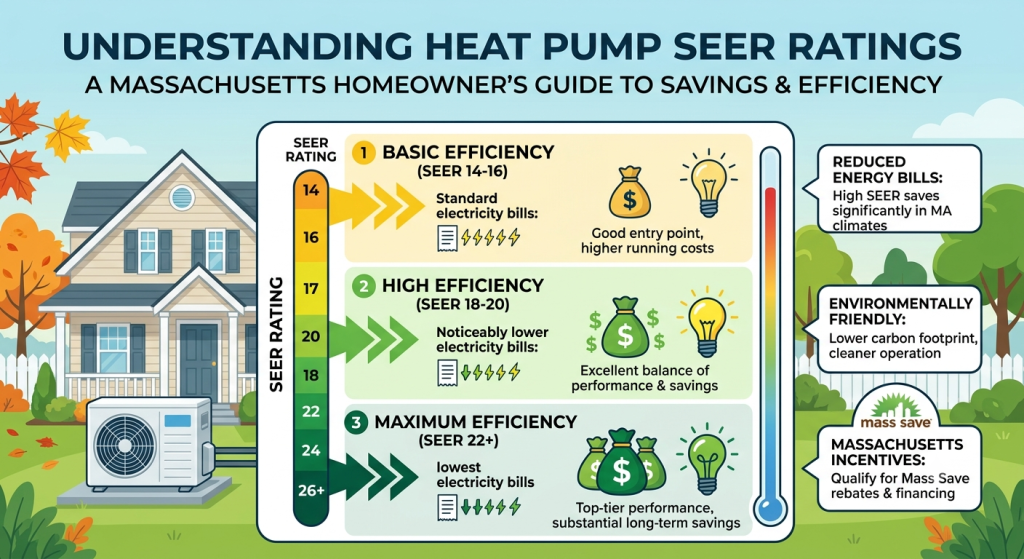
Heat Pump SEER Ratings Explained for Massachusetts Homeowners
If you’ve started researching heat pumps for your Massachusetts home, you’ve probably run into a wall of acronyms: SEER, SEER2, HSPF, HSPF2, EER2, AFUE. It can feel overwhelming, especially when these numbers directly affect your monthly energy bills, your eligibility for Mass Save rebates, and the upfront price of your new system.
The good news is that once you understand what SEER and SEER2 actually measure – and why Massachusetts homeowners need to pay attention to heating efficiency just as much as cooling efficiency – the whole topic becomes much easier to navigate. This guide breaks down everything you need to know in plain language, with specific guidance for homeowners in Worcester and the surrounding Massachusetts communities.
If you’d like a personalized recommendation based on your home’s size, insulation, and heating history, reach out to our team at EddyTech Mini Splits Solutions for a no-pressure consultation.
What Is SEER, Exactly?
SEER stands for Seasonal Energy Efficiency Ratio. It’s a standardized rating that tells you how efficiently an air conditioner or heat pump cools your home over the course of a typical cooling season, expressed as a ratio of cooling output (in BTUs) to electricity consumed (in watt-hours).
In simple terms: the higher the SEER number, the more cooling you get for every dollar of electricity you spend. A unit with a SEER rating of 16 produces 16 BTUs of cooling for every watt-hour of electricity it uses over a season – more efficient than a unit rated at 13 or 14.
SEER has been used for decades to help homeowners compare cooling equipment, but as of 2023, it’s been largely replaced for regulatory purposes by an updated metric: SEER2. If you’re shopping for a new heat pump or mini-split system today, SEER2 is the number you’ll actually see on equipment labels and quotes.

SEER vs. SEER2: What Changed and Why It Matters
SEER2 was introduced by the Department of Energy to reflect more realistic testing conditions. The previous SEER testing method used relatively low static pressure inside the test equipment, which didn’t always represent how systems perform once installed in real ductwork with real airflow resistance.
SEER2 testing uses higher static pressure that better simulates actual home installations. The practical result is that SEER2 numbers run lower than SEER numbers for equivalent equipment – typically by around 4.5%. So a system that would have been rated around 15 SEER under the old methodology might now be labeled closer to 14.3 SEER2.
This matters for two reasons. First, if you’re comparing a quote that lists SEER2 against an older brochure or a neighbor’s system rated in plain SEER, you’re not comparing apples to apples – you’ll need to convert one number to the other. Second, SEER2 is now the figure used for determining whether equipment meets current minimum efficiency standards and, often, whether it qualifies for rebates.
What SEER2 Rating Is Required in Massachusetts?
Efficiency minimums in the United States are set by the Department of Energy according to three climate regions: North, Southeast, and Southwest. Massachusetts falls within the North region.
- Central air conditioners in the North region must meet a minimum of 13.4 SEER2.
- Split-system heat pumps, regardless of region, must meet a national minimum of 14.3 SEER2.
- Heat pumps must also meet a minimum HSPF2 rating of 7.5, which governs heating-season efficiency.
These are floor requirements, not recommendations – most heat pumps installed in Massachusetts homes today, especially cold-climate mini-split systems, are rated well above these minimums. But knowing the baseline helps you recognize when a quoted system is at the bare minimum versus a meaningfully higher-efficiency option.
HSPF2: The Other Number Massachusetts Homeowners Shouldn’t Ignore
SEER2 gets a lot of attention because it’s the more familiar term, but for a state like Massachusetts – where the heating season is considerably longer than the cooling season – HSPF2 often has just as much, or more, impact on your annual energy costs.
HSPF stands for Heating Seasonal Performance Factor, and HSPF2 is its updated counterpart using the same more-realistic testing approach as SEER2. It measures how efficiently a heat pump delivers heat over a typical heating season. The national minimum for split-system heat pumps is 7.5 HSPF2 (roughly equivalent to 8.8 HSPF under the old standard).
When comparing heat pump options for a Massachusetts home, it’s worth asking your installer to walk through both the SEER2 and HSPF2 ratings together, rather than focusing on just one number. A system with an excellent SEER2 but only a minimum-compliant HSPF2 might not be the best fit for a home that relies on the heat pump as its primary winter heat source.
How SEER2 Affects Your Energy Bills
The relationship between SEER2 rating and energy costs isn’t always linear, but the general principle holds: higher SEER2 ratings translate into lower electricity consumption for the same amount of cooling output. Over the lifetime of a system – often 12 to 15 years or more – the difference between a minimum-efficiency unit and a high-efficiency unit can add up to a significant amount in cumulative energy costs.
That said, the size of the savings depends heavily on your home’s specific situation: how much cooling and heating you actually need, your local electricity rates, how well-insulated and air-sealed your home is, and how the system is used day to day. A home with excellent insulation and modest cooling needs may see a smaller absolute difference between a 15 SEER2 and a 20 SEER2 system than a home with poor insulation and heavy AC use.
This is why a one-size-fits-all answer to “what SEER rating should I get” doesn’t really exist. The right answer depends on your home, your budget, and how long you plan to stay – which is exactly the kind of assessment a professional in-home evaluation is designed to provide.
SEER2 Ratings and Mass Save Rebates
One of the most practical reasons to understand SEER2 and HSPF2 ratings is that Massachusetts homeowners have access to some of the strongest heat pump incentive programs in the country through Mass Save. Many of these programs use efficiency tiers – meaning the rebate amount you qualify for can depend directly on the SEER2 and HSPF2 ratings of the equipment you choose.
It’s also worth noting that incentive programs change over time. The federal 25C tax credit for residential heat pumps expired at the end of 2025, which means homeowners should base their savings expectations on currently active programs rather than information from prior years. Refrigerant type can matter too: systems using older refrigerants like R-410A may face different eligibility rules than newer refrigerant systems under current programs.
Because rebate structures and efficiency thresholds are updated periodically, the most reliable approach is to confirm current requirements directly through Mass Save’s official program page and to work with an installer who stays current on these details when preparing your quote.
Why Installation Quality Affects Your Real-World SEER Performance
Here’s something that often gets lost in the SEER conversation: the rated SEER2 number reflects laboratory testing under controlled conditions. The efficiency you actually experience in your home depends heavily on how the system is installed.
Common installation factors that can cause a system to underperform its rated SEER2 include incorrect refrigerant charge, undersized or leaky ductwork (for ducted systems), improperly sized line sets, and outdoor units placed without adequate airflow clearance. In some cases, a high-SEER2 system that’s poorly installed can perform worse in practice than a properly installed system with a lower rating.
This is one of the strongest arguments for working with an experienced, licensed installer rather than choosing equipment based on the rating number alone. Proper mini-split installation – including correct sizing through a load calculation, proper refrigerant charging, and thoughtful placement of indoor and outdoor units – is what allows a system to actually deliver the efficiency printed on its label.
Ductless Mini-Splits and SEER2: Why They Often Score Higher
If you’ve compared SEER2 ratings between ducted central systems and ductless mini-splits, you may have noticed that mini-splits often carry higher ratings. There’s a structural reason for this: ductless systems eliminate the energy losses that occur when conditioned air travels through ductwork, especially ductwork that runs through unconditioned spaces like attics or crawlspaces.
For older Massachusetts homes – many of which were never built with ductwork, or have ductwork that’s undersized, leaky, or poorly routed – a ductless mini-split heat pump can often deliver higher real-world efficiency than retrofitting a ducted system, on top of avoiding the cost and disruption of installing new ducts.
Multi-zone mini-split configurations also allow different rooms to be conditioned independently, which can further improve overall efficiency by avoiding the need to heat or cool unoccupied spaces at the same rate as occupied ones.
How to Compare SEER2 Ratings When Getting Quotes
When you’re reviewing quotes from HVAC contractors, a few practical tips can help you make a meaningful comparison:
- Make sure all quotes reference SEER2 (and HSPF2 for heat pumps) rather than mixing old SEER numbers with new SEER2 numbers.
- Ask whether the quoted system has been verified as a certified “matched system” – SEER2 and HSPF2 ratings are typically certified for specific indoor/outdoor component combinations, not individual parts.
- Request both the SEER2 and HSPF2 ratings together, especially for heat pumps that will serve as your primary heating source.
- Ask how the proposed system’s rating compares to current Massachusetts minimums (13.4 SEER2 for ACs, 14.3 SEER2 / 7.5 HSPF2 for heat pumps) so you understand whether you’re looking at a baseline-compliant system or a higher-efficiency option.
- Confirm whether the rated efficiency aligns with current Mass Save rebate tiers, since this can meaningfully affect your net cost.
If you’d like help interpreting a quote you’ve already received, or want to start from scratch with a home assessment, our team is happy to help – you can also browse our full list of HVAC services for more on what’s involved.

Maintaining Your System’s Rated Efficiency Over Time
A heat pump’s SEER2 and HSPF2 ratings reflect its performance when new and properly maintained. Over time, normal wear, dirt accumulation on coils, refrigerant changes, and airflow restrictions can cause actual efficiency to drift below the original rating.
- Replace or clean air filters on a regular schedule, especially during heavy heating and cooling seasons.
- Keep outdoor units clear of leaves, snow, ice, and other debris that can restrict airflow.
- Schedule annual professional tune-ups to check refrigerant charge and electrical connections.
- Address unusual noises, reduced airflow, or rising energy bills promptly, as these can signal efficiency-robbing issues.
Routine maintenance is one of the most cost-effective ways to help your system continue performing close to the SEER2 and HSPF2 ratings it was designed to achieve, protecting the investment you made in higher-efficiency equipment.
Choosing the Right SEER2 Rating for Your Home
Ultimately, the “right” SEER2 and HSPF2 combination for your Massachusetts home depends on a handful of factors: your current heating fuel and costs, your home’s insulation and air-sealing, your typical summer cooling needs, how long you plan to stay in the home, and the incentives available to you right now.
Rather than chasing the highest number on the shelf, the most reliable approach is a professional assessment that looks at your specific home and walks through realistic options – including how different SEER2 and HSPF2 combinations would affect your upfront cost, monthly bills, and rebate eligibility.
If you’re in Worcester, MA or nearby communities – including Shrewsbury, Westborough, Auburn, Millbury, Grafton, Northborough, Marlborough, Hudson, Hopkinton, Leominster, or Fitchburg – get in touch with EddyTech Mini Splits Solutions LLC for a consultation, or call us directly at (774) 431-2298. You can also learn more about our team or explore more HVAC guides on our blog.
Frequently Asked Questions About Heat Pump SEER Ratings
Below are answers to common questions homeowners search for when researching SEER, SEER2, and HSPF2 ratings for heat pumps.
What does SEER stand for?
SEER stands for Seasonal Energy Efficiency Ratio. It measures how much cooling output a heat pump or air conditioner produces over a typical cooling season compared to the electricity it consumes.
What is SEER2 and how is it different from SEER?
SEER2 is an updated efficiency standard introduced in 2023 that uses more realistic testing conditions, including higher external static pressure that better reflects actual ductwork. A SEER2 rating is typically lower than the equivalent older SEER rating for the same equipment.
Is a higher SEER rating always better?
A higher SEER rating generally means lower cooling costs and better efficiency, but the ‘best’ rating for your home depends on your budget, climate, usage patterns, and how long you plan to stay in the home, since higher-efficiency units cost more upfront.
What is the minimum SEER2 rating allowed in Massachusetts?
Massachusetts falls under the DOE’s North region, where new central air conditioners must meet a minimum of 13.4 SEER2, while split-system heat pumps must meet a national minimum of 14.3 SEER2 and 7.5 HSPF2.
Why did SEER ratings change to SEER2?
The Department of Energy updated testing procedures in 2023 to better reflect real-world ductwork conditions, using higher static pressure during testing. This produces ratings that are more predictive of actual home performance than the older SEER methodology.
How do I convert SEER to SEER2?
As a rough guide, a system’s SEER2 rating is typically about 4.5% lower than its old SEER rating. For example, a unit previously rated at 15 SEER is roughly equivalent to 14.3 SEER2.
What is a good SEER2 rating for a heat pump in a cold climate?
For moderate to cold climates like Massachusetts, many homeowners find a good balance of performance and cost in the 15 to 18 SEER2 range, though higher ratings can still provide value depending on usage and incentive eligibility.
Does a higher SEER rating mean better heating performance too?
Not directly. SEER measures cooling efficiency, while HSPF (or HSPF2) measures heating efficiency. A heat pump can have a high SEER2 rating for cooling and a separate HSPF2 rating that reflects its winter heating performance.
What is HSPF and why does it matter for heat pumps?
HSPF stands for Heating Seasonal Performance Factor, and it measures how efficiently a heat pump heats your home over a typical heating season. For Massachusetts homeowners, HSPF2 is just as important as SEER2 since heating dominates much of the year.
What is the minimum HSPF2 rating for heat pumps?
The national minimum for split-system heat pumps is 7.5 HSPF2, which corresponds to roughly 8.8 HSPF under the older standard.
Can I still install an older SEER-rated system in Massachusetts?
In the North region, units manufactured before January 1, 2023 with older SEER ratings may still be installed in some cases, but new equipment sold and installed today is generally required to meet current SEER2 minimums.
How much can a higher SEER2 rating save on energy bills?
Savings depend on your climate, usage, and electricity rates, but moving from a lower-efficiency unit (around 14 SEER2) to a high-efficiency unit (20 SEER2 or higher) can add up to thousands of dollars in savings over the system’s lifetime.
Does SEER rating affect eligibility for Mass Save rebates?
Yes. Mass Save rebate eligibility for heat pumps depends in part on meeting specific efficiency thresholds, which are tied to SEER2 and HSPF2 ratings. Checking current program requirements before purchasing is essential.
Is the federal tax credit for high-SEER heat pumps still available?
The federal 25C tax credit for residential heat pumps expired at the end of 2025. Massachusetts homeowners should check current Mass Save incentives directly, as state programs may have their own efficiency-based requirements.
What SEER rating do most ductless mini-splits have?
Ductless mini-split heat pumps often have higher SEER2 ratings than central systems because they avoid duct losses entirely, with many residential models falling in the high-teens to low-20s SEER2 range depending on the model and zone configuration.
Does SEER rating change based on outdoor temperature?
SEER is a seasonal average rating based on standardized testing across a range of typical outdoor temperatures. Actual performance on any given day will vary depending on real outdoor conditions, humidity, and how the system is operated.
What is EER2 and how is it different from SEER2?
EER2 (Energy Efficiency Ratio 2) measures cooling efficiency at a single high-temperature point, typically 95°F, making it more relevant to peak summer performance, while SEER2 reflects average efficiency across an entire cooling season.
Why does installation quality affect SEER performance?
A system’s rated SEER2 reflects laboratory testing under ideal conditions. Poor installation — such as incorrect refrigerant charge, undersized line sets, or duct leakage — can significantly reduce real-world efficiency, sometimes below that of a properly installed lower-SEER unit.
Is it worth paying extra for a higher SEER2 rated heat pump?
It depends on your situation. Homes with high cooling demand, all-electric heating, or access to strong rebates often see faster payback from higher-SEER2 equipment, while homes with lower usage may find a mid-range SEER2 unit more cost-effective.
What’s the difference between single-stage, two-stage, and variable-speed systems and SEER?
Single-stage systems run at full capacity only and tend to have lower SEER2 ratings. Two-stage systems offer a high and low setting, improving efficiency. Variable-speed (inverter) systems continuously adjust output and typically achieve the highest SEER2 ratings.
Does a bigger heat pump have a higher SEER rating?
Not necessarily. SEER rating depends on the design and components of the system rather than its size (capacity). In fact, oversized equipment for a given space can sometimes reduce real-world efficiency even if its rated SEER2 is high.
How is SEER calculated?
SEER is calculated by dividing the total cooling output (in BTUs) delivered over a cooling season by the total electricity consumed (in watt-hours) during that same period, based on standardized testing conditions.
What does AFUE mean and does it apply to heat pumps?
AFUE (Annual Fuel Utilization Efficiency) measures how efficiently a furnace converts fuel into heat, expressed as a percentage. It applies to combustion furnaces rather than heat pumps, which use SEER2 and HSPF2 instead.
Can I find a heat pump’s SEER rating on the unit itself?
Yes. SEER2 and HSPF2 ratings are typically listed on the manufacturer’s specification label (often called the AHRI or yellow energy label) attached to the outdoor unit, as well as in the manufacturer’s product documentation.
What does the ENERGY STAR label tell me about SEER?
ENERGY STAR certification indicates that a heat pump meets or exceeds efficiency thresholds set by the EPA, which generally correspond to SEER2 and HSPF2 ratings above the federal minimums, though specific thresholds vary by product type.
Does ductwork condition affect my system’s effective SEER?
Yes. Leaky, poorly sealed, or undersized ductwork can significantly reduce the efficiency a system delivers in practice, even if the equipment itself carries a high SEER2 rating.
Are ductless systems more efficient than ducted systems?
Ductless mini-split systems avoid the energy losses associated with duct leakage and heat transfer through unconditioned spaces, which often allows them to deliver higher real-world efficiency compared to ducted systems with the same nominal SEER2 rating.
How often should I replace my HVAC system based on SEER ratings?
There’s no fixed schedule, but if your current system is significantly below current SEER2 minimums and nearing the end of its typical lifespan (12 to 15+ years), replacing it with a higher-efficiency model can often justify the investment through energy savings.
Does SEER rating affect humidity control?
Higher-efficiency systems, particularly variable-speed units with higher SEER2 ratings, often run longer at lower capacities, which can improve dehumidification compared to single-stage systems that cycle on and off quickly.
What’s the relationship between SEER and BTU?
BTU (British Thermal Unit) measures the cooling or heating capacity of a system, while SEER measures how efficiently that capacity is delivered relative to electricity used. A system can have a large BTU capacity with either a low or high SEER2 rating.
Why do heat pumps have both a SEER2 and HSPF2 rating?
Because heat pumps both cool and heat, two separate ratings are needed: SEER2 for cooling-season efficiency and HSPF2 for heating-season efficiency. Together, they give a fuller picture of year-round performance.
Do all states have the same SEER requirements?
No. The DOE sets minimum efficiency standards based on three climate regions — North, Southeast, and Southwest — with Southern regions generally requiring higher minimum SEER2 ratings for air conditioners due to greater cooling demand.
Is Massachusetts in the North or South DOE efficiency region?
Massachusetts is part of the DOE’s North region, which has a minimum SEER2 requirement of 13.4 for air conditioners, while heat pumps nationwide must meet 14.3 SEER2 regardless of region.
What happens if I install a heat pump below the minimum SEER2 rating?
Installing equipment that doesn’t meet current minimum efficiency standards for your region is generally not permitted for new installations and may also affect rebate eligibility, financing options, and code compliance.
Can upgrading SEER rating help with Mass Save’s whole-home rebate cap?
Mass Save’s whole-home rebate programs often have efficiency-based tiers, where higher-efficiency equipment (reflected in SEER2 and HSPF2 ratings) may qualify for higher rebate amounts, up to the program’s overall cap.
Does outdoor unit placement affect SEER performance?
Yes. Adequate airflow clearance, shade, and protection from snow or debris accumulation around the outdoor unit all support the system’s ability to perform close to its rated efficiency.
What is the lifespan of a high-SEER2 heat pump?
High-efficiency heat pumps generally have similar lifespans to standard-efficiency models — commonly 12 to 15 years or more — with actual longevity depending more on maintenance and installation quality than on SEER2 rating alone.
Should I prioritize SEER2 or HSPF2 for a Massachusetts home?
Because Massachusetts has a longer heating season than cooling season, HSPF2 (heating efficiency) often has a larger overall impact on annual energy costs, though both ratings matter for year-round comfort and savings.
Does a higher SEER rating reduce noise?
Often, yes. Higher-SEER2 systems frequently use variable-speed compressors and fans that run at lower speeds most of the time, which tends to reduce operating noise compared to single-stage systems that cycle at full power.
Can I upgrade just the outdoor unit to improve SEER rating?
Generally no. SEER ratings are based on matched system combinations of indoor and outdoor components. Replacing only one part of the system can void warranties, reduce performance, and may not achieve the rated SEER2 at all.
What’s the difference between rated SEER2 and ‘real world’ SEER2?
Rated SEER2 reflects standardized laboratory testing, while real-world performance depends on factors like installation quality, ductwork condition, climate, thermostat settings, and maintenance — all of which can cause actual efficiency to differ from the rated number.
How do I compare SEER ratings when shopping for a heat pump?
Compare SEER2 (not older SEER numbers) across similarly sized units, and look at HSPF2 for heating performance as well. It’s also useful to compare total estimated annual operating costs, which factor in both ratings together.
Does insulation affect how much SEER rating matters?
Yes. A well-insulated, well-sealed home requires less heating and cooling overall, which means the efficiency of the equipment has less total impact on energy bills compared to a poorly insulated home with high heating and cooling loads.
What is a ‘matched system’ and why does it matter for SEER?
A matched system means the indoor air handler or coil and the outdoor condenser/compressor are designed and certified to work together. SEER2 and HSPF2 ratings are typically certified for specific matched combinations, not individual components.
Can old SEER ratings still be found on used or older equipment?
Yes, older equipment manufactured before 2023 may still display ratings under the original SEER and HSPF standards, which is why direct comparisons to new SEER2-rated equipment require conversion.
Does a heat pump’s SEER rating affect resale value of my home?
While not the primary factor in home value, an efficient, modern heating and cooling system can be a positive selling point for buyers concerned about energy costs, particularly in regions with high heating demand like Massachusetts.
What is the highest SEER2 rating available for residential systems?
Some premium residential systems, particularly ductless mini-splits, can reach SEER2 ratings in the low-to-mid 20s, though availability and pricing vary by manufacturer and model.
Do multi-zone mini-split systems have different SEER ratings per zone?
The overall system SEER2 rating is typically based on the combination of the outdoor unit and connected indoor units as tested together, rather than a separate rating for each individual zone.
How does climate affect the ‘right’ SEER2 rating for my home?
Homes in climates with longer cooling seasons generally see faster payback from higher SEER2 ratings, while homes in climates with shorter cooling seasons (like much of Massachusetts) may find a moderate SEER2 rating, combined with a strong HSPF2, more cost-effective overall.
Are there rebates specifically tied to SEER2 thresholds in Massachusetts?
Some Mass Save incentives are structured around efficiency tiers that reference SEER2 and HSPF2 thresholds, so the specific rebate amount available can depend on the rating of the equipment installed.
What maintenance helps preserve a system’s SEER-rated efficiency?
Regular filter changes, annual professional tune-ups, keeping the outdoor unit clear of debris, and promptly addressing refrigerant or airflow issues all help a system perform closer to its rated SEER2 over its lifetime.
Is SEER2 used for both air conditioners and heat pumps?
Yes. SEER2 applies to the cooling performance of both standalone air conditioners and heat pumps, while HSPF2 applies specifically to the heating performance of heat pumps.
Does humidity in Massachusetts summers affect SEER performance?
High humidity increases the cooling load a system needs to handle, which can affect real-world efficiency. Systems with higher SEER2 ratings and good dehumidification performance tend to handle humid summer conditions more effectively.
What’s the payback period for upgrading to a higher SEER2 system?
Payback periods vary widely based on the SEER2 difference, local electricity rates, available rebates, and usage patterns, but homeowners can estimate this by comparing the incremental equipment cost against projected annual energy savings.
Can I look up SEER2 ratings through AHRI?
Yes. The Air-Conditioning, Heating, and Refrigeration Institute (AHRI) maintains a public directory of certified equipment combinations along with their certified SEER2, EER2, and HSPF2 ratings.
Does a heat pump’s SEER rating change over time as it ages?
Yes. As components wear, refrigerant levels change, and coils accumulate dirt, a system’s actual efficiency typically declines somewhat from its original rated SEER2, which is why ongoing maintenance is important.
What’s the difference between SEER2 and the Energy Guide label numbers?
The Energy Guide label, required on many new HVAC products, displays the SEER2 (and other) ratings along with estimated annual operating costs to help consumers compare models on a standardized basis.
Should I choose SEER2 rating based on summer or winter needs in Massachusetts?
Both matter, but because Massachusetts winters are longer and heating represents a larger share of annual energy use for most homes, HSPF2 often deserves equal or greater attention alongside SEER2 when comparing heat pump options.
Can a professional help me decide which SEER2 rating is right for my home?
Yes. A qualified HVAC professional can evaluate your home’s insulation, square footage, current energy costs, and local incentive programs to recommend a SEER2 and HSPF2 combination that balances upfront cost with long-term savings.
Where can I get a personalized recommendation for SEER2 ratings for my Worcester-area home?
A local HVAC provider familiar with Massachusetts climate conditions and current Mass Save program details can provide a personalized assessment and equipment recommendation based on your specific home.
Get a Personalized SEER2 Recommendation for Your Home
Understanding SEER2 and HSPF2 ratings is a great first step, but the most valuable next step is a home-specific assessment. The team at EddyTech Mini Splits Solutions LLC serves Worcester, MA and the surrounding communities with expert mini-split and heat pump installation, maintenance, and repair services.
Visit our homepage to learn more, check out our blog for additional HVAC guides, or contact our team to schedule your consultation. You can also reach us by phone at (774) 431-2298.
Further Reading
For additional independent information on efficiency standards and certified equipment ratings, see ENERGY STAR’s guidance on air-source heat pumps, the U.S. Department of Energy’s heat pump systems overview, the AHRI certified products directory, and Mass Save’s incentive programs.