

How Heat Pumps Both Heat and Cool Your Home Year-Round
If you’re researching heating and cooling options for your home, you’ve probably come across the term “heat pump” more than once – and for good reason. Heat pumps have quickly become one of the most talked-about home comfort technologies, and for homeowners in Massachusetts and across New England, they represent a genuine shift in how a single system can manage both winter heating and summer cooling.
Unlike traditional setups that rely on a furnace for heat and a separate air conditioner for cooling, a heat pump does both jobs using one piece of equipment. That means less hardware to maintain, often lower energy bills, and a more consistent comfort experience throughout the year. In this guide, we’ll break down exactly how heat pumps work, why they’re effective in both hot and cold weather, what it means for your home’s efficiency, and what to consider if you’re thinking about making the switch.
If you’re located in the Worcester, MA area and want a professional assessment of whether a heat pump or ductless mini-split system is right for your home, our team at EddyTech Mini Splits Solutions can walk you through your options.
What Is a Heat Pump, Exactly?
A heat pump is an HVAC system that transfers heat from one place to another rather than generating heat through combustion or electric resistance. The core idea is simple: heat naturally moves from a warmer area to a cooler one, and a heat pump uses a small amount of energy – typically electricity – to move heat in the direction you want, even when that means moving it against its natural flow.
In winter, a heat pump extracts heat from the outdoor air (yes, even cold air contains usable heat energy) and moves it indoors. In summer, it reverses this process, pulling heat out of your indoor air and releasing it outside – exactly how a traditional air conditioner works. This dual capability is why heat pumps are often described as “a furnace and an air conditioner in one.”
The technology itself isn’t new – refrigerators and air conditioners have used similar refrigeration cycles for decades. What’s changed is the efficiency, reliability, and cold-climate performance of modern heat pump systems, particularly variable-speed (inverter-driven) mini-split heat pumps, which can now handle New England winters far better than older models could.
The Science Behind Heating and Cooling With One System
To understand how a single unit can both heat and cool, it helps to look at the basic refrigeration cycle that powers every heat pump. The system relies on four key components: a compressor, a condenser coil, an expansion valve, and an evaporator coil, all connected by refrigerant lines.
How Heating Mode Works
- The outdoor unit’s evaporator coil absorbs heat from the outside air, even when temperatures are cold.
- Refrigerant inside the coil absorbs this heat and evaporates into a low-pressure gas.
- The compressor pressurizes this gas, which significantly raises its temperature.
- The hot, high-pressure refrigerant travels to the indoor unit, where a fan blows air across the coil, transferring heat into your living space.
- The refrigerant then cools, returns to a liquid state, and cycles back outside to absorb more heat – repeating the process continuously.
How Cooling Mode Works
In cooling mode, a component called the reversing valve switches the direction of refrigerant flow, effectively flipping the entire cycle. Now the indoor coil absorbs heat from inside your home (cooling the air that’s circulated back into your rooms), while the outdoor coil releases that heat outside. This is the same basic process a standard air conditioner uses – the heat pump simply has the added ability to run this cycle in reverse for winter heating.
This reversing valve is really the heart of what makes a heat pump different from either a standalone furnace or a standalone air conditioner. It’s a relatively simple mechanical addition that unlocks a dramatically more versatile system.
Why Heat Pumps Are So Efficient
One of the most compelling reasons homeowners choose heat pumps is efficiency. Traditional heating systems – whether gas furnaces, oil boilers, or electric resistance heaters – create heat by converting fuel or electricity directly into thermal energy. Even the most efficient combustion systems can’t exceed 100% efficiency, because they’re limited by the energy content of the fuel itself.
Heat pumps work differently. Because they move existing heat rather than creating new heat, they can deliver more energy in heating or cooling output than they consume in electricity. This is measured using the Coefficient of Performance (COP) for heating and SEER (Seasonal Energy Efficiency Ratio) for cooling. A heat pump with a COP of 3, for example, delivers roughly three units of heat for every one unit of electricity used – an efficiency level that’s simply not possible with combustion-based heating.
This efficiency translates directly into your energy bills. While the exact savings depend on your home’s insulation, your local electricity rates, and the fuel source you’re replacing, many homeowners switching from oil heat or electric resistance heating to a modern cold-climate heat pump see a meaningful reduction in their annual heating costs, on top of gaining cooling capability they may not have had before.
Heat Pumps in Cold Climates: Do They Really Work in Massachusetts Winters?
This is one of the most common questions homeowners ask, and it’s an important one. Older heat pump technology genuinely struggled in very cold temperatures, which gave rise to the persistent myth that heat pumps “don’t work” in places like Massachusetts. That’s no longer accurate for modern systems.
Today’s cold-climate heat pumps use variable-speed compressors and advanced refrigerant management to maintain strong heating output even as outdoor temperatures drop well below freezing. Many cold-climate-rated mini-split systems are specifically engineered and tested for performance in sub-zero conditions, making them a practical year-round solution for Worcester County and the broader New England region.
That said, not every heat pump on the market is built for extreme cold. If you’re considering a heat pump for a Massachusetts home, it’s important to choose a model that’s specifically rated for cold-climate performance – and to have it sized and installed by a team that understands local conditions. Our heat pump installation services focus specifically on cold-climate systems suited to the Worcester area’s winters.
Ductless Mini-Splits: A Popular Way to Get Heat Pump Benefits
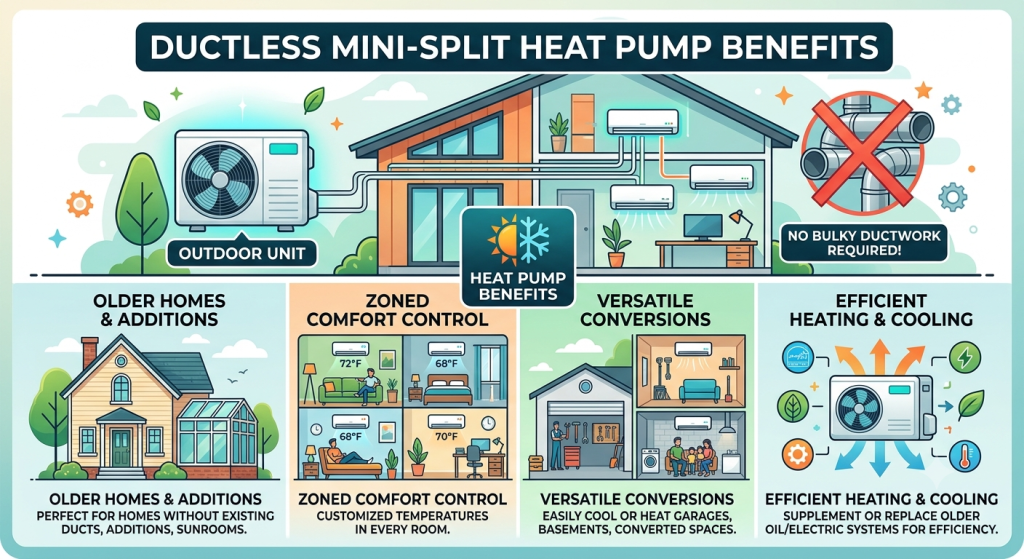
When people talk about residential heat pumps today, they’re very often talking about ductless mini-split systems. A mini-split consists of an outdoor compressor unit connected to one or more indoor air-handling units, all without the need for the bulky ductwork that central HVAC systems require.
This makes mini-splits especially attractive for:
- Older homes that were never built with ductwork
- Home additions or converted spaces like sunrooms, garages, or finished basements
- Homes looking to add zoned comfort control, where different rooms can be set to different temperatures
- Anyone wanting to supplement or eventually replace an aging oil or electric heating system
Because most residential mini-splits are heat pumps by design, installing one effectively gives you a year-round comfort system: efficient heating in winter and effective air conditioning and dehumidification in summer, all from the same equipment. If you’re exploring whether a ductless mini-split is right for your Worcester-area home, our team can evaluate your space and recommend the right configuration.
Heat Pumps and Summer Cooling: More Than Just Air Conditioning
While heating is often the headline feature people focus on, the cooling side of a heat pump is just as important – especially during humid New England summers. In cooling mode, a heat pump performs exactly like a high-efficiency air conditioner, removing heat from your indoor air and expelling it outside.
But heat pumps also offer a meaningful side benefit: dehumidification. As warm, moist indoor air passes over the cold evaporator coil, moisture condenses out of the air and is drained away. This means your home doesn’t just feel cooler in summer – it also feels less humid, which can significantly improve overall comfort and indoor air quality.
For homes that previously relied on window units or struggled with uneven cooling, a properly sized heat pump system can deliver more consistent temperatures room-to-room, along with quieter operation thanks to variable-speed compressor technology in modern units.
Rebates, Incentives, and the Cost of Going Electric
Cost is naturally one of the biggest factors homeowners weigh when considering a heat pump system. The good news is that Massachusetts has historically offered some of the strongest incentive programs in the country for heat pump adoption through Mass Save, which provides rebates for qualifying installations to help offset upfront costs.
It’s worth noting that incentive programs change over time. The federal 25C tax credit for residential heat pumps, for example, expired at the end of 2025, which means current savings calculations should be based on what’s actually available right now rather than older information. Refrigerant type matters too – systems using older refrigerants like R-410A may not qualify for the same incentives as newer, more efficient refrigerant systems.
Because incentive programs and eligibility requirements shift from year to year, the best approach is to work with a local installer who stays current on Mass Save program details and can help you understand exactly what rebates apply to your specific project at the time of installation. You can find more details directly from Mass Save’s official program information.
Sizing and Installation: Why It Matters So Much
A heat pump’s ability to both heat and cool your home effectively depends heavily on proper sizing and installation – arguably more so than with traditional systems. An undersized system will struggle to keep up during extreme weather, while an oversized system can cycle on and off too frequently, reducing both efficiency and comfort, and limiting its ability to dehumidify properly in summer.
Proper sizing takes into account your home’s square footage, insulation levels, window area and orientation, ceiling height, and local climate data – not just a simple square-footage estimate. This is typically done through a load calculation performed by a qualified installer.
Installation quality matters just as much as sizing. Refrigerant line setup, electrical connections, condensate drainage, and outdoor unit placement all affect how well the system performs and how long it lasts. This is why professional installation isn’t just a recommendation – in most cases it’s also required to maintain manufacturer warranties and rebate eligibility.
If you’d like a professional evaluation of your home’s heating and cooling needs, contact our team for a consultation, or browse our full range of HVAC services to see how a heat pump system could fit into your home.

Maintaining Your Heat Pump for Year-Round Performance
Because a heat pump operates year-round – not just during one season – regular maintenance plays an outsized role in keeping it running efficiently. Fortunately, the maintenance requirements are manageable and similar to what you’d expect from any HVAC system:
- Clean or replace air filters regularly, especially during heavy use seasons
- Keep the outdoor unit clear of leaves, snow, ice, and other debris
- Ensure adequate clearance around the outdoor unit for proper airflow
- Schedule an annual professional tune-up to check refrigerant levels, electrical connections, and overall performance
- Avoid blocking indoor unit vents with furniture or curtains
A well-maintained heat pump not only performs better but also tends to last longer, helping you get the most value from your investment over its full lifespan – commonly 12 to 15 years or more.
Is a Heat Pump Right for Your Home?
Heat pumps aren’t a one-size-fits-all solution, but for a large percentage of homes – especially in a climate like Massachusetts where both heating and cooling are genuinely needed throughout the year – they offer a compelling combination of efficiency, comfort, and simplicity. Consolidating two systems into one, gaining cooling capability if you don’t already have it, and potentially reducing your energy costs are all strong reasons homeowners are making the switch.
The right decision depends on factors like your current heating fuel and costs, your home’s insulation and layout, your local climate exposure, and the incentives available to you at the time of installation. A professional assessment is the best way to get clear, home-specific answers rather than general estimates.
If you’re in Worcester, MA or the surrounding communities – including Shrewsbury, Westborough, Auburn, Millbury, Grafton, Northborough, Marlborough, Hudson, Hopkinton, Leominster, or Fitchburg – and you’re curious whether a heat pump or mini-split system makes sense for your home, get in touch with EddyTech Mini Splits Solutions for a no-pressure consultation. You can also call us directly at (774) 431-2298, or learn more about our team and approach.
Frequently Asked Questions About Heat Pumps
Below are answers to common questions homeowners search for when researching heat pump heating and cooling systems.
Can a heat pump really both heat and cool my home?
Yes. A heat pump is a single system that moves heat rather than generating it. In winter it extracts heat from outdoor air and pumps it inside; in summer it reverses the cycle and pulls heat out of your home, working as an air conditioner. One unit handles both jobs year-round.
How does a heat pump heat a home when the air outside is cold?
Even cold outdoor air contains usable thermal energy. The refrigerant absorbs that heat, gets compressed (which raises its temperature), and releases the heat inside through the indoor unit. Cold-climate models can extract heat efficiently even well below freezing.
What is the difference between a heat pump and a furnace?
A furnace generates heat by burning fuel or using electric resistance elements. A heat pump doesn’t generate heat at all – it transfers existing heat from one place to another, which is why it can deliver more heating energy than the electricity it consumes.
What is the difference between a heat pump and a regular air conditioner?
A standard air conditioner only moves heat in one direction – out of your home. A heat pump has a reversing valve that lets the same refrigeration cycle run backward, so it can also move heat indoors for winter heating.
Do heat pumps actually work in cold New England winters?
Modern cold-climate heat pumps, especially inverter-driven mini-splits, are engineered to maintain strong heating capacity in sub-freezing temperatures, with many rated for efficient operation well below 0 degrees F. Choosing a cold-climate-rated model is the key factor for Massachusetts homes.
What does ‘mini-split’ mean?
A mini-split is a ductless heat pump made up of an outdoor compressor unit connected to one or more indoor air-handling units, without traditional ductwork. ‘Mini’ refers to the compact size of the components compared with central systems.
Are all ductless mini-splits heat pumps?
Most mini-splits sold today are heat pumps and provide both heating and cooling, but some models are cooling-only. Always confirm with your installer that the unit you’re buying has reverse-cycle (heating) capability.
How much does it cost to install a mini-split heat pump?
Costs vary based on home size, number of zones, and equipment efficiency tier – ranging from a few thousand dollars for a single-zone system to higher amounts for whole-home multi-zone installations. A site visit and personalized quote is the best way to get an accurate number.
Are there rebates available for heat pumps in Massachusetts?
Yes. The Mass Save program offers rebates for qualifying heat pump installations, with whole-home caps that can reach several thousand dollars in 2026. Eligibility depends on equipment efficiency and program requirements at the time of installation.
Is the federal tax credit for heat pumps still available?
The federal 25C residential energy efficiency tax credit expired at the end of 2025. Massachusetts homeowners should check current Mass Save incentives directly, since state-level rebates may still apply even though the federal credit has ended.
Do R-410A systems qualify for current rebate programs?
Many rebate programs have shifted eligibility away from R-410A refrigerant systems toward newer refrigerants with lower environmental impact. Confirm refrigerant type and current program eligibility with your installer before purchasing.
How efficient are heat pumps compared to traditional heating systems?
Because heat pumps transfer heat instead of generating it, they typically deliver multiple units of heating or cooling output for every unit of electricity used – often two to four times more efficient than electric resistance heating, depending on conditions.
What is SEER and why does it matter?
SEER (Seasonal Energy Efficiency Ratio) measures cooling efficiency over a season – higher ratings mean lower cooling costs. A higher SEER2 rating generally signals better long-term energy savings when comparing models.
What is HSPF and why does it matter?
HSPF (Heating Seasonal Performance Factor) measures a heat pump’s heating efficiency over a season. A higher HSPF rating means more heating output per unit of electricity consumed.
Can one system heat and cool an entire house?
It depends on layout and size. Multi-zone ductless systems can serve several rooms from one outdoor unit, while larger homes may need multiple outdoor units or a ducted central heat pump to condition every space effectively.
How long do heat pumps typically last?
With regular maintenance, heat pumps commonly last 12 to 15 years, and well-maintained systems can run longer. Lifespan depends on usage, climate exposure, and how consistently the system is serviced.
What maintenance does a heat pump need?
Routine maintenance includes cleaning or replacing filters, clearing debris from the outdoor unit, checking refrigerant charge, inspecting electrical connections, and a professional tune-up at least once a year.
Why does a heat pump’s air feel cooler than a furnace’s air?
Heat pumps deliver a steady, moderate-temperature airflow rather than the short blasts of very hot air a furnace produces. This constant flow keeps rooms at a more even temperature even though the air at the vent feels less hot to the touch.
Do heat pumps need a backup heating source?
In very cold climates, some homeowners pair a heat pump with a backup source – such as existing baseboard heat or a furnace – for the coldest days, though many modern cold-climate units are sized to handle the full heating load on their own.
Can a heat pump replace my old furnace and air conditioner entirely?
Yes, in many homes a properly sized cold-climate heat pump system can replace both a furnace and a separate air conditioner, consolidating heating and cooling into one efficient system.
Will a heat pump increase my electric bill?
Heating costs typically shift from fuel (oil, gas, propane) to electricity, but because heat pumps are so efficient, many homeowners see overall energy cost reductions, especially when replacing electric resistance heat or older oil systems.
How noisy are modern heat pumps?
Variable-speed (inverter) heat pumps run at lower speeds most of the time and are designed to operate quietly, often comparable to background household noise, unlike older single-speed units that cycle loudly on and off.
What size heat pump do I need for my home?
Sizing depends on square footage, insulation, window area, ceiling height, and local climate – not just square footage alone. A professional load calculation (often called a Manual J calculation) determines the correct capacity for your space.
Can a heat pump dehumidify my home in summer?
Yes. As part of the cooling cycle, a heat pump removes moisture from indoor air, which helps improve comfort and indoor air quality during humid Massachusetts summers.
What happens to a heat pump’s efficiency in extreme cold?
As outdoor temperatures drop, a heat pump’s heating capacity and efficiency gradually decrease, which is why cold-climate models are built with enhanced compressors and refrigerant systems designed to maintain performance at low temperatures.
Do I need ductwork for a heat pump?
No – ductless mini-split heat pumps don’t require ductwork, making them a popular option for additions, older homes, or homes without existing ducts. Ducted heat pumps are also available for homes that already have duct systems.
How many indoor units can one outdoor heat pump unit support?
Multi-zone systems can typically support multiple indoor air handlers from a single outdoor unit, allowing different rooms or zones to be heated and cooled independently and at different temperatures.
What’s the difference between single-zone and multi-zone systems?
A single-zone system has one outdoor unit connected to one indoor unit, ideal for a single room or small space. A multi-zone system connects one outdoor unit to multiple indoor units, allowing independent temperature control in several areas.
Can a heat pump be installed in an older home?
Yes. Ductless mini-split heat pumps are especially well-suited to older homes because they don’t require the extensive ductwork modifications that central systems often need.
Do heat pumps work well in humid climates during summer?
Yes. Heat pumps actively remove humidity as part of normal cooling operation, which is one of the reasons they perform well in the humid summers typical of the Northeast.
How does a heat pump defrost itself in winter?
Heat pumps periodically run a defrost cycle that briefly reverses operation to melt any frost or ice that builds up on the outdoor coil, ensuring the system continues operating efficiently.
Is it normal for a heat pump’s outdoor unit to look like it’s ‘smoking’ in winter?
Yes – what looks like smoke during a defrost cycle is usually steam created as accumulated frost melts off the outdoor coil. This is a normal part of operation.
What temperature should I set my heat pump thermostat to in winter?
Most manufacturers recommend setting a consistent temperature rather than large setbacks, since heat pumps are most efficient maintaining a steady temperature instead of working to recover from a big overnight drop.
Should I turn my heat pump off when I’m not home?
Generally, it’s more efficient to maintain a moderate setback temperature rather than turning the system off completely, since heat pumps work best with gradual temperature changes rather than large swings.
What is an inverter-driven heat pump?
An inverter-driven (variable-speed) heat pump can adjust its compressor speed continuously to match the heating or cooling demand, rather than simply cycling on and off at full power, which improves efficiency, comfort, and noise levels.
Can heat pumps be used with solar panels?
Yes. Pairing a heat pump with solar panels is a common strategy for reducing both energy costs and environmental impact, since the heat pump’s electric demand can be offset by on-site solar generation.
How do I know if a heat pump is the right choice for my home?
Factors to consider include your current heating fuel and costs, home insulation level, climate zone, available incentives, and whether you want to add cooling capability. A professional home energy assessment can help clarify the right fit.
What is a heat pump’s COP?
COP (Coefficient of Performance) is a ratio that describes how much heating or cooling output a heat pump produces compared to the electrical energy it consumes – a COP of 3, for example, means three units of heat delivered per unit of electricity used.
Do heat pumps require a permit to install?
In most Massachusetts municipalities, HVAC installations including heat pumps require permits and inspections. A licensed installer typically handles the permitting process as part of the project.
Can a heat pump be added to a home with existing ductwork?
Yes, ducted heat pump systems can be installed to work with existing ductwork, though duct condition and sizing should be evaluated to ensure they’re compatible with the new system’s airflow requirements.
What’s the ideal time of year to install a heat pump?
Heat pumps can be installed any time of year, but scheduling during shoulder seasons (spring or fall) can sometimes mean shorter wait times before the high-demand summer and winter seasons.
Does a heat pump work during a power outage?
No – like central air conditioners and most modern furnaces, heat pumps require electricity to operate and will not run during a power outage unless connected to a backup generator or battery system.
How does local climate affect heat pump performance?
Heat pump performance is primarily affected by outdoor temperature. In colder regions like Massachusetts, selecting a cold-climate-rated unit with strong low-temperature performance is the most important consideration.
Can a heat pump help with allergies or indoor air quality?
Heat pumps filter air as part of normal operation, and some models offer enhanced filtration options. Combined with dehumidification in summer, this can contribute to improved indoor air quality, though dedicated air purification may still be beneficial for severe allergies.
What’s the difference between a heat pump and a geothermal system?
An air-source heat pump (including mini-splits) exchanges heat with outdoor air, while a geothermal (ground-source) heat pump exchanges heat with the relatively stable temperature of the ground. Geothermal systems often cost more to install but can offer high efficiency.
How do I maintain a heat pump during the winter?
Keep the outdoor unit clear of snow, ice, and debris, ensure adequate clearance for airflow, replace or clean filters regularly, and avoid blocking vents on indoor units to maintain efficient operation.
Can a heat pump be too big for my home?
Yes – an oversized heat pump can cycle on and off too frequently, reducing efficiency, comfort, and dehumidification performance. Proper sizing through a load calculation helps avoid both undersizing and oversizing.
What brands of heat pumps are commonly installed in Massachusetts?
Many cold-climate mini-split and heat pump brands are available and approved under programs like Mass Save. An installer can recommend models that balance efficiency, reliability, and rebate eligibility for your specific project.
How quickly can a heat pump heat up a cold room?
Recovery time depends on the system’s capacity, the room’s insulation, and the outdoor temperature, but properly sized heat pumps are designed to bring rooms to target temperature within a reasonable timeframe under normal conditions.
Is professional installation required for a heat pump?
Yes. Proper installation – including correct sizing, refrigerant line setup, electrical connections, and commissioning – is essential for performance, efficiency, warranty coverage, and rebate eligibility, and should be performed by a licensed HVAC professional.
Ready to Explore Heat Pump Options for Your Home?
Whether you’re upgrading from an older oil or electric heating system, adding cooling to a home that doesn’t have it, or simply exploring more efficient options, the team at EddyTech Mini Splits Solutions LLC can help. We serve Worcester, MA and the surrounding communities with expert mini-split and heat pump installation, maintenance, and repair services.
Visit our homepage to learn more, explore our blog for more HVAC guides and tips, or reach out to our team to schedule your consultation today. You can also reach us by phone at (774) 431-2298.
Further Reading
For additional independent information on heat pump technology and efficiency programs, see ENERGY STAR’s heat pump guidance, the U.S. Department of Energy’s heat pump overview, and Mass Save’s incentive programs.