
Mini Split vs. Heat Pump: What’s the Difference and Which Is Right for Your Home?
If you’ve been researching new heating and cooling options, you’ve likely run into two terms that seem to overlap: mini-split and heat pump. Are they the same thing? Different things? Which one should you actually choose for your home?
It’s a fair source of confusion, because the relationship between these two terms isn’t quite a simple either-or comparison. In this guide, we’ll clear up exactly how mini-splits and heat pumps relate to each other, walk through the practical differences between ducted and ductless systems, and help you think through which option makes the most sense for a Massachusetts home – whether you’re starting from scratch, replacing an aging system, or adding comfort to a specific space.
If you’d like a professional opinion tailored to your home, contact our team at EddyTech Mini Splits Solutions for a no-pressure consultation covering both ducted and ductless options.
The Short Answer: A Mini-Split Is a Type of Heat Pump
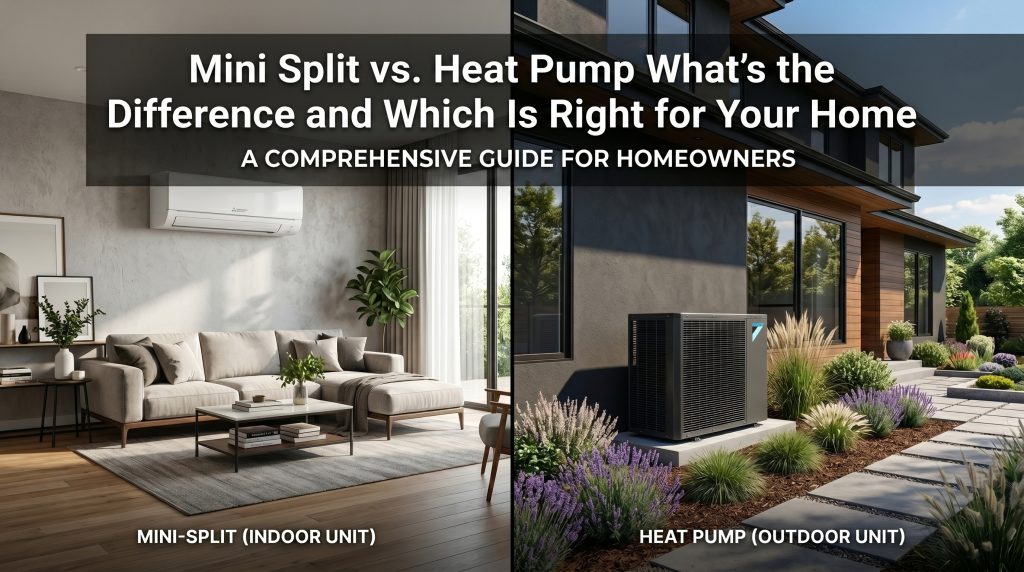
Here’s the key fact that resolves most of the confusion: a mini-split is a heat pump. Specifically, it’s a ductless heat pump. ‘Heat pump’ is the broader category of technology – any HVAC system that uses a refrigeration cycle and a reversing valve to both heat and cool a space by transferring heat rather than generating it.
Within that broader category, heat pumps come in two main delivery formats: ducted (central) systems that distribute air through ductwork, just like a traditional furnace and air conditioner, and ductless (mini-split) systems that deliver conditioned air directly into rooms through individual indoor units, with no ductwork involved.
So the real question most homeowners are actually asking isn’t ‘mini-split or heat pump’ – it’s ‘ducted heat pump or ductless heat pump (mini-split)?’ That’s the comparison this guide focuses on, since it’s the decision that actually affects your installation, your comfort, and your costs.
How Both Systems Work: The Shared Technology
Whether ducted or ductless, heat pumps rely on the same basic refrigeration cycle. A compressor, condenser coil, expansion valve, and evaporator coil work together with refrigerant to move heat from one place to another.
In winter, the system extracts heat from outdoor air – even cold air contains usable thermal energy – and moves it indoors. In summer, a reversing valve flips the cycle, pulling heat out of your indoor air and releasing it outside, just like a standard air conditioner. This is true for both a central ducted heat pump and a ductless mini-split; the underlying mechanism is identical.
The difference lies entirely in what happens after the heat is moved: a ducted system pushes conditioned air through ductwork and out through vents and registers, while a ductless mini-split delivers that conditioned air directly into the room through a wall-, ceiling-, or floor-mounted indoor unit.
Ducted Heat Pumps: How They Work and Where They Shine
A ducted (central) heat pump looks and functions much like a traditional central air conditioner combined with a furnace, except it can both heat and cool using the same equipment. It connects to your home’s existing duct system, distributing air through the same vents and registers you’re likely already familiar with.
Ducted heat pumps tend to make the most sense for homes that already have ductwork in good condition. In these cases, replacing an aging furnace and AC combo with a single ducted heat pump can be a relatively straightforward swap, often integrating with a familiar central thermostat setup.
The tradeoff is that the system’s performance is tied to the condition of your ductwork. Leaky, undersized, or poorly insulated ducts – especially those running through unconditioned attics, crawlspaces, or garages – can meaningfully reduce the efficiency the system actually delivers compared to its rated performance.
Ductless Mini-Splits: How They Work and Where They Shine
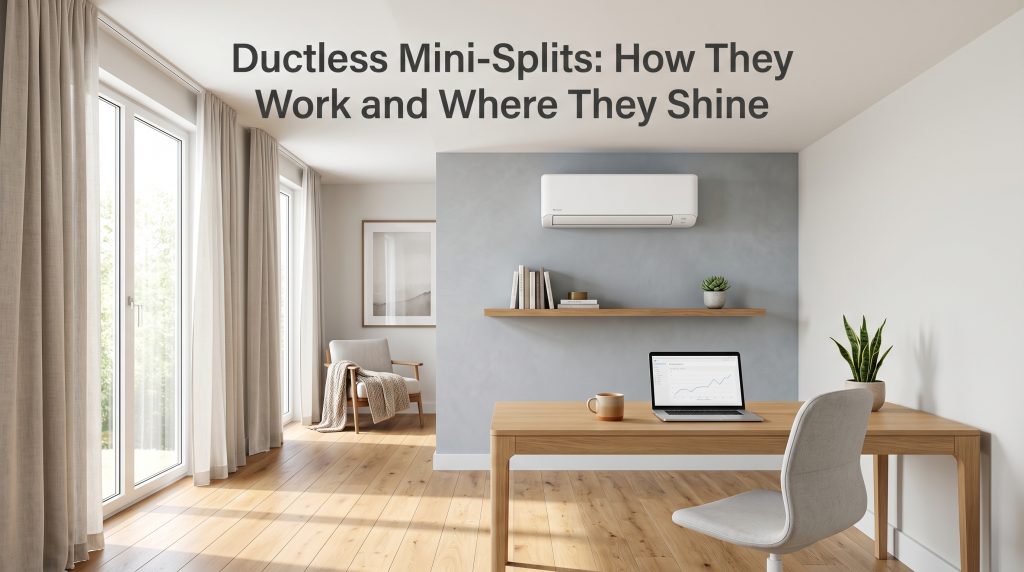
A ductless mini-split consists of an outdoor compressor/condenser unit connected to one or more indoor air-handling units, joined by refrigerant lines and electrical wiring run through a small wall penetration. There’s no ductwork involved at any point – each indoor unit conditions the room it’s installed in directly.
This makes mini-splits especially well-suited to:
- Older homes that were never built with ductwork
- Additions, converted garages, sunrooms, and finished basements that are difficult to connect to existing ducts
- Homes where zoned comfort – different temperatures in different rooms – is a priority
- Situations where avoiding the cost, mess, and space requirements of new ductwork is important
- Replacing inefficient, noisy window air conditioning units
Because mini-splits skip ductwork entirely, they also avoid the energy losses that come with it, which is one reason ductless systems often carry higher efficiency ratings than comparable ducted equipment. If you’re exploring whether a mini-split makes sense for your Worcester-area home, our team can walk through your space and goals.
Zoning: One of the Biggest Practical Differences
One of the most significant day-to-day differences between ducted heat pumps and mini-splits is zoning – the ability to heat or cool different areas of your home to different temperatures at the same time.
A standard ducted heat pump, like a traditional central system, generally conditions the whole home to a single thermostat setting unless paired with additional zoning dampers and controls. A multi-zone mini-split system, by contrast, is inherently zoned: each indoor unit can be set to its own temperature, so a home office can run cooler while a bedroom stays warmer, without any extra equipment.
For households where different family members have different comfort preferences, or where certain rooms (like a sunroom or finished attic) tend to run hotter or colder than the rest of the house, this built-in zoning capability is often one of the most appreciated features of a mini-split system.
Efficiency Comparison: Mini-Splits vs. Ducted Heat Pumps
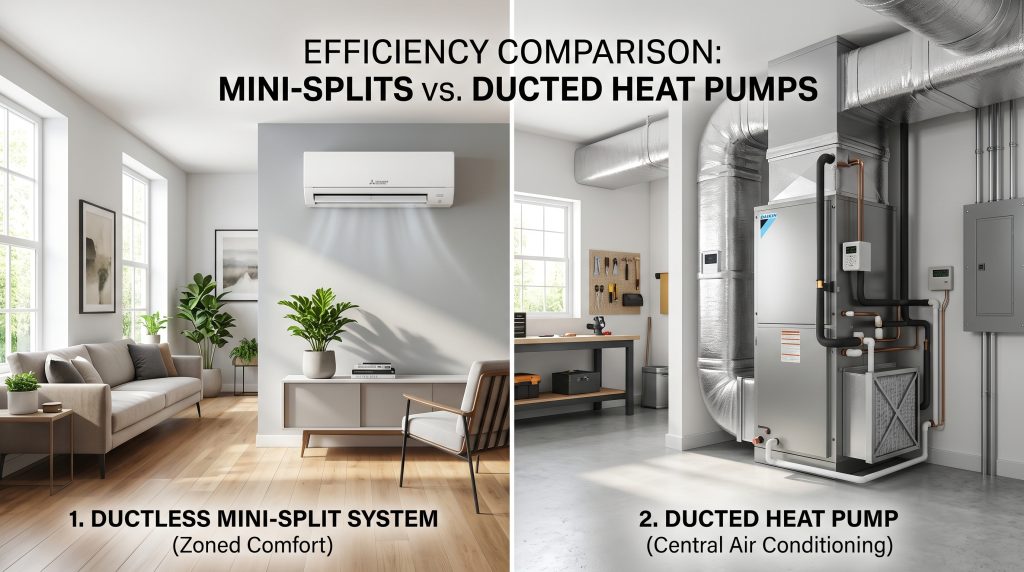
Both system types use the same core heat pump technology, and both can achieve high efficiency ratings (measured in SEER2 for cooling and HSPF2 for heating). However, mini-splits often have a structural efficiency advantage because they don’t lose energy to ductwork.
In a ducted system, conditioned air travels through ducts before reaching your living space – and any leaks, poor insulation, or heat transfer along the way represent lost efficiency, even if the equipment itself is highly rated. A mini-split delivers conditioned air directly to the room, eliminating this loss entirely.
That said, a well-designed ducted system with properly sealed, insulated, and sized ductwork can still perform very well. The practical takeaway is that for homes with poor or nonexistent ductwork, a mini-split often delivers more of its rated efficiency in real-world use – while a ducted system’s performance is only as good as the ducts it relies on.
Cost Considerations: Installation and Beyond
Installation costs depend heavily on your starting point. If your home already has ductwork in good condition, a ducted heat pump replacement can sometimes be installed at a comparable or lower upfront cost than a multi-zone mini-split system, since the distribution infrastructure already exists.
If your home doesn’t have ductwork – or has ductwork that would need significant repair or replacement to support a heat pump – installing new ducts can be expensive, invasive, and may reduce usable space (ductwork has to go somewhere). In these cases, a mini-split is often the more cost-effective path, since it avoids ductwork costs entirely.
Beyond installation, ongoing operating costs depend on the efficiency of the specific equipment, how well it’s sized for your home, and your usage patterns. For a personalized cost comparison based on your specific home, reach out for a consultation – our team can walk through both ducted and ductless options and what they’d realistically cost for your situation.
Aesthetics and Noise: What to Expect
Ducted heat pumps are largely invisible day-to-day – aside from vents and registers you’re likely already used to, the equipment itself is tucked away in a basement, attic, or utility closet, with a single outdoor unit outside.
Mini-splits have a more visible footprint: each zone has an indoor unit mounted on a wall, ceiling, or floor, in addition to the outdoor unit. Some homeowners view this as a minor tradeoff for the comfort and efficiency benefits; others prefer the more discreet look of a fully ducted system. Modern mini-split indoor units come in a range of styles, including slim wall-mounted units and ceiling-recessed cassettes that blend more seamlessly into a room’s design.
On noise, both system types – particularly variable-speed (inverter) models – tend to operate quietly. Mini-splits are often praised for especially quiet indoor operation, since the indoor unit contains only a fan (no ductwork-related airflow noise), while ducted systems can sometimes carry more noticeable airflow sounds through vents depending on duct design.
Cold-Climate Performance: What Matters for Massachusetts Homes
A common myth is that heat pumps – ducted or ductless – struggle in cold climates. That hasn’t been true of modern equipment for some time. Cold-climate-rated heat pumps, including many mini-split models, use variable-speed compressors and enhanced refrigerant management to maintain strong heating output even well below freezing.
For Massachusetts homeowners, the more important question than ‘ducted vs. ductless’ when it comes to winter performance is whether the specific equipment – whatever its delivery format – carries a cold-climate rating appropriate for New England winters. Our heat pump and mini-split installation services focus specifically on systems suited to Worcester-area winters.
Hybrid Approaches: You Don’t Always Have to Choose Just One
It’s worth noting that the decision isn’t always all-or-nothing. Many homeowners use a hybrid approach: keeping an existing ducted system for the main living areas while adding one or more mini-split zones for spaces that are difficult to serve with ductwork, such as additions, finished basements, or converted attics.
This approach can make sense when your existing ductwork is in reasonable shape and serves most of the home well, but certain rooms have always been too hot, too cold, or simply weren’t included in the original duct design. A single mini-split zone can solve a localized comfort problem without requiring a full system overhaul.
How to Decide: Mini-Split, Ducted Heat Pump, or Both?
There’s no universal right answer – the best choice depends on your specific home and priorities. A few questions can help narrow things down:
- Do you already have ductwork in good condition, or would a system require new or significantly repaired ducts?
- Is zoned comfort – different temperatures in different rooms – important to you, or is whole-home consistency preferred?
- Are there specific rooms or additions that your current system doesn’t serve well?
- How important are aesthetics – are you comfortable with visible indoor units, or do you prefer everything hidden behind vents?
- What’s your budget, and how does that compare between a ducted replacement and a ductless installation for your home’s layout?
Working through these questions with a professional who can assess your specific home – including your ductwork condition, square footage, and goals – is the most reliable way to land on the right answer. Get in touch with EddyTech Mini Splits Solutions for a consultation, or browse our full range of HVAC services to learn more about what’s involved.
The Bottom Line
To recap: a mini-split is a heat pump – specifically, a ductless one. The real decision most homeowners face is between a ducted (central) heat pump and a ductless (mini-split) heat pump, and the right choice depends on your home’s existing ductwork, your priorities around zoning and aesthetics, and your budget for installation.
Both options use the same efficient, electric heat pump technology, and both are capable of providing reliable heating and cooling year-round – including through Massachusetts winters – when properly sized, selected for cold-climate performance, and professionally installed.
If you’re in Worcester, MA or the surrounding communities – including Shrewsbury, Westborough, Auburn, Millbury, Grafton, Northborough, Marlborough, Hudson, Hopkinton, Leominster, or Fitchburg – and want help deciding between a mini-split and a ducted heat pump for your home, contact EddyTech Mini Splits Solutions LLC or call us at (774) 431-2298. You can also learn more about our team or explore more HVAC guides on our blog.
Frequently Asked Questions: Mini-Splits vs. Heat Pumps
Below are answers to common questions homeowners search for when comparing mini-splits and heat pumps.
Is a mini-split the same thing as a heat pump?
Yes, in most cases. A mini-split is technically a type of heat pump – specifically, a ductless heat pump. The terms are often used interchangeably, but ‘heat pump’ is the broader category, while ‘mini-split’ describes one ductless way of delivering heat pump technology.
What is the main difference between a mini-split and a central heat pump?
The main difference is ductwork. A central (ducted) heat pump distributes conditioned air through your home’s existing duct system, while a mini-split delivers air directly into each room through wall- or ceiling-mounted indoor units, with no ducts required.
Are all heat pumps ductless?
No. Heat pumps can be ducted (central systems that use ductwork like a traditional furnace and AC) or ductless (mini-splits). Both use the same basic refrigeration cycle to provide heating and cooling.
Are all mini-splits heat pumps?
Most residential mini-splits sold today are heat pumps, meaning they provide both heating and cooling. However, some mini-split models are cooling-only, so it’s worth confirming heating capability before purchasing.
Which is more efficient, a mini-split or a central heat pump?
Mini-splits often have an efficiency advantage because they avoid the energy losses associated with ductwork, especially ducts that run through unconditioned attics or crawlspaces. A central heat pump with well-sealed, properly sized ducts can still be highly efficient, but ductless systems tend to have an edge.
Can a mini-split heat an entire house?
It depends on the home. Multi-zone mini-split systems, which connect several indoor units to one outdoor unit, can effectively heat and cool an entire home, especially smaller to mid-sized homes or those with an open layout. Larger homes may need multiple outdoor units.
Is a mini-split cheaper to install than a central heat pump?
For homes that already have ductwork in good condition, a central heat pump may have a comparable or sometimes lower installation cost. For homes without ductwork, installing a mini-split is often significantly less expensive than adding new ductwork for a central system.
Do mini-splits work well in cold climates like Massachusetts?
Yes. Modern cold-climate mini-split heat pumps are specifically engineered with variable-speed compressors and enhanced refrigerant systems to maintain strong heating performance even in sub-freezing New England winters.
What does ‘zoned’ heating and cooling mean?
Zoned comfort means different areas (zones) of a home can be heated or cooled to different temperatures independently. Multi-zone mini-split systems excel at this, while traditional central heat pumps typically condition the whole home to a single thermostat setting unless paired with additional zoning equipment.
Can I add a mini-split to a home that already has central heating?
Yes. Many homeowners use a mini-split to supplement existing central heating – for example, to add cooling to a home that only has a furnace, or to condition an addition, sunroom, or finished basement that isn’t well served by the main system.
How many indoor units can connect to one mini-split outdoor unit?
It depends on the system, but multi-zone outdoor units commonly support multiple indoor air handlers – often ranging from two to five or more zones – depending on the outdoor unit’s capacity and the manufacturer’s specifications.
Do mini-splits require professional installation?
Yes. While some smaller DIY-marketed kits exist, a properly installed mini-split involves refrigerant line connections, electrical work, and precise charging that should be performed by a licensed HVAC professional to ensure performance, efficiency, and warranty coverage.
Is a ducted heat pump better for whole-home comfort?
A ducted heat pump can be a strong choice for whole-home comfort, particularly in homes that already have good-condition ductwork, since it can integrate with a single central thermostat and existing air distribution.
What is a ‘ductless heat pump’?
A ductless heat pump is another name for a mini-split system – it uses the same heat pump refrigeration cycle as a central system but delivers air directly to rooms through indoor units rather than through ductwork.
How long do mini-split systems last?
With regular maintenance, mini-split heat pumps commonly last 12 to 15 years or more, similar to the lifespan of central heat pump and air conditioning systems.
Are mini-splits noisy?
Modern mini-splits, especially variable-speed (inverter) models, are generally quiet, both indoors and outdoors, often operating at sound levels comparable to a quiet conversation or background noise.
Can mini-splits dehumidify a room?
Yes. As part of normal cooling operation, mini-splits remove humidity from indoor air, which can be a meaningful comfort benefit during humid Massachusetts summers.
What’s better for an older home without ductwork: mini-split or central heat pump?
For older homes without existing ductwork, a mini-split is often the more practical and cost-effective choice, since installing new ductwork for a central system can be invasive, expensive, and may reduce usable space.
Do mini-splits increase home value?
An efficient, modern heating and cooling system – including a well-installed mini-split – can be an attractive feature for buyers, particularly those concerned about energy costs, though it’s typically one factor among many in overall home value.
Can a mini-split replace my window air conditioners?
Yes. Many homeowners replace multiple window AC units with a multi-zone mini-split system, gaining quieter operation, better efficiency, year-round heating capability, and improved aesthetics since there’s no unit blocking the window.
What is the difference between single-zone and multi-zone mini-split systems?
A single-zone system connects one outdoor unit to one indoor unit, ideal for a single room. A multi-zone system connects one outdoor unit to multiple indoor units, allowing independent temperature control across several rooms or areas.
Do mini-splits need filters changed?
Yes. Mini-split indoor units have filters that should be cleaned or replaced regularly – often more frequently than central system filters – to maintain airflow, efficiency, and indoor air quality.
How much maintenance does a mini-split need compared to a central heat pump?
Both system types need regular filter care, outdoor unit clearing, and annual professional tune-ups. Mini-splits may require slightly more frequent filter cleaning due to their design, but generally avoid duct-related maintenance issues that central systems can have.
Can a heat pump (ducted or ductless) fully replace a furnace?
In many homes, yes. A properly sized cold-climate heat pump – whether ducted or a mini-split – can serve as the primary heating source, replacing a furnace entirely, though some homeowners in very cold climates choose to keep a backup heat source for extreme conditions.
What is an air handler in a mini-split system?
The air handler is the indoor component of a mini-split – it contains a coil and fan that either releases heat (in heating mode) or absorbs heat (in cooling mode) and circulates conditioned air directly into the room.
Do mini-splits work without electricity during a power outage?
No. Like central heat pumps and air conditioners, mini-splits require electricity to operate and will not function during a power outage unless connected to a backup generator or battery system.
Is a mini-split a good option for a home addition or garage conversion?
Yes. Mini-splits are commonly used for additions, converted garages, sunrooms, and other spaces that are difficult or costly to connect to existing ductwork, since they only require a small hole for refrigerant lines and electrical connections.
How is a mini-split installed?
Installation involves mounting an indoor air handler on a wall or ceiling, placing an outdoor compressor unit nearby, connecting them with refrigerant lines and electrical wiring through a small wall penetration, and then charging and commissioning the system.
Can mini-splits be used alongside solar panels?
Yes. Because mini-splits are fully electric and highly efficient, they pair well with solar panel systems, allowing homeowners to offset some or all of the electricity used for heating and cooling with on-site solar generation.
What’s the difference between a heat pump and an air conditioner?
An air conditioner only moves heat out of your home (cooling only). A heat pump includes a reversing valve that allows it to also move heat into your home, providing heating in addition to cooling – this applies to both ducted and ductless (mini-split) heat pumps.
Do mini-splits qualify for Mass Save rebates in Massachusetts?
Many ductless mini-split heat pumps qualify for Mass Save rebates, provided they meet specific efficiency requirements (SEER2 and HSPF2 thresholds). Checking current program details before purchasing helps confirm eligibility for your chosen model.
Are central heat pumps or mini-splits better for allergy sufferers?
Mini-splits can be advantageous for allergy sufferers because they don’t rely on ductwork, which can accumulate dust, allergens, and debris over time. Central systems can still provide good air quality with proper duct maintenance and filtration.
What size mini-split do I need for a room?
Sizing depends on the room’s square footage, insulation, ceiling height, window area, and orientation – not square footage alone. A professional load calculation helps determine the correct BTU capacity for each zone.
Can I control each mini-split zone with a separate thermostat?
Yes. Each indoor unit in a multi-zone mini-split system typically has its own remote control or thermostat, allowing independent temperature settings for each zone.
Is it more expensive to run a mini-split or a central heat pump?
Operating costs depend on efficiency ratings, usage patterns, and how well each system is matched to the home. Mini-splits often have higher SEER2 ratings due to the absence of duct losses, which can translate into lower operating costs in many cases.
What’s a ‘reversing valve’ and why does it matter?
A reversing valve is the component that allows a heat pump – whether ducted or ductless – to switch between heating and cooling modes by reversing the direction of refrigerant flow. It’s the key feature that distinguishes a heat pump from a cooling-only air conditioner.
Can a mini-split be installed in just one room while keeping central heat for the rest of the house?
Yes. This is a common hybrid approach – using a mini-split to add efficient heating and cooling to a specific room (like a converted attic, home office, or addition) while the rest of the home continues using its existing central system.
Do mini-splits require outdoor space for the compressor unit?
Yes. Mini-split systems require an outdoor compressor unit, typically mounted on a pad, bracket, or the exterior wall, with adequate clearance for airflow and maintenance access.
How close does the outdoor unit need to be to the indoor unit?
Refrigerant line length limits vary by manufacturer and model, but many residential mini-splits can support line runs of 25 feet or more between indoor and outdoor units, with some systems supporting significantly longer runs depending on design.
What’s the typical lifespan difference between mini-splits and central heat pumps?
Both system types generally have similar lifespans – commonly 12 to 15 years or more with proper maintenance – though actual longevity depends more on installation quality, usage, and maintenance than on whether the system is ducted or ductless.
Can mini-splits be mounted on the ceiling instead of the wall?
Yes. In addition to wall-mounted units, mini-split indoor units are also available in ceiling-recessed (cassette) and floor-mounted configurations, offering flexibility for different room layouts and aesthetic preferences.
Is a geothermal heat pump the same as a mini-split?
No. A geothermal (ground-source) heat pump exchanges heat with the ground rather than outdoor air and is typically a ducted system. A mini-split is an air-source ductless heat pump. Both are types of heat pumps but use different heat sources and distribution methods.
Do mini-splits cool as well as traditional central air conditioning?
Yes, when properly sized and installed, mini-splits can cool effectively – and in many cases more efficiently than central AC – though the experience may feel different since cooled air comes directly from wall or ceiling units rather than ceiling or floor vents.
What’s the advantage of a multi-zone mini-split over multiple single-zone units?
A multi-zone system uses one outdoor unit to serve multiple indoor units, which can be more space-efficient and sometimes more cost-effective than installing several separate single-zone systems, while still allowing independent zone control.
Can a mini-split be too big for a room?
Yes. An oversized mini-split can cycle on and off too frequently, leading to temperature swings, reduced efficiency, and poor dehumidification – proper sizing through a load calculation helps avoid this.
Do ducted heat pumps lose efficiency through duct leaks?
Yes. Leaky, poorly sealed, or poorly insulated ductwork – especially ducts running through attics, crawlspaces, or garages – can significantly reduce the efficiency a ducted heat pump delivers compared to its rated performance.
What is a ‘hyper-heat’ or ‘cold climate’ mini-split?
These terms refer to mini-split heat pump models specifically engineered to maintain strong heating output and efficiency at low outdoor temperatures, often rated for effective operation well below freezing – an important consideration for Massachusetts winters.
Can I use a mini-split as my only heating source in Massachusetts?
Many homeowners do use cold-climate mini-splits as their primary or sole heating source, though some choose to retain a backup heat source for extremely cold days or as a redundancy, depending on the specific system and home.
How does humidity control compare between mini-splits and central systems?
Both system types dehumidify as part of normal cooling operation. Variable-speed mini-splits, which run longer at lower capacities, can sometimes provide more consistent dehumidification compared to single-stage central systems that cycle on and off.
Is professional sizing important for both mini-splits and central heat pumps?
Yes. Proper sizing through a load calculation is important for both system types – undersized systems struggle to keep up with demand, while oversized systems cycle inefficiently and may not dehumidify well, regardless of whether the system is ducted or ductless.
What’s the difference between a ‘heat pump’ and an ‘air-source heat pump’?
An air-source heat pump is the most common type of heat pump, exchanging heat with outdoor air. Both central ducted heat pumps and mini-splits are typically air-source heat pumps, distinguished from water-source or ground-source (geothermal) systems.
Can mini-splits be installed in a finished basement?
Yes. Mini-splits are a popular choice for finished basements, which often lack adequate ductwork connections or have heating and cooling needs that differ from the rest of the home.
Do mini-splits and central heat pumps use the same refrigerant?
Many modern systems use similar refrigerant types, though specific refrigerants can vary by manufacturer, model, and production year. It’s worth confirming refrigerant type with your installer, especially regarding rebate eligibility.
What’s the difference in aesthetics between mini-splits and central systems?
Central heat pumps are largely hidden, with only vents visible inside the home and a single outdoor unit. Mini-splits have visible indoor units mounted on walls or ceilings in each zone, along with an outdoor unit, which some homeowners weigh as a design consideration.
Can a mini-split be connected to a smart thermostat or app?
Many modern mini-split systems offer app-based controls or compatibility with smart home systems, allowing remote temperature adjustments and scheduling, in addition to the included remote control.
Is it possible to convert a central heat pump system to mini-splits?
Yes, though it involves removing or decommissioning the central system and installing new ductless equipment. Some homeowners choose a hybrid approach instead, keeping central ductwork for part of the home and adding mini-splits elsewhere.
How do I decide between a mini-split and a central heat pump for my home?
Key factors include whether you already have functional ductwork, whether you want zoned temperature control, your budget for installation, the layout of your home, and your priorities around efficiency, aesthetics, and noise.
Do both mini-splits and central heat pumps require the same permits?
In most Massachusetts municipalities, both ducted and ductless heat pump installations typically require permits and inspections, which a licensed installer usually handles as part of the project.
Are mini-splits a good fit for multi-family or rental properties?
Yes. Multi-zone or multiple single-zone mini-split systems are commonly used in multi-family properties because they allow each unit or room to be metered and controlled independently without shared ductwork.
Can I get a professional recommendation on mini-split vs. heat pump for my Worcester home?
Yes. A local HVAC provider familiar with Massachusetts homes, climate, and current Mass Save program details can assess your specific layout, ductwork situation, and goals to recommend whether a mini-split, central heat pump, or hybrid approach is the best fit.
Ready to Compare Your Options?
Whether you’re leaning toward a ducted heat pump, a ductless mini-split, or a hybrid setup, the team at EddyTech Mini Splits Solutions LLC can help you make the right call for your Worcester-area home. We provide expert mini-split and heat pump installation, maintenance, and repair services.
Visit our homepage to learn more, check out our blog for more HVAC guides and tips, or contact our team to schedule your consultation. You can also reach us by phone at (774) 431-2298.
Further Reading
For additional independent information on heat pump and mini-split technology, see ENERGY STAR’s guidance on air-source heat pumps, the U.S. Department of Energy’s heat pump systems overview, and Mass Save’s incentive programs.