
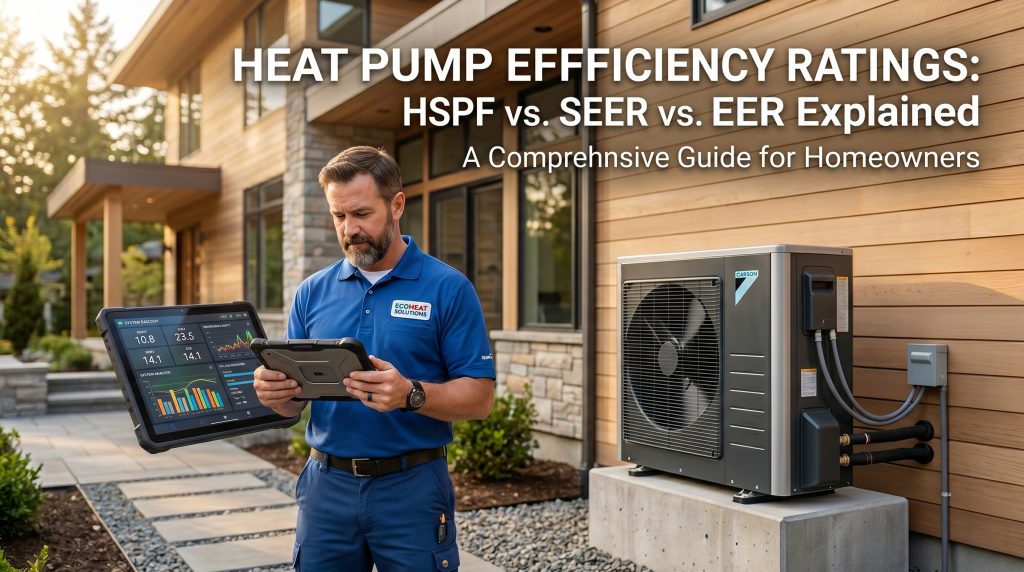
Heat Pump Efficiency Ratings: HSPF vs. SEER vs. EER Explained
If you’ve started shopping for a new heating and cooling system, you’ve probably run into a wall of acronyms: SEER, SEER2, HSPF, HSPF2, EER, EER2, and sometimes COP. These ratings can look intimidating, but they’re actually one of the most useful tools you have for comparing heat pumps before you buy. Understanding what each rating measures — and which ones matter most for a Worcester, Massachusetts home — can help you avoid overpaying for efficiency you won’t use, or underbuying a system that struggles through a New England winter.
In this guide, we’ll break down HSPF, SEER, and EER (plus their newer “2” versions), explain how the U.S. Department of Energy uses them, and show you how to apply these numbers to a real-world ductless mini split heat pump installation in Worcester.
What Is SEER (Seasonal Energy Efficiency Ratio)?
SEER stands for Seasonal Energy Efficiency Ratio, and it measures the cooling efficiency of an air conditioner or heat pump over an entire cooling season. As one HVAC resource explains, SEER is calculated by taking the system’s total cooling output over a typical cooling season and dividing it by the total energy consumed. The higher the SEER number, the more cooling you get per unit of electricity.
According to one 2026 efficiency guide, SEER ratings typically range from about 13 to 26, with higher numbers representing more efficient equipment. For context, a SEER 16 unit produces 16 BTUs of cooling for every watt-hour of electricity it uses — the higher that number, the lower your cooling costs tend to be over the life of the system.
It’s worth noting that SEER only applies to cooling. As one source points out, SEER ratings don’t have anything to do with heating, which is why they don’t apply to furnaces. For a heat pump, which both heats and cools, SEER tells you only half the story.
What Is HSPF (Heating Seasonal Performance Factor)?
HSPF stands for Heating Seasonal Performance Factor, and it’s essentially the heating-mode counterpart to SEER. As one industry overview puts it, HSPF measures how efficiently a heat pump warms your home over a typical heating season, and just like SEER, a higher number means greater efficiency.
HSPF is calculated by dividing the total heat output delivered over the heating season by the total electricity consumed to produce it. The same source notes that an HSPF rating of 8 or higher is generally considered efficient, and a high HSPF translates directly into lower winter electric bills — which matters a great deal in a cold-climate market like Worcester.
For Massachusetts homeowners, HSPF is arguably the most important of the three ratings, because our heating season is long and our winters are demanding. A heat pump with strong cooling efficiency but a weak HSPF could end up costing more to run overall once you factor in five or six months of New England heating.
What Is EER (Energy Efficiency Ratio)?
EER stands for Energy Efficiency Ratio, and unlike SEER, it isn’t a seasonal average — it’s a snapshot. One technical overview explains that EER is mainly used by technicians to get real-time performance data without accounting for seasonal temperature changes, and the higher the EER, the less energy the system consumes at that specific test condition.
Specifically, EER measures cooling efficiency at a fixed outdoor temperature, typically 95°F. As one HVAC company describes it, EER measures cooling efficiency at a specific outdoor temperature and is particularly useful in regions where extreme heat is common, since it shows exactly how the system performs on the hottest days of the year.
For most Worcester homeowners, EER is a secondary consideration — useful for comparing peak-day performance between similar systems, but less impactful than SEER2 and HSPF2 for our climate, where extended cooling at 95°F+ is far less common than in the Southwest or Southeast.
SEER2, HSPF2, and EER2: What Changed in 2023?
If you’ve seen ratings with a “2” attached — SEER2, HSPF2, EER2 — that’s not a typo or a marketing gimmick. As one HVAC resource explains, the Department of Energy changed the rating system from SEER, EER, and HSPF to SEER2, EER2, and HSPF2 to better reflect real-world performance.
The change came down to testing methodology. According to one regulatory overview, the new M1 test procedure uses external static pressures up to five times higher than the older test method, which more accurately mirrors how a system performs once it’s connected to real ductwork, filters, and registers — not a lab bench. Because the new test is more demanding, SEER2 and HSPF2 numbers are generally lower than the old SEER and HSPF numbers for equivalent equipment.
As of January 1, 2023, every newly manufactured system sold in the U.S. must be rated using SEER2, EER2, and HSPF2 — the older ratings are now effectively legacy figures used mainly for comparing against older installed equipment.
Old vs. New Rating Comparison
| Old Rating (Pre-2023) | New Rating (2023+) | What It Measures |
| SEER | SEER2 | Seasonal cooling efficiency |
| HSPF | HSPF2 | Seasonal heating efficiency |
| EER | EER2 | Peak-condition cooling efficiency (95°F) |
| 14.0 SEER / 8.0 HSPF (split system minimum) | 13.4 SEER2 / 6.7 HSPF2 | Approximate equivalent minimums |
| 15.0 SEER / 8.8 HSPF (split heat pump minimum, all regions) | 14.3 SEER2 / 7.5 HSPF2 | Current national minimum for split heat pumps |
These figures reflect the national minimums described in current industry resources, including one overview noting that all split-system heat pumps must now achieve at least 14.3 SEER2 and 7.5 HSPF2, equivalent to roughly 15.0 SEER and 8.8 HSPF under the old test method. Regional minimums can vary slightly, and the Southwest region carries an additional EER2 requirement that doesn’t apply in Massachusetts.
Why These Ratings Matter for Worcester, MA Homeowners
Worcester sits squarely in the DOE’s “North” climate region, which is defined by long, cold winters and moderate summers. That has a direct impact on which rating should carry the most weight in your decision:
- HSPF2 should be a top priority. Because our heating season is long, even small differences in HSPF2 compound into meaningful savings over a Massachusetts winter.
- SEER2 still matters, but less dramatically. Worcester summers are warm but not extreme, so the gap between a SEER2 14.3 system and a SEER2 18+ system in cooling costs is smaller than it would be in Georgia or Arizona.
- EER2 is a nice-to-have, not a must-have. Peak 95°F days are relatively rare in Central Massachusetts, so EER2 differences have less impact on your annual bill than they would in a hot, dry climate.
For a deeper look at how equipment efficiency affects your specific costs, see our guide on lowering energy bills in Worcester, Massachusetts.
HSPF2 and Cold-Climate Performance
HSPF2 is calculated using a range of outdoor temperatures, but it’s a seasonal average — it doesn’t tell you exactly how a unit performs at, say, 5°F. That’s where the Coefficient of Performance, or COP, comes in. As one technical guide explains, COP is a ratio of energy consumed to heating output, and manufacturers typically specify COP at 47°F, 32°F, 17°F, and 5°F.
If you’re comparing two heat pumps with similar HSPF2 ratings, checking the manufacturer’s COP chart at low temperatures can reveal real differences in cold-weather performance — information that’s especially relevant for a Worcester winter. When you’re ready to compare specific systems for your home, our team can walk through these specs as part of a free consultation and estimate.
Efficiency Ratings, Rebates, and Incentives
Efficiency ratings aren’t just about your utility bill — they often determine whether a system qualifies for rebates or tax credits. One 2026 guide notes that for the federal Section 25C credit on heat pump systems (where applicable), qualifying split systems generally needed SEER2 of 16 or higher, EER2 of 12 or higher, and HSPF2 of 9 or higher. It’s worth noting that the federal 25C heat pump tax credit expired at the end of 2025, so homeowners should verify current federal incentive status before budgeting.
At the state level, Massachusetts homeowners may still have access to Mass Save incentives, which carry their own equipment eligibility requirements — including a 2026 whole-home rebate cap of $8,500 and the exclusion of R-410A refrigerant systems from current eligibility. Because these programs change periodically, confirming current requirements before purchasing is essential. If you’re researching system costs alongside efficiency ratings, our Worcester heat pump installation cost guide is a good starting point.
How to Use These Ratings When Shopping for a Heat Pump
- Don’t chase the highest number blindly. One 2026 analysis found that in cooler climates with fewer than 1,000 cooling hours per year — like much of Massachusetts — the savings from going above SEER2 17 rarely justify the price premium.
- Prioritize HSPF2 for Worcester’s climate. Since heating dominates your energy use here, a strong HSPF2 rating typically delivers more real-world savings than a marginal SEER2 upgrade.
- Check Energy Star certification. Energy Star-certified equipment meets higher efficiency thresholds and is often a prerequisite for rebate programs.
- Calculate payback period. Compare the upfront price difference between efficiency tiers against your estimated annual savings to find your break-even point.
- Get a professional load calculation. An oversized or undersized system — regardless of its rating — won’t deliver its rated efficiency in real use.
Final Thoughts
SEER, HSPF, and EER (and their SEER2/HSPF2/EER2 successors) each tell a different part of the efficiency story. SEER2 covers seasonal cooling, HSPF2 covers seasonal heating, and EER2 covers peak-day cooling performance. For Worcester homeowners, HSPF2 deserves the most attention given our long heating season, while SEER2 and EER2 remain useful for comparing overall system quality.
If you’re ready to compare specific heat pump models and efficiency ratings for your Worcester home, the team at EddyTech Mini Splits Solutions LLC offers free, no-pressure consultations across Worcester and Central Massachusetts. Contact us today to schedule your free estimate, or call us directly at (774) 431-2298.
100 Frequently Asked Questions About HSPF, SEER, and EER Ratings
The following FAQs answer common search questions about heat pump efficiency ratings. For installation-specific questions, see our main Worcester mini split installation page.
1. What does SEER stand for?
SEER stands for Seasonal Energy Efficiency Ratio, a measurement of an air conditioner or heat pump’s cooling efficiency over a typical cooling season.
2. What is a good SEER rating for a heat pump?
Ratings of 16 or higher are generally considered efficient for most climates, though what counts as ‘good’ depends on your local energy costs and cooling hours.
3. What is the minimum SEER rating allowed by law?
As of 2023, split-system heat pumps must meet a minimum of 14.3 SEER2, equivalent to roughly 15.0 SEER under the old testing method.
4. Is a higher SEER rating always better?
A higher SEER generally means better cooling efficiency, but the added upfront cost may not be worth it in climates with fewer cooling hours, like New England.
5. How is SEER calculated?
SEER is calculated by dividing the total cooling output over a season (in BTUs) by the total electricity consumed (in watt-hours) during that same period.
6. Does SEER apply to furnaces?
No. SEER measures cooling efficiency only, so it doesn’t apply to furnaces, which only provide heat.
7. What SEER rating do most new heat pumps have?
Most new heat pumps fall in the 15 to 22 SEER2 range, with premium variable-speed systems reaching higher numbers.
8. Can a low SEER rating still cool a home effectively?
Yes, a lower SEER system can still cool a home adequately if properly sized, but it will use more electricity to do so compared to a higher-rated unit.
9. Does SEER rating affect humidity control?
Higher SEER2 systems often run longer at lower speeds, which can improve dehumidification compared to older single-stage systems.
10. How often do SEER ratings change due to regulations?
Federal minimum efficiency standards are updated periodically by the Department of Energy, with the most recent major change taking effect in 2023.
11. What is the highest SEER rating available?
Some premium residential systems reach SEER2 ratings in the low-to-mid 20s, though these are typically the most expensive options.
12. Does a higher SEER rating mean a quieter system?
Not directly, but high-SEER systems often use variable-speed compressors, which tend to run more quietly than older single-stage units.
13. Is SEER2 lower than SEER for the same unit?
Yes, because SEER2 uses a more demanding test procedure with higher external static pressure, SEER2 numbers are generally lower than SEER numbers for equivalent equipment.
14. When did SEER2 become mandatory?
SEER2 became the mandatory rating standard for newly manufactured equipment starting January 1, 2023.
15. Can I still buy a unit rated only in SEER, not SEER2?
No, all newly manufactured central air conditioners and heat pumps sold after the transition must be rated using SEER2, though older SEER-rated inventory built before 2023 may still be installed in some cases.
16. Does SEER rating impact resale value of a home?
Energy-efficient HVAC equipment, including higher-SEER systems, is generally viewed favorably by buyers, though it’s typically one of many factors in a home’s value.
17. What’s the difference between SEER and SEER2 numerically?
SEER2 values are generally lower than SEER values for the same physical equipment due to the more rigorous 2023 testing procedure.
18. Do ductless mini splits have different SEER ratings than central systems?
Ductless mini splits are subject to national minimum efficiency levels and are tested and rated using SEER2 just like ducted systems, though typical ranges can differ by product line.
19. Is SEER rating the same for cooling and heating?
No, SEER measures cooling only; heating efficiency for heat pumps is measured separately using HSPF.
20. How does duct condition affect real-world SEER performance?
Leaky or poorly insulated ducts can reduce a system’s real-world efficiency well below its rated SEER2, since conditioned air is lost before reaching living spaces.
21. What does HSPF stand for?
HSPF stands for Heating Seasonal Performance Factor, a measurement of a heat pump’s heating efficiency over a typical heating season.
22. What is a good HSPF rating?
An HSPF rating of 8 or higher is generally considered efficient, with higher numbers indicating better heating performance per unit of electricity.
23. What is the minimum HSPF rating required by law?
As of 2023, split-system heat pumps must meet a minimum of 7.5 HSPF2, equivalent to roughly 8.8 HSPF under the old testing method.
24. How is HSPF calculated?
HSPF is calculated by dividing the total heat output over a heating season (in BTUs) by the total electricity consumed (in watt-hours) during that period.
25. Why is HSPF important in cold climates?
In regions with long heating seasons, like Massachusetts, a higher HSPF translates into significant cumulative savings on winter electric bills.
26. What is HSPF2?
HSPF2 is the updated heating efficiency rating introduced in 2023, calculated using a more rigorous test procedure that better reflects real-world ductwork conditions.
27. Is HSPF2 lower than HSPF for the same unit?
Yes, similar to SEER2, HSPF2 values are generally lower than HSPF values for the same equipment due to the updated 2023 test method.
28. Does HSPF rating account for very cold temperatures?
HSPF and HSPF2 are seasonal averages across a range of temperatures; for performance at specific cold temperatures, check the manufacturer’s COP data.
29. What is COP and how does it relate to HSPF?
COP, or Coefficient of Performance, measures heating efficiency at a specific outdoor temperature, while HSPF is a seasonal average across many temperatures.
30. What COP rating is considered good for cold climates?
A COP of around 2.0 or higher at very low temperatures (such as 5°F) is generally considered solid performance for a cold-climate heat pump.
31. Can a heat pump have a high SEER but low HSPF?
Yes, cooling and heating efficiency are tested and rated separately, so it’s possible for a system to excel in one area and be average in the other.
32. Does HSPF apply to air conditioners?
No, HSPF only applies to heat pumps, since standard air conditioners don’t provide heating.
33. How does HSPF affect my winter electric bill?
A higher HSPF rating means the heat pump produces more heat per unit of electricity, which generally reduces your winter electricity consumption and costs.
34. What HSPF rating is typical for cold-climate heat pumps?
Many cold-climate heat pumps designed for northern markets have HSPF2 ratings in the 8 to 10+ range, though specific numbers vary by model.
35. Does altitude affect HSPF performance?
HSPF ratings are based on standardized test conditions; real-world performance at significant altitude may vary slightly due to differences in air density.
36. Is HSPF2 mandatory for all heat pumps sold today?
Yes, all newly manufactured heat pumps sold in the U.S. since 2023 must be rated using HSPF2.
37. Can I convert an old HSPF rating to HSPF2?
Manufacturers and industry resources often provide approximate conversion figures, though exact conversions can vary by specific model and testing conditions.
38. Does a higher HSPF mean less wear on the compressor?
Not necessarily directly, but many high-HSPF systems use variable-speed compressors designed for long-duration, lower-stress operation.
39. Why do some heat pumps need backup heat despite a high HSPF?
HSPF measures average seasonal efficiency; in extreme cold, a heat pump’s heating capacity may decline, which is why some installations include backup heat for the coldest days.
40. Does HSPF rating affect how a heat pump performs during defrost cycles?
HSPF accounts for typical seasonal performance including defrost behavior, but real-world defrost frequency depends on local humidity and temperature conditions.
41. What does EER stand for?
EER stands for Energy Efficiency Ratio, a measurement of cooling efficiency at a specific, fixed outdoor temperature, typically 95°F.
42. How is EER different from SEER?
EER is a single-point measurement at peak conditions, while SEER is a seasonal average across a range of temperatures throughout the cooling season.
43. What is a good EER rating?
EER ratings above 11 to 12 are generally considered efficient for peak-condition cooling performance.
44. Why does EER matter in hot climates?
EER is especially useful in hot regions because it shows how efficiently a system performs during extended periods of extreme heat.
45. Is EER important for Massachusetts homeowners?
EER is less critical in Massachusetts than in hot southern climates, since extended 95°F+ days are relatively rare in Central Massachusetts.
46. What is EER2?
EER2 is the updated peak-condition cooling efficiency rating introduced alongside SEER2 and HSPF2 in 2023, using the same more rigorous testing procedure.
47. Do all regions require an EER2 rating?
No, the Southwest region has additional EER2 requirements for certain equipment, while other regions, including the North, do not have the same EER2 mandate.
48. Can EER help me compare two similar SEER-rated units?
Yes, if two units have similar SEER2 ratings, comparing their EER2 can reveal which one performs better specifically on the hottest days.
49. Does EER tell you about heating performance?
No, EER measures cooling efficiency only and has no bearing on a heat pump’s heating performance.
50. Is EER tested at a single humidity level?
EER testing uses standardized conditions, including a specified outdoor temperature and humidity level, to ensure consistent comparisons between units.
51. How does EER relate to a system’s energy bill in summer?
A higher EER means the system uses less electricity during the hottest part of the day, which can meaningfully reduce peak-season cooling costs.
52. Do ductless mini splits have published EER ratings?
Many manufacturers publish EER or EER2 ratings for ductless mini splits, especially for models marketed toward hot-climate regions.
53. Is EER used for commercial HVAC systems too?
Yes, EER and related ratings are commonly used to evaluate commercial cooling equipment performance under peak-load conditions.
54. Can a system have a high SEER2 but low EER2?
It’s possible, since SEER2 reflects seasonal averages while EER2 reflects a single peak condition; the two ratings emphasize different performance aspects.
55. Should I prioritize EER2 when buying a heat pump in Worcester?
For most Worcester homes, EER2 is a secondary consideration compared to HSPF2, which more directly affects costs during our long heating season.
56. Why did the ratings change to SEER2, HSPF2, and EER2?
The Department of Energy updated the testing procedure in 2023 to better reflect real-world performance with ductwork, filters, and other field conditions.
57. When did the new testing standards take effect?
The new M1 testing procedure and associated SEER2, EER2, and HSPF2 ratings became mandatory for newly manufactured equipment starting January 1, 2023.
58. Are SEER2 numbers always lower than SEER numbers?
Generally yes, because the new test procedure uses higher external static pressure, which tends to reduce the resulting efficiency figures compared to the older method.
59. What are the national minimum requirements for heat pumps under the new standards?
Split-system heat pumps must meet a minimum of approximately 14.3 SEER2 and 7.5 HSPF2 regardless of region.
60. Do single-packaged heat pumps have different minimums?
Yes, single-packaged heat pumps generally have a lower minimum requirement, around 13.4 SEER2 and 6.7 HSPF2.
61. What are the three DOE efficiency regions?
The Department of Energy divides the country into North, Southeast, and Southwest regions, each with its own minimum efficiency requirements for certain equipment.
62. Which region is Massachusetts in?
Massachusetts falls within the DOE’s North region, which is defined by colder climates and longer heating seasons.
63. Does the North region have an EER2 requirement?
No, the additional EER2 requirement applies specifically to the Southwest region, not the North region where Massachusetts is located.
64. Can I still install equipment manufactured before 2023?
Existing inventory manufactured before the 2023 deadline may, in some cases, still be installed depending on regional sell-through rules, though new manufacturing must meet SEER2/HSPF2/EER2 standards.
65. Do SEER2 and HSPF2 ratings appear on the same product label?
Yes, modern equipment labels and Energy Guide stickers typically display SEER2, EER2, and HSPF2 ratings together for heat pumps.
66. How can I find the SEER2/HSPF2 rating of a specific model?
Manufacturer spec sheets, AHRI directory listings, and Energy Guide labels are common sources for a model’s official SEER2, EER2, and HSPF2 ratings.
67. What is the AHRI directory?
The AHRI (Air-Conditioning, Heating, and Refrigeration Institute) directory is a database where certified equipment ratings, including SEER2 and HSPF2, can be verified.
68. Does upgrading to SEER2-rated equipment require new ductwork?
Not necessarily, but because the new testing reflects different airflow conditions, some installations may need adjustments to ductwork or air handlers for optimal performance.
69. Will my existing SEER-rated system stop working after 2023?
No, existing installed systems continue operating normally; the 2023 changes affect ratings and standards for newly manufactured equipment, not equipment already in service.
70. Is it worth replacing an older SEER system early to get SEER2 equipment?
This depends on your current system’s age, condition, and efficiency compared to available rebates and long-term energy savings; a professional assessment can help determine the right timing.
71. How do I choose the right efficiency rating for my home?
Consider your climate’s heating and cooling hours, local energy rates, your budget, and available rebates to find the efficiency tier with the best return on investment.
72. Is it worth paying extra for a higher SEER2 rating in New England?
For homes with limited cooling hours, the payback period for very high SEER2 ratings can be long; HSPF2 often offers better value in our climate.
73. What’s more important for Worcester: SEER2 or HSPF2?
HSPF2 is generally more important for Worcester homeowners given the region’s long heating season and relatively moderate summers.
74. Do efficiency ratings affect heat pump installation cost?
Yes, higher-rated equipment, especially variable-speed systems, typically costs more upfront, though it may offer long-term operating savings.
75. Can a contractor help me calculate payback period for different ratings?
Yes, a qualified HVAC contractor can compare equipment options and estimate how long it would take for energy savings to offset a higher upfront cost.
76. Does Energy Star certification relate to these ratings?
Yes, Energy Star certification requires equipment to meet or exceed certain SEER2, EER2, and HSPF2 thresholds beyond the federal minimums.
77. Are variable-speed heat pumps always higher rated?
Variable-speed compressors often achieve higher SEER2 and HSPF2 ratings than single-stage equipment, though ratings still vary by specific model and brand.
78. Do efficiency ratings affect noise levels?
Not directly, but higher-efficiency variable-speed systems often run at lower speeds more often, which can result in quieter operation.
79. Can poor installation reduce a system’s rated efficiency?
Yes, improper sizing, refrigerant charge issues, or duct problems can prevent a system from achieving its rated SEER2, EER2, or HSPF2 in real-world use.
80. How often should efficiency ratings be checked when comparing quotes?
Every time you compare HVAC quotes, it’s worth confirming the SEER2, EER2, and HSPF2 ratings of each proposed system, since these directly affect long-term costs.
81. Do higher-rated systems require more maintenance?
Higher-efficiency systems, especially those with variable-speed components, may have specific maintenance recommendations, but routine care requirements are generally similar across efficiency tiers.
82. Can I retrofit an old system to improve its SEER or HSPF rating?
Generally no — efficiency ratings are tied to the system’s certified design as a whole, so achieving a different rating typically requires replacing major components or the entire system.
83. Does climate zone affect which ratings I should focus on?
Yes, homes in colder regions should weight HSPF2 more heavily, while homes in hot regions may prioritize SEER2 and EER2.
84. What is the relationship between BTUs and efficiency ratings?
BTUs measure heating or cooling capacity (how much heat is moved), while efficiency ratings like SEER2 and HSPF2 measure how much electricity is used to move that heat.
85. Can a smaller, higher-rated system outperform a larger, lower-rated one?
In some cases, a properly sized high-efficiency system can deliver better comfort and lower costs than an oversized, lower-efficiency unit, but proper load calculation is essential either way.
86. Do these ratings apply to geothermal heat pumps?
Geothermal systems use different rating metrics, such as EER and COP specific to ground-source equipment, rather than the SEER2/HSPF2 standards used for air-source systems.
87. Are ductless mini splits generally more efficient than central systems?
Ductless mini splits can achieve high efficiency ratings partly because they avoid duct losses, though efficiency still depends on the specific model and installation quality.
88. How long does it take to recoup the cost of a higher-efficiency system?
Payback periods vary widely based on the price difference, local energy rates, and usage patterns; a contractor can provide a home-specific estimate.
89. Do efficiency ratings change as equipment ages?
A system’s certified rating reflects its performance when new; efficiency can decline over time due to wear, refrigerant loss, or lack of maintenance.
90. Where can I get a personalized recommendation for my Worcester home?
EddyTech Mini Splits Solutions offers free consultations to assess your home’s heating and cooling needs and recommend equipment with appropriate efficiency ratings.
91. What areas does EddyTech serve for heat pump installation?
EddyTech serves Worcester and Central Massachusetts communities including Shrewsbury, Westborough, Northborough, Grafton, Auburn, Millbury, Marlborough, Hudson, Leominster, Fitchburg, and Hopkinton.
92. Does EddyTech install high-efficiency cold-climate heat pumps?
EddyTech specializes in ductless mini split systems suited to Worcester’s climate; contact us to discuss specific model options and their efficiency ratings.
93. Can EddyTech help me understand Mass Save rebate eligibility based on ratings?
EddyTech can help explain how equipment ratings relate to current incentive program requirements as part of your consultation.
94. Does EddyTech provide written quotes that include efficiency ratings?
Yes, EddyTech provides written estimates that detail the proposed equipment, including relevant specifications for your review.
95. How quickly can EddyTech schedule a consultation?
Consultations and installations are typically scheduled within one to two weeks, with flexible scheduling including weekends.
96. Is a free estimate available before choosing equipment ratings?
Yes, EddyTech offers free on-site consultations and written estimates for Worcester-area mini split installation projects.
97. Can I request a specific HSPF2 or SEER2 rating for my installation?
Yes, you can discuss your efficiency priorities with EddyTech, who can recommend equipment options that align with your goals and budget.
98. Does a higher-rated system mean a longer warranty?
Warranty terms vary by manufacturer and are generally separate from efficiency ratings, though premium product lines sometimes include extended warranty options.
99. What documentation should I keep for efficiency ratings after installation?
Keep the AHRI certificate, Energy Guide label, and manufacturer spec sheet, as these may be required for rebate applications or future resale documentation.
100. How do I contact EddyTech to discuss heat pump efficiency options?
You can call EddyTech directly, visit eddytechminisplits.com, or use the online contact form to schedule a free consultation and discuss efficiency ratings for your home.