
How Much Does a Cold-Climate Heat Pump Cost in Massachusetts? (2026 Pricing Guide)
If you’re a homeowner in Worcester, Shrewsbury, Westborough, or anywhere else in Central Massachusetts, you’ve probably heard the buzz: cold-climate heat pumps can heat your home through brutal New England winters while cutting your energy bills and qualifying for thousands of dollars in rebates. But the question every homeowner actually wants answered is simple — how much does a cold-climate heat pump actually cost in Massachusetts in 2026? In this guide, we break down real installation costs, what affects your final price, available Mass Save rebates and financing, and how to choose the right contractor for your home.
What Is a Cold-Climate Heat Pump?
A cold-climate heat pump (sometimes called a cold-climate ductless mini-split or cold-climate ASHP) is a heating and cooling system specifically engineered to deliver efficient heat even when outdoor temperatures drop well below freezing. Unlike older heat pump models that lost most of their heating capacity below 30°F, today’s cold-climate units — built by manufacturers like Mitsubishi, Daikin, LG, and Fujitsu — use variable-speed inverter compressors to maintain reliable heating output down to -13°F to -22°F.
For Massachusetts homeowners, this matters because our winters routinely bring sub-zero wind chills, and an undersized or non-cold-climate system will leave you cold exactly when you need heat the most. To qualify for Mass Save rebates, a system must carry the ENERGY STAR Cold Climate certification (formerly listed under NEEP) and, as of 2026, use a low-GWP refrigerant such as R-32 or R-454B.
If you’re not sure whether your current setup can support a cold-climate heat pump, our team can walk you through the basics on our mini-split installation page, where we explain how ductless systems work in older Massachusetts homes that lack existing ductwork.
Average Cold-Climate Heat Pump Cost in Massachusetts (2026)
Pricing varies significantly depending on system type, home size, and the complexity of installation. Below is a realistic breakdown of what Massachusetts homeowners are paying in 2026, based on current contractor data across the state.
| System Type | Typical Installed Cost (Before Rebates) | Notes |
| Single-Zone Ductless Mini-Split | $4,500 – $7,500 | Ideal for one room, addition, or open-concept space |
| Multi-Zone Ductless Mini-Split (2–4 zones) | $10,000 – $20,000 | Covers multiple rooms with one outdoor unit |
| Whole-Home Ducted Air-Source Heat Pump | $15,000 – $28,000 | Replaces furnace/boiler as primary heat source |
| Geothermal (Ground-Source) Heat Pump | $20,000 – $45,000+ | Highest efficiency; larger upfront investment |
These figures reflect equipment, labor, permits, and standard electrical work. They do not include items like electrical panel upgrades, oil tank removal, or ductwork modifications, which can add $1,000–$5,000 depending on your home’s condition.
What Affects the Price of Your Heat Pump Installation?
Several factors determine where your project falls within these ranges:
- Home size and layout: Larger homes or homes with more rooms require more zones, more indoor units, or a larger ducted system.
- Number of zones: Each additional indoor head adds equipment and labor cost, though multi-zone systems are more cost-efficient per zone than separate single-zone units.
- Manual J load calculation: A proper load calculation — not a rough square-footage estimate — determines exact equipment sizing. Oversized or undersized systems waste money and underperform.
- Electrical capacity: Older Worcester-area homes with 100-amp service may need a panel upgrade to support a heat pump, especially for whole-home ducted systems.
- Line set length and mounting location: Longer refrigerant line runs, tricky wall penetrations, or condensate pump requirements add labor time.
- Refrigerant type: As of 2026, Mass Save requires R-32 or R-454B refrigerant; R-410A systems are no longer eligible for rebates.
- Brand and warranty tier: Mitsubishi and Fujitsu units with 12-year compressor warranties typically cost more than budget-tier alternatives but offer stronger long-term reliability.
Because of these variables, no contractor can give you an accurate number over the phone. A proper quote requires an in-home visit and load calculation — something our technicians provide as part of every free consultation. Learn more about how our process works on our Worcester mini-split installation page.
Mass Save Rebates and Financing for 2026
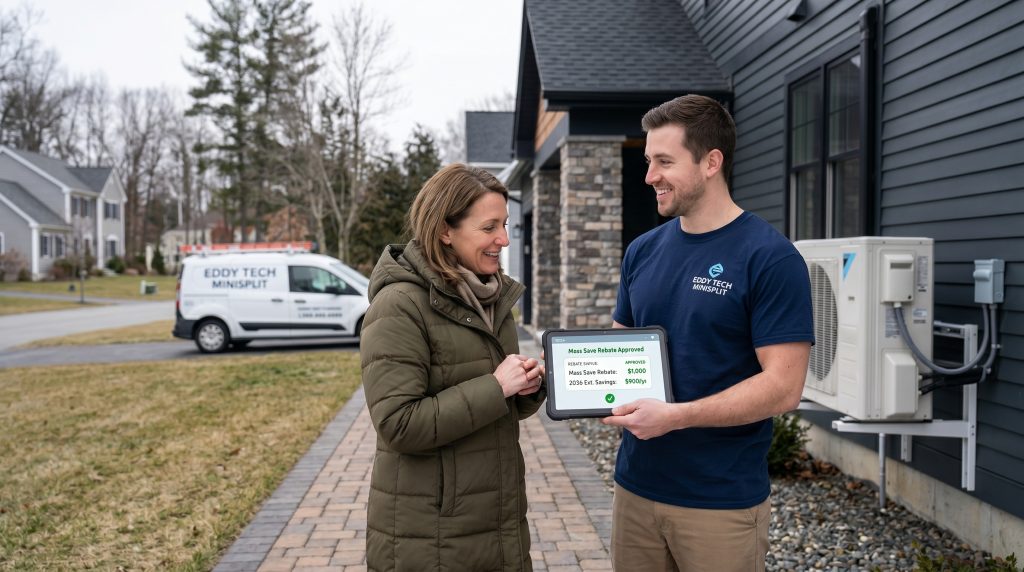
Massachusetts remains one of the most generous states in the country for heat pump incentives, even after several rebate adjustments. Here’s what’s currently available:
- Whole-Home Air-Source Heat Pump Rebate: Up to $8,500 per home, calculated at roughly $2,650 per ton of installed capacity for 2026.
- Partial / Supplemental Rebates: Smaller rebates ranging from $1,250 to several thousand dollars are available for partial-home or supplemental installations, depending on system type and eligibility.
- 0% HEAT Loan: Mass Save’s HEAT Loan program offers 0% interest financing for up to $25,000 over a 7-year term. You can apply your rebate first and finance only the remaining balance interest-free.
- Income-Eligible Enhanced Rebates: Households that qualify for income-based programs may access significantly higher rebate amounts through Mass Save’s enhanced pathway.
Important update: The federal Section 25C Energy Efficient Home Improvement Credit expired on December 31, 2025, and is no longer available for residential heat pump installations in 2026. Massachusetts homeowners should rely on Mass Save rebates and the 0% HEAT Loan as their primary incentive sources. Eligibility now also requires equipment using R-32 or R-454B refrigerant rather than R-410A, in line with EPA AIM Act phase-down rules. For full program details and to confirm current eligibility, visit the official Mass Save website.
Example: Net Cost After Rebates
Consider a Worcester homeowner installing a 3.5-ton whole-home ducted heat pump at a total project cost of $20,000. After applying the maximum $8,500 Mass Save whole-home rebate, the net out-of-pocket cost drops to roughly $11,500. If financed through the 0% HEAT Loan over 7 years, that works out to approximately $137 per month with zero interest — often comparable to or lower than what homeowners previously spent on oil or propane deliveries.
Homeowners switching from oil or propane typically see the fastest payback, often within 3 to 4 years, while also gaining central air conditioning as a built-in benefit of the new system.
Operating Costs: What Will You Pay to Run It?
At current Eversource and National Grid rates, a properly sized cold-climate heat pump in a typical 2,500 sq ft Massachusetts home costs roughly $1,100–$1,400 per year to heat, compared to $1,400–$1,800 per year for a gas furnace and significantly more for oil or electric resistance heating. Homeowners switching from oil to a heat pump commonly save $1,500–$2,500 annually on heating costs. Many utilities, including Eversource and National Grid, also offer special winter electric rates for heat pump households that further reduce operating costs.
Choosing the Right Cold-Climate Heat Pump for Your Massachusetts Home
Not every heat pump marketed as ‘cold climate’ performs the same way. When evaluating options, look for:
- 5°F rated capacity (not the 47°F nameplate rating) that meets your home’s Manual J heating load
- AHRI-certified matched indoor/outdoor pairings
- R-32 or R-454B refrigerant for 2026 Mass Save eligibility
- A 10- to 12-year compressor warranty
- A local installer certified as a Mass Save Heat Pump Coordinator (HPC) for your chosen brand
Mitsubishi and Fujitsu currently have the deepest contractor support networks in Massachusetts, which matters for long-term maintenance and warranty service. If you’d like help comparing brands and system types for your specific home, our team can walk you through options during a free in-home consultation — just contact us to schedule a visit.
Why Work With a Local Worcester-Area Installer
Cold-climate heat pump performance depends heavily on correct sizing, refrigerant line installation, and electrical work — all of which are easiest to get right with a local team that knows Massachusetts building stock, from historic triple-deckers on Worcester’s East Side to newer builds in Tatnuck and surrounding towns. At EddyTech Mini Splits Solutions, our certified technicians handle everything from the initial Manual J load calculation to Mass Save paperwork, so you get an accurate quote and a smooth rebate process from day one.
We proudly serve homeowners throughout Worcester and the surrounding Massachusetts communities, including Shrewsbury, Westborough, Northborough, Grafton, Auburn, Millbury, Marlborough, Hudson, Leominster, Fitchburg, and Hopkinton.
Repairs, Maintenance, and Replacement
If you already have a mini-split or heat pump and are dealing with performance issues rather than a new install, our team also handles diagnostics and repairs. Visit our mini-split repair page for common troubleshooting information, or our maintenance services page to learn about seasonal tune-ups that extend system life and protect efficiency — and your Mass Save warranty requirements.
Replacing an aging oil furnace or an older heat pump nearing end-of-life is often the best time to take advantage of current Mass Save rebate levels, since program funding and rebate caps have trended downward year over year. For more on upgrade options, see our replacement and upgrade page.
Final Thoughts: Is a Cold-Climate Heat Pump Worth It in Massachusetts?
For most Massachusetts homeowners — especially those currently using oil, propane, or electric baseboard heat — a cold-climate heat pump remains one of the highest-value home upgrades available in 2026. Even with the federal tax credit expired, Mass Save’s combination of rebates up to $8,500 and 0% financing up to $25,000 can bring a $20,000 whole-home system down to an $11,000–$12,000 net cost, with monthly loan payments often lower than previous heating bills.
The most important step is getting an accurate, in-home quote based on a proper Manual J load calculation — not a phone estimate. EddyTech Mini Splits Solutions LLC offers free consultations for homeowners throughout Worcester and Central Massachusetts. Schedule your free quote today or call us at (774) 431-2298 to get started.
Frequently Asked Questions
Below are answers to the most common questions Massachusetts homeowners search for regarding cold-climate heat pump costs, rebates, and installation.
1. How much does a cold-climate heat pump cost in Massachusetts?
A single-zone ductless system typically runs $4,500-$7,500 installed, multi-zone systems range $10,000-$20,000, and whole-home ducted systems run $15,000-$28,000 before Mass Save rebates. For an accurate number, request a free in-home quote.
2. What is the average cost of a heat pump installation in Worcester, MA?
Most Worcester homeowners pay between $6,000 and $20,000 depending on system size and number of zones. See our Worcester installation page for typical project scopes.
3. Do cold-climate heat pumps really work in below-zero temperatures?
Yes. Modern cold-climate units maintain a large share of their rated heating capacity down to -13F to -22F, a major improvement over older models, according to ENERGY STAR’s heat pump program.
4. What is the Mass Save heat pump rebate amount for 2026?
The 2026 whole-home air-source heat pump rebate is capped at $8,500 per home, calculated at roughly $2,650 per ton. Confirm current figures on the official Mass Save site.
5. Is the federal tax credit for heat pumps still available in 2026?
No. The Section 25C federal tax credit expired on December 31, 2025, and is not available for residential heat pump installs in 2026, per IRS guidance.
6. How much does a single-zone mini-split cost installed?
A single-zone ductless mini-split typically costs $4,500-$7,500 installed in Massachusetts, depending on line set length and electrical access.
7. How much does a multi-zone mini-split system cost?
Multi-zone systems with 2-4 indoor units generally run $10,000-$20,000 installed, covering equipment, labor, and standard electrical work.
8. How much does a whole-home ducted heat pump cost?
Whole-home ducted air-source heat pumps typically cost $15,000-$28,000 before rebates, depending on home size and ductwork condition.
9. How much does a geothermal heat pump cost in Massachusetts?
Geothermal systems run $20,000-$45,000+ due to ground loop installation, though they offer the highest efficiency and qualify for strong Mass Save incentives.
10. What is the 0% HEAT Loan and how does it work?
The Mass Save HEAT Loan offers 0% interest financing up to $25,000 over a 7-year term. You can apply rebates first and finance only the remaining balance.
11. Can I combine Mass Save rebates with the HEAT Loan?
Yes. Homeowners typically apply the rebate to reduce the project cost, then finance the remainder interest-free through the HEAT Loan.
12. What size heat pump do I need for my house?
Sizing should be based on a Manual J load calculation, not square footage alone. Our technicians perform this during every free consultation.
13. What refrigerant do 2026 Mass Save-eligible heat pumps use?
As of 2026, Mass Save requires R-32 or R-454B refrigerant. R-410A systems were removed from the Qualified Products List on January 1, 2026, per EPA AIM Act phase-down rules.
14. How much does it cost to run a heat pump per month in Massachusetts?
At current Eversource and National Grid rates, a typical 2,500 sq ft home costs roughly $90-$120 per month to heat with a cold-climate heat pump in winter.
15. How much can I save by switching from oil to a heat pump?
Homeowners switching from oil typically save $1,500-$2,500 per year on heating costs, with payback periods of 3-4 years after rebates.
16. Do heat pumps work for both heating and cooling?
Yes. Cold-climate heat pumps provide efficient heating in winter and central air conditioning in summer from the same system.
17. What brands of cold-climate heat pumps are best for Massachusetts?
Mitsubishi and Fujitsu have the deepest Mass Save-certified contractor networks in Massachusetts, along with strong cold-climate performance ratings.
18. How long does a heat pump installation take?
Single-zone installs typically take one day, while multi-zone or whole-home ducted systems can take two to four days depending on complexity.
19. Do I need to replace my electrical panel for a heat pump?
Some older homes with 100-amp service may need a panel upgrade, especially for whole-home ducted systems. This is assessed during your in-home consultation.
20. What is a Manual J load calculation?
A Manual J calculation is an industry-standard method for determining a home’s exact heating and cooling load, accounting for insulation, windows, and orientation, as outlined by the U.S. Department of Energy.
21. Are ductless mini-splits good for old Worcester triple-deckers?
Yes. Ductless mini-splits are ideal for older homes without existing ductwork, including Worcester’s classic triple-deckers. See our installation page for details.
22. How much does Mass Save cover for a mini-split installation?
Coverage depends on system type and zones; partial rebates can range from $1,250 up to the $8,500 whole-home cap for qualifying systems.
23. What is the lifespan of a cold-climate heat pump?
Most cold-climate heat pumps last 12-15 years with proper maintenance, and some well-maintained units run longer.
24. Do heat pumps need annual maintenance?
Yes. Annual maintenance helps maintain efficiency and may be required to preserve manufacturer warranties. See our maintenance services page.
25. What happens if my heat pump breaks down in winter?
Contact a certified technician immediately for diagnostics. Our repair services page covers common troubleshooting steps.
26. Can a heat pump fully replace my furnace?
Yes, a properly sized whole-home ducted heat pump can fully replace a furnace as the primary heat source, often with electric resistance backup for extreme cold.
27. How does a heat pump’s COP affect my heating bill?
A higher Coefficient of Performance (COP) means more heat output per unit of electricity used, directly lowering your winter electric bill.
28. What is the difference between SEER and HSPF ratings?
SEER measures cooling efficiency while HSPF measures heating efficiency; cold-climate units typically have SEER2 ratings of 20+ and strong cold-weather HSPF performance.
29. Is it cheaper to heat with a heat pump or natural gas in MA?
At current rates, heat pumps cost roughly $1,100-$1,400/year to heat a typical home versus $1,400-$1,800/year for gas, though gas remains competitive in some scenarios.
30. Do heat pumps increase home value?
Energy-efficient heating systems, including heat pumps, are increasingly viewed as a value-add by homebuyers, particularly in markets focused on efficiency.
31. What permits are needed for heat pump installation in Massachusetts?
Electrical and HVAC permits are typically required and are handled by your contractor as part of the installation process.
32. How do I qualify for Mass Save income-eligible rebates?
Eligibility is based on household income relative to area median income; details are available through Mass Save’s program guidelines.
33. Can I install a heat pump myself to save money?
No. Heat pump installation requires licensed electrical and refrigerant handling work, and DIY installs void warranties and Mass Save eligibility.
34. What’s the difference between ducted and ductless heat pumps?
Ducted systems distribute air through existing ductwork, while ductless mini-splits use individual wall-mounted units connected by refrigerant lines, ideal for homes without ducts.
35. How noisy are cold-climate heat pumps?
Modern units are designed to run quietly, with indoor units often producing sound levels comparable to a quiet conversation.
36. Will a heat pump work if my power goes out?
No, heat pumps require electricity to operate, so backup heating or a generator may be considered for outage-prone areas.
37. How do I find a Mass Save-approved heat pump contractor?
Look for a contractor listed as a Mass Save Heat Pump Coordinator (HPC) for your chosen brand; our team holds this certification for several major brands.
38. What is the average cost per ton for a heat pump installation?
Installed costs generally range from $4,000-$6,000 per ton depending on system type, with rebates calculated at $2,650 per ton for 2026.
39. How many zones do I need for a 2,000 sq ft home?
Most 2,000 sq ft homes need 2-4 zones depending on layout, though a Manual J calculation will confirm the exact configuration.
40. Can heat pumps dehumidify my home in summer?
Yes, heat pumps function as central air conditioners and provide effective dehumidification during cooling season.
41. What’s the difference between R-32 and R-454B refrigerant?
Both are low-GWP refrigerants replacing R-410A; R-32 is single-component and R-454B is a blend, with functionally equivalent performance.
42. Does Eversource offer a special electric rate for heat pump owners?
Yes, Eversource and National Grid offer winter heat pump rate programs designed to reduce electricity costs for heat pump households – check Eversource’s website for current offers.
43. How much does heat pump repair cost in Massachusetts?
Repair costs vary by issue, from minor refrigerant or sensor fixes to more involved compressor work; our repair page covers common scenarios.
44. What’s included in a free heat pump consultation?
A free consultation includes an in-home assessment, Manual J load calculation, system recommendations, and a detailed written quote.
45. Can I get a heat pump quote over the phone?
No reputable contractor can provide an accurate quote without an in-home visit, since sizing and electrical factors significantly affect pricing.
46. What is the payback period for a heat pump in Massachusetts?
Homeowners switching from oil typically see payback in 3-4 years; gas switchers may take longer but still see savings over a 10-year period.
47. Are there rebates for replacing an old heat pump?
Yes, replacing an aging heat pump with a Mass Save-qualified cold-climate model is generally eligible for the same rebate programs as new installations.
48. How does home insulation affect heat pump cost and sizing?
Poor insulation increases the heating load, which can require larger equipment and higher installation costs; improving insulation first can reduce both.
49. What is a backup heat source and do I need one?
A backup heat source, such as electric resistance coils, supplements the heat pump during extreme cold; many whole-home systems include this by design.
50. How do I know if my home is a good candidate for a heat pump?
Most Massachusetts homes are good candidates, especially those with oil, propane, or electric baseboard heat. A site visit confirms feasibility.
51. What’s the cost difference between Mitsubishi and other brands?
Mitsubishi and Fujitsu units often carry a premium due to longer warranties and stronger cold-climate ratings, but pricing is competitive within the broader $4,500-$28,000 range depending on system type.
52. Do heat pumps qualify for property tax exemptions in MA?
Some municipalities offer incentives for renewable energy upgrades; check with your local assessor’s office or the Massachusetts Department of Energy Resources for current programs.
53. How often should I clean my mini-split filters?
Filters should generally be cleaned every 2-4 weeks during heavy use seasons to maintain efficiency and air quality.
54. What happens during a mini-split maintenance visit?
A maintenance visit typically includes filter cleaning, coil inspection, refrigerant level checks, and a performance test. See our maintenance page for details.
55. Can a heat pump heat a finished basement?
Yes, with proper sizing a heat pump zone can effectively heat a finished basement, though basements often require careful load calculation due to ground temperatures.
56. What is the warranty on a typical cold-climate heat pump?
Most cold-climate systems carry 10-12 year compressor warranties when installed by a certified dealer and properly registered.
57. How does outdoor unit placement affect cost and performance?
Outdoor units need clearance for airflow and snow accumulation; difficult placements can add labor cost but proper placement protects performance.
58. Is a heat pump a good option for a home addition?
Yes, single-zone mini-splits are a popular and cost-effective way to heat and cool home additions without extending existing ductwork.
59. How much does line set length add to installation cost?
Longer line set runs can add several hundred to over a thousand dollars depending on distance, wall penetrations, and condensate routing needs.
60. What’s the process for applying for Mass Save rebates?
Your contractor typically submits required documentation, including AHRI certificates and Manual J calculations, as part of the Mass Save application process.
61. Can renters get heat pump rebates in Massachusetts?
Rebate eligibility generally depends on the property owner’s participation; renters should coordinate with landlords regarding Mass Save programs.
62. How does humidity affect heat pump performance in summer?
Cold-climate heat pumps effectively manage humidity during cooling season, similar to or better than standard central air systems.
63. What is the difference between a heat pump and an air conditioner?
An air conditioner only cools, while a heat pump can both heat and cool by reversing the refrigerant cycle.
64. How do I prepare my home for a heat pump installation?
Clear access to planned indoor and outdoor unit locations and ensure your electrical panel location is accessible for assessment.
65. Can I install a heat pump in a condo or apartment in Massachusetts?
Yes, single-zone ductless systems are common in condos, though association approval may be required for exterior unit placement.
66. What is the cost to upgrade from a 100-amp to 200-amp panel?
Panel upgrades typically range from $1,500-$3,500 depending on complexity and utility coordination requirements.
67. How does a cold-climate heat pump defrost in winter?
Units periodically run a defrost cycle that briefly reverses operation to melt ice from the outdoor coil, then resumes heating.
68. Do I need a generator backup for a heat pump in MA winters?
A generator isn’t required but can be useful for households concerned about power outages during extreme cold events.
69. How does a heat pump compare to a furnace in terms of safety?
Heat pumps don’t burn fuel, eliminating risks like carbon monoxide exposure associated with combustion-based furnaces.
70. How much does it cost to remove an old oil tank?
Oil tank removal typically costs $500-$1,500 depending on tank size, location, and any required environmental testing.
71. Can heat pumps be used with existing ductwork?
Yes, ducted air-source heat pumps can often use existing ductwork if it’s properly sized and in good condition, which is assessed during your consultation.
72. What’s the energy efficiency difference between SEER2 16 and SEER2 20?
A SEER2 20-rated system uses meaningfully less electricity for the same cooling output compared to a SEER2 16 system, lowering summer bills.
73. How do I read my electric bill to estimate heat pump costs?
Check your kWh usage rate from Eversource or National Grid and multiply by estimated heat pump consumption, or use the U.S. Energy Information Administration resources for regional averages.
74. Is it normal for outdoor units to ice up in winter?
Some frost buildup is normal and cleared automatically through defrost cycles; excessive ice may indicate a service issue.
75. What’s the cost of adding an extra zone to an existing mini-split system?
Adding a zone to an existing multi-zone system, if outdoor unit capacity allows, typically costs less than a standalone single-zone install.
76. How do AHRI certifications affect my rebate eligibility?
Mass Save requires AHRI-matched indoor/outdoor pairings listed in the AHRI Directory to confirm verified performance ratings for rebate approval.
77. What’s the best time of year to install a heat pump in Massachusetts?
Spring and fall are popular for scheduling flexibility, though installations can be completed year-round based on contractor availability.
78. How does a heat pump handle a Massachusetts cold snap below 0F?
Cold-climate units are rated to maintain significant heating capacity at 5F and below, with backup heat available for extreme outliers.
79. Can I finance a heat pump without using the Mass Save HEAT Loan?
Yes, many contractors offer alternative financing options, though the 0% HEAT Loan is generally the most cost-effective for qualifying projects.
80. What documentation do I need to keep after installation?
Keep your AHRI certificate, Manual J report, warranty registration, and Mass Save rebate paperwork for future reference and resale value.
81. How do multi-zone systems handle different temperature preferences per room?
Each indoor unit operates independently with its own thermostat control, allowing different temperatures in different rooms simultaneously.
82. What’s the difference between inverter and non-inverter compressors?
Inverter compressors adjust speed continuously to match demand, improving efficiency and comfort compared to fixed-speed non-inverter units.
83. How long do Mass Save rebate funds typically take to process?
Processing times vary, but rebates are generally issued within several weeks to a couple of months after application approval.
84. Can a heat pump help with allergies or air quality?
Heat pumps with quality filtration can help reduce airborne particles, though dedicated air purification may be needed for severe allergy concerns.
85. What’s the cost difference between a 2-zone and 4-zone mini-split system?
Each additional zone adds roughly $2,500-$4,000 depending on unit capacity and installation complexity within the multi-zone range.
86. Do heat pumps require a condensate drain?
Yes, indoor units produce condensate during cooling that must be drained, sometimes requiring a condensate pump depending on location.
87. How does location affect heat pump sizing in Massachusetts?
Local climate data, including heating degree days specific to your town, factors into the Manual J load calculation for accurate sizing.
88. What’s the typical cost range for a full heat pump system in a 1,500 sq ft home?
A 1,500 sq ft home typically falls in the $10,000-$16,000 range for a properly sized multi-zone or partial ducted system, before rebates.
89. Can businesses in Massachusetts get heat pump rebates too?
Commercial Mass Save programs exist separately from residential programs, with different eligibility and rebate structures.
90. How do I know if my current ductwork can handle a heat pump?
A technician will inspect duct sizing, insulation, and condition during your consultation to determine compatibility with a ducted heat pump.
91. What’s the role of a thermostat in heat pump efficiency?
A compatible smart or heat-pump-specific thermostat helps optimize cycling and avoid unnecessary backup heat use, improving overall efficiency.
92. How much value does a heat pump add when selling a home in MA?
While exact figures vary by market, energy-efficient systems with Mass Save documentation can be a selling point for cost-conscious buyers.
93. What’s the difference between a Mass Save rebate and a tax credit?
A rebate reduces your upfront project cost directly, while a tax credit reduces your tax liability when filing; only the rebate is currently available for 2026.
94. Can I get a second opinion on my heat pump quote?
Yes, getting multiple in-home assessments is recommended to compare sizing recommendations, equipment, and pricing before committing.
95. How do I maintain my heat pump during a Massachusetts winter?
Keep the outdoor unit clear of snow and debris, change filters regularly, and schedule annual maintenance before peak heating season. See our maintenance page for a full checklist.
96. What should I do if my heat pump isn’t heating effectively?
Check filters and thermostat settings first; if issues persist, contact a technician for diagnostics through our repair services.
97. Is it worth upgrading from an older heat pump model in 2026?
Yes, especially since older R-410A systems no longer qualify for rebates, while newer R-32/R-454B models access the full $8,500 incentive. Learn more on our replacement page.
98. Do you offer heat pump installation in Shrewsbury, MA?
Yes, we provide full installation services in Shrewsbury – see our Shrewsbury installation page for details.
99. Do you install heat pumps in Westborough and Northborough?
Yes, we serve both towns. Visit our Westborough page and Northborough page for local information.
100. Do you provide service in Grafton, Auburn, and Millbury, MA?
Yes, our team covers these communities – see our Grafton, Auburn, and Millbury pages for more.
101. Do you serve Marlborough and Hudson, MA for mini-split installs?
Yes, both towns are within our service area. See our Marlborough and Hudson pages for details.
102. Are heat pump installations available in Leominster and Fitchburg, MA?
Yes, we provide installation, repair, and maintenance in both cities. Visit our Leominster and Fitchburg pages.
103. Do you offer heat pump services in Hopkinton, MA?
Yes, Hopkinton is part of our service area – see our Hopkinton page for local details.
104. How do I schedule a free heat pump quote with EddyTech?
You can reach out through our contact page or call (774) 431-2298 to schedule your free in-home consultation.
105. What areas does EddyTech Mini Splits Solutions serve?
We serve Worcester and surrounding Central Massachusetts communities. Visit our homepage for a full overview of our services and service area.