
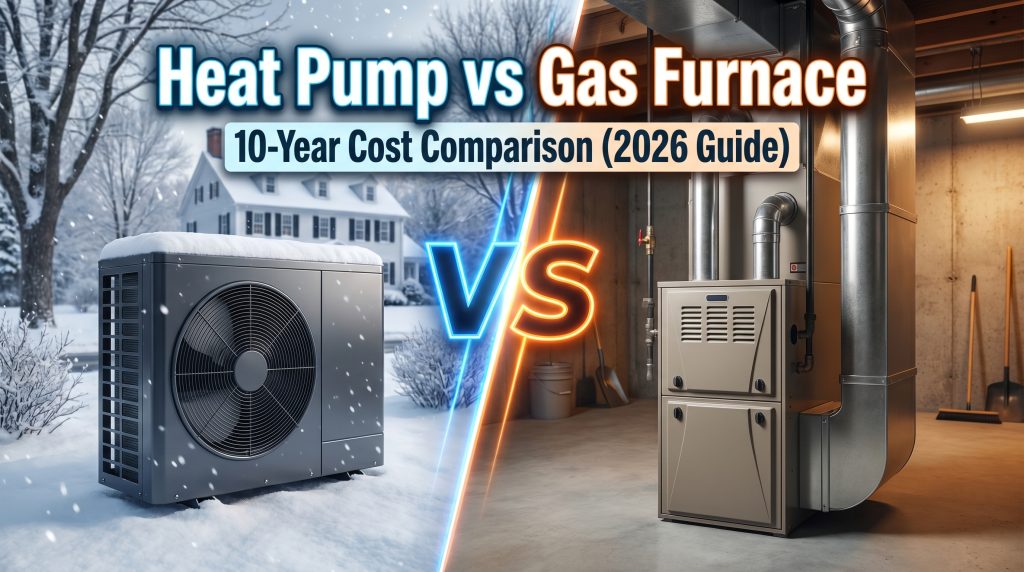
Heat Pump vs. Gas Furnace: The Complete 10-Year Cost Comparison for Worcester, MA Homeowners (2026 Guide)
If you’re a homeowner in Worcester, Massachusetts trying to decide between a heat pump and a gas furnace, you’re not alone. With Massachusetts electricity rates ranking among the highest in the nation and natural gas prices climbing steadily over the past decade, the heating decision you make today could mean a difference of thousands of dollars over the next ten years.
This guide breaks down the real, Worcester-specific numbers: upfront installation costs, annual operating expenses, available Mass Save rebates, maintenance costs, and a full 10-year total cost of ownership comparison. Whether you’re upgrading an aging oil furnace, replacing central AC, or building a new home, this comparison will help you make a confident, financially sound decision. If you’d like a personalized quote for your Worcester home, contact EddyTech Mini Splits Solutions for a free consultation.
Why Worcester Homeowners Are Rethinking Their Heating Systems in 2026
Worcester’s cold winters and aging housing stock (much of it built before 1980) make heating one of the largest line items in any household budget. Two major shifts have changed the math for 2026:
- The federal 25C heat pump tax credit expired on December 31, 2025, and is no longer available for new installations.
- The Mass Save whole-home heat pump rebate cap was reduced to a maximum of $8,500 in 2026, down from prior years — making timing and proper system sizing more important than ever.
Meanwhile, natural gas prices in the Boston-Worcester metro area have risen roughly 93% over the past decade, far outpacing the national average. Electricity prices have also climbed, but Mass Save’s Winter Heat Pump Rate programs help offset this for heat pump owners. Understanding both trends is essential before you commit to a 15-20 year heating investment.
Upfront Installation Costs: Heat Pump vs. Gas Furnace in Worcester
The starting price tag is often the first thing homeowners look at, but it only tells part of the story. Here’s what Worcester homeowners can typically expect to pay for installation in 2026:
| Cost Factor | Heat Pump (Ductless Mini-Split) | Gas Furnace + Central AC |
| Average equipment + installation cost | $8,000 – $18,000 (whole home, multi-zone) | $6,500 – $12,000 (furnace + separate AC unit) |
| Ductwork required? | No (ductless) or uses existing ducts (ducted) | Yes — new ductwork adds $5,000-$15,000 if absent |
| Mass Save rebate available (2026) | Up to $8,500 (whole-home, $1,125-$2,650/ton) | Not eligible — rebates apply to heat pumps only |
| Federal tax credit (2026) | $0 — 25C credit expired Dec 31, 2025 | $0 — never eligible for efficiency credits |
| Estimated net upfront cost after rebate | $2,000 – $10,000 | $6,500 – $12,000 |
| Provides both heating AND cooling? | Yes, included | No — requires separate AC system |
As the table shows, the net upfront cost of a heat pump after applying the 2026 Mass Save rebate is often comparable to — or even lower than — installing a new gas furnace, especially when you factor in that a heat pump also replaces your central air conditioning system in one piece of equipment.
EddyTech specializes in ductless mini-split installation across Worcester County and can help you determine your exact rebate eligibility and net cost during a free in-home estimate.
Annual Operating Costs: What You’ll Actually Pay Each Year
Operating costs depend on your home’s size, insulation quality, and local utility rates. Using 2026 Massachusetts averages — electricity at approximately 30.5 cents per kWh and natural gas at approximately $2.50 per therm — here is a typical annual heating cost comparison for a 2,000 sq. ft. Worcester home:
| Annual Expense | Cold-Climate Heat Pump | Gas Furnace |
| Estimated annual heating cost | $900 – $1,400 | $1,100 – $1,700 |
| Cooling cost (summer) | Included — no extra cost | Separate central AC: $300 – $600/year |
| Maintenance (annual tune-up) | $100 – $200 | $120 – $250 |
| Combined annual total (heating + cooling + maintenance) | $1,000 – $1,600 | $1,520 – $2,550 |
Massachusetts utilities, including Eversource and National Grid, also offer discounted Winter Heat Pump electric rates for enrolled customers, which can lower the effective cost per kWh used for heating during the coldest months — further improving the heat pump’s annual cost advantage.
10-Year Total Cost of Ownership: The Full Comparison
This is the number that matters most. The table below combines upfront net cost (after 2026 Mass Save rebates), 10 years of operating expenses, and typical maintenance/repair costs over a decade, using mid-range estimates for a 2,000 sq. ft. Worcester home.
| 10-Year Cost Category | Heat Pump (Mini-Split) | Gas Furnace + AC |
| Net upfront cost (after rebate) | $6,000 (avg.) | $9,000 (avg.) |
| 10 years of heating + cooling costs | $13,000 (avg. $1,300/yr) | $20,350 (avg. $2,035/yr) |
| 10 years of maintenance | $1,500 | $1,850 |
| Major repairs / part replacement (avg. over 10 yrs) | $500 – $1,000 | $800 – $1,800 (incl. AC compressor) |
| Estimated 10-Year Total Cost | $20,500 – $21,500 | $32,000 – $33,000 |
| Estimated 10-Year Savings with Heat Pump | $10,500 – $12,000 | — |
Based on these figures, a Worcester homeowner who switches from a gas furnace and separate AC system to a properly sized cold-climate heat pump can expect to save approximately $10,000-$12,000 over a 10-year period — even before accounting for potential gas price increases, which have historically outpaced electricity in Massachusetts.
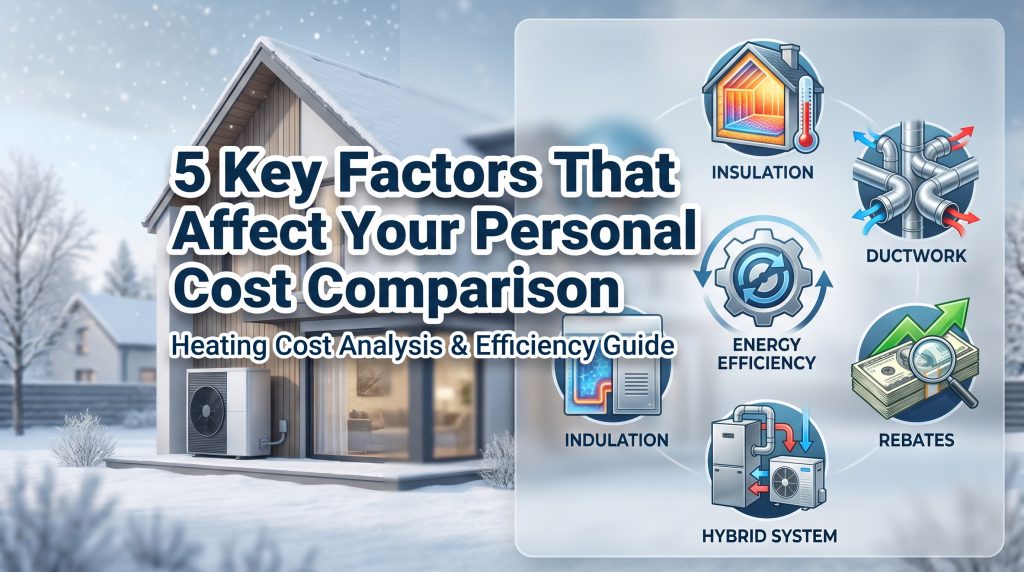
5 Key Factors That Affect Your Personal Cost Comparison
1. Your Home’s Insulation and Age
Older Worcester homes — particularly pre-1980 triple-deckers and colonials — often have inadequate insulation, which increases heating costs regardless of system type. A Mass Save Home Energy Assessment can identify weatherization opportunities that improve the performance and savings of either system.
2. Existing Ductwork
Homes without ductwork favor ductless mini-split heat pumps, which avoid the $5,000-$15,000 cost of installing new ducts. Homes with existing ducts in good condition may consider a ducted heat pump or furnace with similar installation complexity.
3. System Sizing and Cold-Climate Performance
Not all heat pumps are created equal. A properly sized, ENERGY STAR Cold Climate-certified heat pump maintains efficient output even at temperatures well below freezing — critical for Worcester’s winters. Oversized or undersized systems lead to higher operating costs and shorter equipment lifespan.
4. Rebate Timing
Mass Save rebate amounts have decreased year over year, and the 2026 program runs through early 2027. Homeowners considering a switch should verify current eligibility on the Mass Save website and act before further reductions take effect.
5. Hybrid (Dual-Fuel) Systems
Some Worcester homeowners choose a hybrid setup: a heat pump as the primary system paired with a backup gas furnace for extreme cold or emergencies. This can qualify for Mass Save’s Partial-Home rebate (up to $8,500) while providing a redundancy layer — though it does not eliminate gas utility costs entirely.
Which System Is Right for Your Worcester Home?
Generally speaking:
- Choose a cold-climate heat pump if: you want to lower long-term costs, eliminate a separate AC system, take advantage of the 2026 Mass Save rebate, and reduce your home’s carbon footprint.
- Choose a gas furnace if: your home already has an efficient, recently installed furnace with significant remaining lifespan, and gas prices in your specific utility territory remain favorable.
- Consider a hybrid system if: you want maximum reliability during extreme cold snaps and are willing to maintain two fuel sources.
The best way to know which option saves you the most money is a free, no-obligation home assessment. Schedule your free Worcester heat pump consultation with EddyTech and get a personalized 10-year cost projection based on your home’s actual size, insulation, and current heating system.
Final Thoughts: Make the Switch Before 2026 Rebates Decrease Further
For most Worcester homeowners, a cold-climate heat pump offers significant long-term financial advantages over a traditional gas furnace — especially when the 2026 Mass Save rebate of up to $8,500 is applied. While upfront costs can be similar, the combination of lower annual operating costs, included cooling, reduced maintenance, and available incentives typically results in $10,000+ in savings over a decade.
Ready to find out what a heat pump would cost for your specific Worcester home? Get your free quote from EddyTech Mini Splits Solutions today, or explore our full range of HVAC services for Worcester and surrounding Massachusetts communities.
Frequently Asked Questions: Heat Pump vs. Gas Furnace in Worcester, MA
Below are 100 commonly searched questions and answers covering cost, performance, rebates, and installation topics related to heat pumps and gas furnaces in Worcester and Massachusetts.
1. Is a heat pump cheaper to run than a gas furnace in Massachusetts?
In most Worcester homes, a cold-climate heat pump’s annual operating cost is comparable to or lower than a gas furnace, especially when Mass Save’s discounted winter electric rates are applied.
2. How much does it cost to install a heat pump in Worcester, MA?
Whole-home heat pump installations typically range from $8,000 to $18,000 before rebates, and $2,000 to $10,000 after the 2026 Mass Save rebate of up to $8,500.
3. How much does a new gas furnace cost in Massachusetts?
A new gas furnace typically costs between $4,000 and $8,000 for the unit and installation alone, with a separate central AC system adding another $3,500 to $6,000.
4. What is the Mass Save rebate for heat pumps in 2026?
In 2026, Mass Save offers up to $8,500 for whole-home heat pump systems and up to $8,500 for partial-home/supplemental systems, depending on tonnage and eligibility.
5. Did the federal heat pump tax credit expire?
Yes. The federal 25C energy efficiency tax credit for heat pumps expired on December 31, 2025, and is not available for systems installed in 2026.
6. Can a heat pump heat a home in cold Massachusetts winters?
Yes. ENERGY STAR Cold Climate-certified heat pumps are designed to operate efficiently in temperatures well below 0°F, making them suitable for Worcester winters.
7. Do heat pumps work below 0 degrees Fahrenheit?
Modern cold-climate heat pumps can maintain heating capacity down to -13°F or lower, though efficiency decreases somewhat in extreme cold.
8. Is it worth switching from gas to a heat pump?
For many Worcester homeowners, switching is worth it due to combined heating/cooling functionality, available rebates, and lower projected 10-year costs.
9. How long do heat pumps last compared to furnaces?
Heat pumps typically last 15-20 years, while gas furnaces last 15-25 years, though furnaces require a separate AC unit that has its own 10-15 year lifespan.
10. What is the average electricity rate in Massachusetts in 2026?
Massachusetts residential electricity rates average around 30 cents per kWh in 2026, among the highest in the United States.
11. What is the average natural gas price in Massachusetts?
Natural gas in the Boston-Worcester area has averaged around $2.50 per therm recently, having risen roughly 93% over the past decade.
12. Does a heat pump replace central air conditioning?
Yes. A heat pump provides both heating and cooling in a single system, eliminating the need for a separate central AC unit.
13. How many heat pumps does a typical Worcester home need?
Most homes require a multi-zone ductless system with 2-5 indoor units depending on square footage and the number of rooms needing climate control.
14. What size heat pump do I need for a 2,000 sq ft home?
A 2,000 sq ft home typically requires a 3 to 4 ton (36,000-48,000 BTU) heat pump system, though exact sizing depends on insulation and layout.
15. Are ductless mini-splits more efficient than central heat pumps?
Ductless mini-splits avoid duct losses entirely, often making them more efficient than ducted systems, especially in homes without existing ductwork.
16. Can I keep my gas furnace as backup with a heat pump?
Yes, this is called a hybrid or dual-fuel system, and it may qualify for Mass Save’s Partial-Home rebate.
17. How much does heat pump maintenance cost per year?
Annual maintenance for a heat pump typically costs $100-$200, similar to or slightly less than gas furnace maintenance.
18. Do heat pumps increase home value?
Yes, energy-efficient heating and cooling systems, including heat pumps, are increasingly valued by homebuyers in Massachusetts.
19. What happens to a heat pump during a power outage?
Since heat pumps run on electricity, they will not operate during a power outage unless backed by a generator or battery storage system.
20. Is natural gas heating dangerous?
Gas furnaces carry risks of carbon monoxide leaks and require proper venting and annual inspection to operate safely.
21. How do I qualify for the Mass Save heat pump rebate?
Eligibility depends on your utility provider (must be a Mass Save sponsor like Eversource or National Grid), your existing heating fuel type, and using equipment from the Qualified Product List.
22. What is the Mass Save HEAT Loan?
The HEAT Loan is a 0% interest financing program offered through Mass Save to help homeowners afford qualifying heating system upgrades, including heat pumps.
23. Can low-income households get a free heat pump in Massachusetts?
Households earning at or below 60% of the Area Median Income may qualify for a heat pump system at no cost through Mass Save’s income-eligible programs.
24. How much can I save per month switching to a heat pump?
Savings vary, but many Worcester homeowners report monthly heating bill reductions of $50-$150 after switching to an efficient heat pump, especially with winter rate programs.
25. Are heat pumps good for old houses in Worcester?
Yes, ductless mini-split heat pumps are particularly well-suited for older homes without ductwork, such as triple-deckers and colonials common in Worcester.
26. What is a cold climate heat pump?
A cold climate heat pump is a specially engineered air-source heat pump certified by ENERGY STAR to maintain efficient heating output in sub-zero temperatures.
27. How long does heat pump installation take?
Most ductless mini-split installations take 1-3 days depending on the number of zones and any electrical upgrades needed.
28. Do I need an electrical panel upgrade for a heat pump?
Some homes, especially those with older 100-amp panels, may need an electrical panel upgrade to support a whole-home heat pump system.
29. What is the difference between a heat pump and an air conditioner?
An air conditioner only cools, while a heat pump can both cool in summer and heat in winter by reversing its refrigerant cycle.
30. Will a heat pump lower my carbon footprint?
Yes, especially as the Massachusetts electric grid incorporates more renewable energy, heat pumps produce significantly fewer emissions than fossil fuel furnaces.
31. What brands of heat pumps does EddyTech install?
EddyTech installs leading cold-climate certified brands suited for Massachusetts winters; contact us for current brand and model recommendations for your home.
32. How often should a gas furnace be serviced?
Gas furnaces should be professionally serviced annually, ideally before the heating season begins, to maintain safety and efficiency.
33. What is AFUE rating for furnaces?
AFUE (Annual Fuel Utilization Efficiency) measures how much fuel a furnace converts to heat; modern high-efficiency furnaces have AFUE ratings of 90-98%.
34. What is SEER and HSPF for heat pumps?
SEER measures cooling efficiency and HSPF measures heating efficiency; higher numbers indicate better performance and lower operating costs.
35. Can heat pumps dehumidify a home in summer?
Yes, heat pumps function as air conditioners in cooling mode and effectively reduce indoor humidity.
36. Is propane cheaper than electricity for heating in Massachusetts?
Propane is generally more expensive per unit of heat than both natural gas and heat pump electricity in Massachusetts, making heat pumps attractive for propane-heated homes.
37. What is the lifespan of a ductless mini-split system?
Ductless mini-split systems typically last 15-20 years with proper maintenance.
38. Does Worcester have local incentives beyond Mass Save?
Worcester residents primarily access incentives through the statewide Mass Save program, which is funded by Eversource and National Grid ratepayer contributions.
39. How do I find out if my utility is a Mass Save sponsor?
Eversource, National Grid, Cape Light Compact, Berkshire Gas, Liberty Utilities, and Unitil are all Mass Save sponsors; check your utility bill or the Mass Save website to confirm.
40. Can a heat pump be installed in a single day?
Single-zone ductless mini-split installations can often be completed in one day, while whole-home multi-zone systems may take 2-3 days.
41. What temperature should I set my heat pump in winter?
Most manufacturers recommend setting a heat pump to a consistent temperature (around 68-70°F) rather than frequently adjusting it, as this maximizes efficiency.
42. Do heat pumps need defrosting in winter?
Yes, cold-climate heat pumps have an automatic defrost cycle that periodically clears frost from the outdoor unit during cold, humid weather.
43. Is it cheaper to heat with oil or a heat pump in Massachusetts?
Heating oil costs have historically been higher than the equivalent cost of heat pump electricity, especially with Mass Save winter rate programs, making heat pumps the more economical choice for oil-heated homes.
44. What is a ducted heat pump?
A ducted heat pump uses existing ductwork to distribute heated or cooled air throughout a home, similar to a central furnace or AC system.
45. Can heat pumps be used with radiant floor heating?
Air-to-water heat pumps can be paired with radiant floor heating systems, though this requires specialized equipment and design.
46. How noisy are heat pumps?
Modern heat pump outdoor units typically operate at 50-60 decibels, comparable to a quiet conversation, while indoor units are even quieter.
47. What is the payback period for a heat pump in Worcester?
With 2026 Mass Save rebates applied, many Worcester homeowners see a payback period of 3-7 years through energy savings alone.
48. Does EddyTech offer financing for heat pump installations?
Contact EddyTech directly to discuss financing options, including information on the Mass Save HEAT Loan program.
49. What is the difference between R-410A and R-32 refrigerant?
R-32 is a newer refrigerant with a lower global warming potential than R-410A and is increasingly required for Mass Save rebate eligibility in 2026.
50. Can heat pumps cause higher electric bills?
Electric bills may increase compared to a fully gas-heated home, but total energy costs (electric plus eliminated gas/oil costs) are often lower overall with an efficient heat pump.
51. What size home qualifies for the maximum Mass Save rebate?
The maximum $8,500 rebate is based on the tonnage of the system installed (at $1,125-$2,650 per ton depending on the program tier), not directly on home square footage.
52. Are there rebates for replacing a gas furnace with a heat pump?
Yes, replacing a gas furnace with a qualifying whole-home heat pump is eligible for the highest Mass Save rebate tier in 2026.
53. What is a heat pump water heater?
A heat pump water heater uses the same technology to heat water far more efficiently than standard electric resistance water heaters, and may qualify for an additional Mass Save rebate.
54. How do heat pumps affect indoor air quality?
Many heat pump systems include advanced filtration that can improve indoor air quality compared to older furnace systems.
55. What maintenance does a ductless mini-split need?
Regular maintenance includes cleaning or replacing filters monthly, cleaning indoor and outdoor coils, and an annual professional inspection.
56. Can I install a heat pump myself?
No, heat pump installation involves refrigerant handling and electrical work that requires a licensed HVAC contractor for safety, warranty, and rebate eligibility.
57. What happens if my heat pump breaks down in winter?
Reputable HVAC companies, including EddyTech, offer emergency repair services; homes with a backup heat source have additional protection during repairs.
58. Is a heat pump quieter than a furnace?
Heat pump indoor units are generally quieter than forced-air furnace systems, which can produce ductwork noise and blower sounds.
59. Do heat pumps work well in humid Massachusetts summers?
Yes, heat pumps actively dehumidify while cooling, often performing better than older central AC systems in humid conditions.
60. What is the difference between single-zone and multi-zone mini-splits?
A single-zone system has one indoor unit connected to one outdoor unit, while a multi-zone system connects multiple indoor units to a single outdoor unit for whole-home coverage.
61. How much electricity does a heat pump use per month in winter?
Usage varies by home size and climate, but a whole-home heat pump may add roughly 800-1,500 kWh per month during peak winter, partially offset by eliminated gas/oil costs.
62. Can a heat pump be too big for a room?
Yes, an oversized heat pump can short-cycle, reducing efficiency, comfort, and equipment lifespan — proper sizing by a professional is essential.
63. What is a variable speed heat pump?
A variable speed (inverter) heat pump adjusts its output continuously to match heating or cooling demand, improving efficiency and comfort compared to single-speed units.
64. Does Worcester get cold enough to need a backup heating system?
Worcester winters can see temperatures well below freezing, but properly sized cold-climate heat pumps are designed to handle these conditions without a backup in most cases.
65. What is the typical SEER2 rating for heat pumps sold in 2026?
Heat pumps sold in 2026 typically have SEER2 ratings of 15-22 or higher for higher-efficiency models eligible for rebates.
66. Do gas furnaces produce carbon monoxide?
Yes, gas furnaces produce carbon monoxide as a combustion byproduct, which is why proper venting and a working carbon monoxide detector are essential.
67. Can heat pumps be installed in apartments or condos?
Yes, ductless mini-splits are commonly installed in apartments and condos, though association approval may be needed for outdoor unit placement.
68. What is the average lifespan of a gas furnace?
Gas furnaces typically last 15-25 years with regular maintenance, though efficiency can decline in later years.
69. How do I know if my gas furnace needs replacing?
Signs include rising energy bills, frequent repairs, uneven heating, age over 15-20 years, and visible rust or cracks in the heat exchanger.
70. What is a heat exchanger crack and is it dangerous?
A cracked heat exchanger can allow carbon monoxide to enter the home’s air supply and is considered a serious safety hazard requiring immediate furnace replacement.
71. Are heat pumps covered by homeowners insurance?
Heat pumps are generally covered similarly to other major HVAC equipment under standard homeowners insurance policies, though specifics vary by insurer.
72. What is the warranty on a typical heat pump?
Most manufacturers offer 10-12 year parts warranties on heat pumps when professionally installed and registered, with labor warranties varying by contractor.
73. Can heat pumps be used with solar panels?
Yes, pairing a heat pump with solar panels can significantly reduce or eliminate the additional electricity cost of heating and cooling.
74. What is the difference between air-source and ground-source heat pumps?
Air-source heat pumps extract heat from outdoor air and are more common and affordable, while ground-source (geothermal) systems use underground temperatures and cost significantly more to install.
75. Do heat pumps qualify for property tax exemptions in Massachusetts?
Massachusetts offers a renewable energy property tax exemption for certain qualifying systems; homeowners should consult their local assessor for specifics.
76. What is the Mass Save Home Energy Assessment?
A free home energy assessment evaluates insulation, air sealing, and heating/cooling systems, and is often required before accessing certain Mass Save rebates.
77. How does humidity affect heat pump performance?
High humidity can increase frost buildup on outdoor units in winter, but modern defrost cycles are designed to manage this efficiently.
78. What is the difference between a furnace and a boiler?
A furnace heats and distributes warm air through ductwork, while a boiler heats water or steam distributed through radiators or radiant flooring.
79. Can I get a rebate for a furnace tune-up?
Mass Save does not typically offer rebates for routine furnace tune-ups, as incentives are focused on efficient equipment upgrades like heat pumps.
80. What is the cost difference between gas and electric heating per BTU?
The cost per BTU varies with current utility rates, but efficient heat pumps (which produce 2-4 units of heat per unit of electricity) often offset electricity’s higher per-unit cost.
81. How does EddyTech determine the right system size for my home?
EddyTech performs a load calculation based on square footage, insulation, window count, and layout to recommend properly sized equipment.
82. Is it better to replace a furnace and AC at the same time?
Replacing both systems together, or switching to a single heat pump system, can save on labor costs and ensure compatible, efficiently matched components.
83. What financing options exist besides the Mass Save HEAT Loan?
Homeowners may also consider personal loans, home equity lines of credit, or manufacturer financing promotions; consult a financial advisor for guidance specific to your situation.
84. Can heat pumps freeze up in extreme cold?
Properly functioning cold-climate heat pumps include defrost cycles to prevent ice buildup, though extreme prolonged cold can occasionally require professional attention.
85. What is the difference between a heat pump and a furnace in terms of comfort?
Heat pumps often provide more consistent temperatures through continuous low-speed operation, while furnaces cycle on and off, causing temperature swings.
86. Does EddyTech service all of Worcester County?
Yes, EddyTech provides HVAC services throughout Worcester and surrounding Worcester County communities including Shrewsbury, Auburn, Millbury, and more.
87. What should I ask an HVAC contractor before installation?
Ask about licensing, insurance, manufacturer certifications, load calculation methods, warranty terms, and Mass Save rebate experience.
88. How do I clean my mini-split filters?
Mini-split filters typically slide out from the front of the indoor unit and can be rinsed with water and mild soap, then dried before reinserting.
89. What is short cycling and why is it bad?
Short cycling occurs when a heating or cooling system turns on and off too frequently, increasing wear, reducing efficiency, and shortening equipment lifespan.
90. Can a heat pump replace a wood or pellet stove?
Yes, heat pumps can replace wood or pellet stoves as a primary heat source, offering more consistent temperature control without manual fuel loading.
91. What is the typical installation timeline from quote to completion?
After an initial assessment and quote, installation is typically scheduled within 1-4 weeks depending on equipment availability and contractor workload.
92. Does a heat pump require a permit in Worcester?
Yes, HVAC installations including heat pumps typically require permits from the City of Worcester; licensed contractors handle this process.
93. What is the difference between single-stage, two-stage, and variable capacity systems?
Single-stage systems run at full capacity only, two-stage systems offer high and low settings, and variable capacity (inverter) systems adjust output continuously for maximum efficiency.
94. Are there tax implications for receiving a Mass Save rebate?
Mass Save rebates are generally not considered taxable income, but homeowners should consult a tax professional for their specific situation.
95. How do heat pumps perform during a Nor’easter or major snowstorm?
Cold-climate heat pumps continue operating during snowstorms as long as the outdoor unit remains clear of snow and ice and power supply is maintained.
96. What is the best time of year to install a heat pump in Massachusetts?
Spring and fall are popular for installation due to milder weather and contractor availability, though installations occur year-round based on need.
97. Can I switch back to gas heat after installing a heat pump?
Many homeowners keep gas service for cooking or as a hybrid backup, but switching entirely back to gas-only heating after a heat pump install would require restoring the prior system.
98. What is the difference between EER, SEER, and SEER2?
EER measures efficiency at a single condition, SEER averages efficiency over a cooling season, and SEER2 is an updated testing standard introduced for more accurate real-world ratings.
99. How do I read my Eversource or National Grid bill for heating costs?
Your bill itemizes usage in kWh (electric) or therms/CCF (gas), along with delivery and supply charges; comparing year-over-year usage helps track heating costs.
100. What rebates are available for insulation upgrades alongside heat pumps?
Mass Save offers significant rebates and no-cost weatherization for income-eligible households, and discounted insulation rates for others, which can be combined with heat pump rebates.
101. Can EddyTech help me apply for Mass Save rebates?
Yes, EddyTech assists Worcester customers with rebate paperwork and ensures equipment selections meet Mass Save’s Qualified Product List requirements.
102. What is the difference between a heat pump and a furnace in terms of installation disruption?
Ductless heat pump installation is generally less disruptive since it avoids major ductwork changes, while furnace replacement in homes with existing ducts is also relatively contained.
103. How can I get a free heat pump quote in Worcester?
Contact EddyTech Mini Splits Solutions directly through their website to schedule a free, no-obligation in-home consultation and quote.
Helpful Resources & Related EddyTech Pages
Internal Links (EddyTech Mini Splits Solutions Website):
- EddyTech Homepage
- Ductless Mini-Split Installation Services
- All HVAC Services in Worcester County
- Contact EddyTech for a Free Quote
- About EddyTech Mini Splits Solutions
External Links (Authoritative Sources):