
How Heat Pumps Work Below Freezing: Cold-Climate Technology Explained
For a long time, the conventional wisdom in New England was simple: heat pumps are great for shoulder seasons, but you still need a furnace or boiler for the real cold. That assumption is now outdated. As one 2026 industry overview puts it, the idea that heat pumps stop working when temperatures hit freezing is a myth based on outdated technology. Modern cold-climate heat pumps are engineered specifically for places like Worcester, Massachusetts, where winter temperatures regularly drop into the teens, single digits, or below zero.
In this guide, we’ll explain the science behind how heat pumps pull warmth out of cold outdoor air, what makes a “cold-climate” heat pump different from an older or standard model, and what Worcester homeowners should know before choosing a ductless mini split heat pump installation in Worcester.
The Basic Physics: How Heat Pumps Move Heat, Not Create It
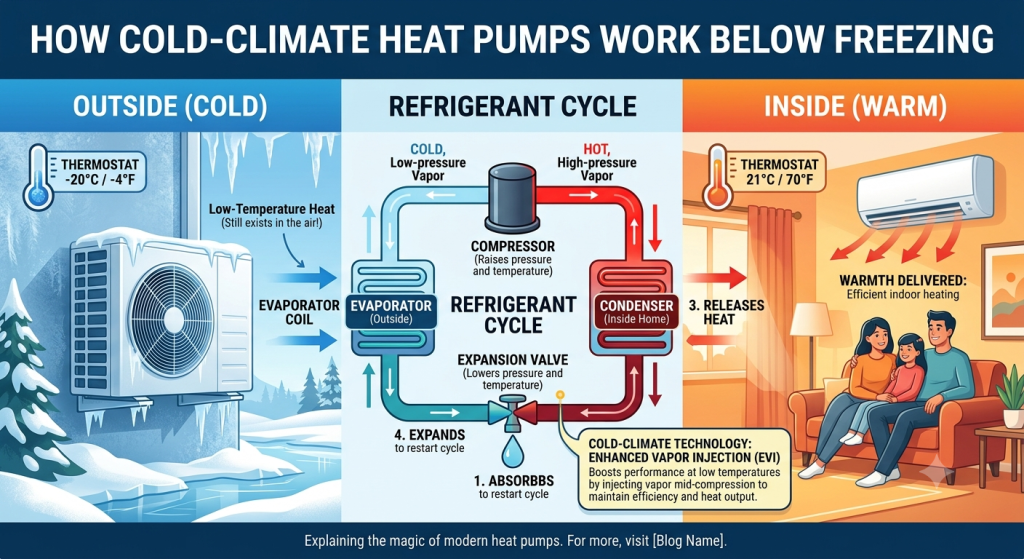
The most important concept to understand is that a heat pump doesn’t generate heat the way a furnace does by burning fuel — it moves heat from one place to another. As one cold-climate equipment manufacturer explains, in winter, a heat pump takes heat energy from the outside air, draws it into the unit, and uses that energy to heat the air inside your home.
This might sound impossible when it’s 10°F outside, but the key is that even very cold air still contains usable thermal energy. As one cold-climate technology resource puts it, air below freezing has nearly the same relative energy as air above freezing, and only at absolute zero (-273°C) is there no energy left to extract. A heat pump’s refrigerant is engineered to be colder than the outdoor air even on the coldest days, so heat naturally flows from the (relatively) warmer outdoor air into the (colder) refrigerant — the same basic principle that lets a kitchen refrigerator pull heat out of food that’s already cold.
Inside the Refrigeration Cycle
To understand cold-weather performance, it helps to walk through the refrigerant cycle itself. According to a technical patent description of heat pump operation, liquid refrigerant leaving the compressor at around 110°F is cooled to roughly 100°F as it heats the indoor air, then passes through an expansion valve where it vaporizes and drops to a much lower temperature. This cold, low-pressure refrigerant then travels to the outdoor coil, where heat from the outdoor air — even outdoor air in the 35°F to 60°F range — raises its temperature before it returns to the compressor to repeat the cycle.
In a cold-climate system, this same basic cycle continues to function at much lower outdoor temperatures because of several engineering upgrades working together, which we’ll cover next.

What Makes a Cold-Climate Heat Pump Different?
1. Variable-Speed Inverter Compressors
The single biggest difference between an older heat pump and a modern cold-climate model is the compressor. Consumer Reports notes that the key feature in a cold-climate heat pump is a variable-speed compressor, powered by an inverter, built for the wide temperature swings the Northeast and Midwest see every winter.
Older single-stage compressors were either fully on or fully off. A variable-speed inverter compressor, by contrast, can ramp its output up or down continuously to match the heating demand — running hard during a cold snap and idling efficiently during milder weather. This not only improves efficiency, it also allows the system to keep producing meaningful heat output even as outdoor temperatures plunge.
2. Enhanced Defrost Cycles
One challenge unique to air-source heat pumps is frost buildup on the outdoor coil. As one HVAC manufacturer explains, coil surface temperatures can be much lower than the surrounding air, and combined with moisture, frost can form even when the weather feels mild.
When this happens, the system briefly reverses into a defrost cycle. According to one HVAC resource, a defrost cycle typically takes 5 to 15 minutes, with cycles occurring roughly every 30 to 90 minutes during cold, damp weather, and the outdoor fan pauses during this process while the system briefly redirects warm refrigerant to melt accumulated ice. Cold-climate heat pumps use smarter, “demand-based” defrost logic that triggers only when needed, minimizing wasted energy compared to older time-based systems.
3. Two-Stage or Booster Compression
Some cold-climate systems use a secondary, or “booster,” compressor to maintain heating capacity at very low temperatures. As described in technical documentation on cold-climate heat pump design, a booster compressor activates only when outdoor temperatures fall below a certain threshold, preventing the inefficiency of running an oversized primary compressor at mild temperatures. This staged approach allows one system to be efficient on a 40°F day and still powerful on a -5°F day.
4. Advanced Refrigerants and Heat Exchanger Design
Cold-climate models also rely on refrigerant blends and expanded heat exchanger surface area designed specifically to capture heat from very cold air. As one cold-climate equipment resource notes, by using a refrigerant that remains far colder than the surrounding air even at -25°C, the system can still cause heat to transfer from the outdoor air into the refrigerant. Larger outdoor coils and optimized airflow paths further improve heat capture in frigid conditions.
Real-World Cold-Climate Performance: What the Data Shows
This isn’t just theory — it’s been tested extensively. According to one 2026 overview of the Department of Energy’s Cold Climate Heat Pump Challenge, modern cold-climate heat pumps operate efficiently even at -15°F, maintaining over 70% capacity while delivering 200-350% efficiency, equivalent to a COP of 2.0 to 3.5. The same program tested units across 23 sites in 10 U.S. states and 2 Canadian provinces.
Manufacturers are pushing these limits even further. Trane has reported that its cold-climate heat pump prototype, developed for the DOE challenge, performed in temperatures as low as -23°F in lab testing, surpassing the DOE’s mandatory -20°F requirement, with field testing completed over two winters ahead of a planned 2026 residential rollout.
On the consumer side, one HVAC resource notes that many high-performance models can deliver 100% of their heating capacity at 5°F and continue operating effectively down to -13°F or lower, a dramatic improvement over older units that often struggled below 30°F to 40°F.
Typical Cold-Climate Heat Pump Performance by Temperature
| Outdoor Temperature | Typical Heating Capacity | Notes |
| 47°F | 100% | Standard rated condition |
| 17°F | ~85-100% | Many cold-climate units maintain near-full capacity |
| 5°F | ~70-100% | High-performance models still near full output |
| -13°F to -15°F | ~70%+ | DOE Cold Climate Challenge benchmark range |
| -20°F to -23°F | Varies by model | Frontier of current cold-climate prototypes |
Worcester’s coldest winter nights typically fall in the single digits to low teens, occasionally dipping below zero during extreme cold snaps — well within the range where today’s cold-climate ductless mini splits are designed to perform.
Do You Still Need Backup Heat?
This is one of the most common questions Worcester homeowners ask. The honest answer is: it depends on the system and the home. Older heat pumps often required an auxiliary heat source once temperatures dropped below about 5°F, switching to electric resistance heat strips to make up the difference. Modern cold-climate models reduce or eliminate this need.
One cold-climate equipment provider notes that for many climates, a properly sized cold-climate heat pump can handle 100% of the heating load without backup heat, while a 2026 industry summary similarly states that properly installed cold-climate heat pumps can handle 100% of a home’s heating needs even in regions where temperatures regularly drop below freezing.
The deciding factors are proper sizing, your home’s insulation level, and the specific equipment chosen. Some Worcester homeowners choose to keep an existing oil or gas system as a backup for the rare extreme cold event, while others fully replace their heating system with a correctly sized cold-climate heat pump. To explore what makes sense for your home, see our breakdown of heat pump installation costs in Worcester, MA.
Why Sizing and Insulation Matter More Than Ever
Cold-climate technology is impressive, but it’s not magic — it works best when paired with a properly sized system and a reasonably well-insulated home. Consumer Reports points out that drafty homes with leaky, uninsulated walls and ducts remain a challenge for any heating system, including heat pumps, and can drive up both installation and operating costs.
For Worcester’s older housing stock — including the area’s many triple-deckers — this often means an HVAC professional needs to perform a proper heat load calculation rather than simply matching the size of an old furnace. An undersized system will struggle on the coldest days, while an oversized one cycles inefficiently. If you’re researching ways to improve your home’s overall efficiency alongside a heat pump upgrade, our guide on lowering energy bills in Worcester, Massachusetts covers both equipment and building-envelope improvements.
Ductless Mini Splits and Cold-Climate Performance
Ductless mini split systems have become especially popular for cold-climate retrofits because they pair well with zoned, room-by-room heating strategies and avoid the energy losses associated with old or leaky ductwork. Many manufacturers now offer mini split lines specifically branded for cold-climate performance, using the same variable-speed compressor and enhanced defrost technology described above.
For Worcester homeowners replacing oil, propane, or electric baseboard heat, a cold-climate ductless mini split can often serve as the primary heat source for most of the season, with the system automatically modulating output as outdoor temperatures swing from a 45°F November afternoon to a 5°F January night. To see what this looks like for your specific home, schedule a free consultation with EddyTech Mini Splits.

Winter Maintenance Tips for Cold-Climate Heat Pumps
- Keep the outdoor unit clear of snow drifts, ice buildup, and debris to maintain proper airflow.
- Don’t be alarmed by steam or fan pauses during a defrost cycle — this is normal operation, not a malfunction.
- Avoid covering the outdoor unit completely, as this can trap moisture and interfere with defrost cycles.
- Have filters cleaned regularly so the system isn’t working harder than necessary during peak winter demand.
- Schedule an annual professional inspection before the heating season to catch refrigerant or component issues early.
If you notice ice accumulation that doesn’t clear after a defrost cycle, reduced heat output during moderately cold weather, or unusual noises, it’s worth having a professional take a look. You can schedule a service visit with EddyTech for diagnostics and maintenance.
Final Thoughts
Cold-climate heat pumps represent one of the biggest shifts in residential HVAC technology in decades. Through variable-speed inverter compressors, smarter defrost logic, booster compression, and refrigerant engineering designed for sub-zero performance, today’s systems can reliably heat a Worcester home through even the harshest parts of winter — often without backup heat, when properly sized and installed.
If you’re considering a heat pump for your Worcester home and want to understand how cold-climate technology applies to your specific house, the team at EddyTech Mini Splits Solutions LLC offers free consultations across Worcester and Central Massachusetts. Contact us today to schedule your free estimate, or call us directly at (774) 431-2298.
100 Frequently Asked Questions About Cold-Climate Heat Pumps
The following FAQs answer common search questions about how heat pumps perform in freezing temperatures. For installation-specific questions, see our main Worcester mini split installation page.
1. Do heat pumps work below freezing?
Yes, modern cold-climate heat pumps are specifically engineered to provide efficient heating well below freezing, with many models performing effectively down to -13°F or lower.
2. How do heat pumps get heat from cold air?
Even cold air contains usable thermal energy; the heat pump’s refrigerant is kept colder than the outdoor air, so heat naturally transfers from the air into the refrigerant, which is then compressed and released indoors.
3. At what temperature do heat pumps stop working?
Standard older heat pumps often struggled below 30-40°F, but modern cold-climate models can continue operating efficiently at temperatures as low as -15°F to -20°F or lower.
4. Is it a myth that heat pumps don’t work in cold weather?
Yes, this is largely an outdated belief based on older heat pump technology; modern cold-climate heat pumps are designed to handle freezing and sub-zero temperatures.
5. Can a heat pump heat a home at 0°F?
Many cold-climate heat pumps can continue providing significant heating capacity at 0°F, though exact performance depends on the specific model.
6. Do heat pumps lose efficiency in cold weather?
Efficiency does decrease somewhat as outdoor temperatures drop, since there’s less heat available to extract, but cold-climate models are designed to minimize this drop-off.
7. What is the coldest temperature a heat pump can operate in?
Some cold-climate prototypes have been tested down to around -23°F, while many commercially available cold-climate models are rated for reliable operation to -15°F or -20°F.
8. Why do heat pumps feel less warm in winter than a furnace?
Heat pumps typically deliver air at a lower temperature than a furnace but circulate it more continuously, which can feel different even though the home is being heated effectively.
9. Do heat pumps work the same in heating and cooling mode?
The same refrigeration cycle is used in both modes, but a reversing valve changes the direction of refrigerant flow so the system either absorbs heat from outside (heating) or from inside (cooling).
10. How does a heat pump know when to switch to defrost mode?
Sensors monitor the outdoor coil’s temperature and operating conditions, triggering a defrost cycle when frost buildup reaches a certain threshold.
11. What is a defrost cycle?
A defrost cycle is a brief period where the heat pump reverses operation to send warm refrigerant to the outdoor coil, melting any accumulated frost or ice before resuming normal heating.
12. How long does a defrost cycle take?
A typical defrost cycle lasts about 5 to 15 minutes, depending on outdoor conditions and the amount of frost buildup.
13. Is it normal to see steam from my heat pump in winter?
Yes, steam or vapor during a defrost cycle is normal and simply water vapor from melting frost, not a sign of malfunction.
14. Why does my heat pump fan stop running sometimes in winter?
The outdoor fan typically pauses during a defrost cycle while the system melts frost from the coil; this is normal and temporary.
15. How often do defrost cycles occur?
Most systems check for frost every 30 to 90 minutes during heating mode, with actual defrost cycles occurring more frequently in cold, damp conditions.
16. Can heat pumps freeze up completely in extreme cold?
Properly functioning cold-climate heat pumps are designed to manage frost through defrost cycles; persistent ice buildup that doesn’t clear may indicate a need for professional service.
17. Do heat pumps need to run constantly in winter?
Cold-climate heat pumps with variable-speed compressors are designed to run for longer periods at modulated speeds, which is normal and often more efficient than frequent on/off cycling.
18. Why does my heat pump run longer on cold days?
As outdoor temperatures drop, the system needs to work harder to extract enough heat, so longer run times at higher compressor speeds are expected.
19. Can wind affect heat pump performance in winter?
Strong winds can increase heat loss from a home and may slightly affect the outdoor unit’s performance, though properly placed units are designed to handle typical wind conditions.
20. Do heat pumps work during a power outage?
No, heat pumps require electricity to operate; during a power outage, the system will not function unless backup power, such as a generator, is available.
21. What makes a heat pump a ‘cold-climate’ model?
Cold-climate heat pumps use technologies such as variable-speed inverter compressors, enhanced defrost controls, and refrigerant systems engineered for low-temperature performance.
22. What is a variable-speed compressor?
A variable-speed compressor can adjust its output continuously to match heating or cooling demand, rather than simply turning fully on or off like older single-stage compressors.
23. What is an inverter-driven heat pump?
An inverter-driven heat pump uses electronic controls to vary the compressor’s speed, allowing for more precise, efficient operation across a wide range of conditions, including cold weather.
24. What is a booster compressor?
A booster compressor is a secondary compression stage that activates only in very cold conditions to help maintain heating capacity without oversizing the primary compressor.
25. Do all heat pumps have two-stage compression?
No, two-stage or booster compression is a feature of some cold-climate designs, while many standard heat pumps use single-stage or variable-speed single compressors without a booster stage.
26. What refrigerants are used in cold-climate heat pumps?
Cold-climate heat pumps use refrigerants engineered to remain effective at low temperatures; specific refrigerant types vary by manufacturer and model.
27. How does coil size affect cold-weather performance?
Larger outdoor coils provide more surface area for heat exchange, which can help a system extract sufficient heat from cold outdoor air.
28. What is the Cold Climate Heat Pump Challenge?
It’s a Department of Energy initiative that tested cold-climate heat pump prototypes at multiple sites across the U.S. and Canada to validate performance at very low temperatures.
29. What temperature did the DOE Cold Climate Heat Pump Challenge target?
The challenge set a mandatory benchmark of -20°F, with some prototypes, including Trane’s, performing even lower in lab testing.
30. What does COP mean for cold-climate heat pumps?
COP, or Coefficient of Performance, measures how much heat output a system produces per unit of electricity consumed at a specific outdoor temperature.
31. What COP can cold-climate heat pumps achieve at -15°F?
Testing from the DOE Cold Climate Heat Pump Challenge found units delivering a COP of roughly 2.0 to 3.5 at -15°F, equivalent to 200-350% efficiency.
32. Are cold-climate heat pumps more expensive than standard models?
Cold-climate models often carry a price premium due to their more advanced compressors and components, though the added cost may be offset by improved performance and efficiency in cold regions.
33. Can a standard heat pump be upgraded to cold-climate performance?
Generally no — cold-climate performance is built into the system’s compressor, refrigerant, and coil design, so achieving it typically requires installing a cold-climate-rated unit rather than modifying an existing one.
34. Do cold-climate heat pumps cost more to run?
Operating costs depend on usage, electricity rates, and home insulation, but cold-climate heat pumps are designed to remain efficient even as temperatures drop, which can help control winter energy costs.
35. How is heating capacity measured at different temperatures?
Manufacturers typically publish capacity ratings (in BTUs) at standard temperatures like 47°F, 17°F, and 5°F, allowing buyers to compare cold-weather performance between models.
36. What does ‘100% capacity at 5°F’ mean?
It means the system can still deliver its full rated heating output even when outdoor temperatures are at 5°F, without needing supplemental heat.
37. Why do some heat pumps have heating capacity that increases with electricity use at low temps?
As outdoor temperatures drop, the compressor may need to work harder (use more electricity) to maintain the same heat output, which is reflected in the system’s capacity and efficiency curves.
38. What is the difference between heating capacity and efficiency?
Heating capacity refers to how much heat (in BTUs) a system can produce, while efficiency refers to how much electricity is required to produce that heat.
39. Do cold-climate heat pumps work well in humid winter climates?
Yes, though humidity can increase frost formation on the outdoor coil, which is managed through the system’s defrost cycle.
40. Can extreme cold damage a heat pump?
Properly designed and maintained cold-climate heat pumps are built to withstand extreme cold; issues are more likely to stem from improper sizing, lack of maintenance, or component wear over time.
41. Do I need a backup heating system with a cold-climate heat pump?
It depends on the specific system, home insulation, and local climate; many properly sized cold-climate heat pumps can serve as the sole heat source, while some homeowners choose to keep backup heat for extreme events.
42. What is auxiliary heat?
Auxiliary heat, often electric resistance heat strips, is a backup heat source that some heat pump systems use when the heat pump alone can’t meet demand in very cold conditions.
43. Is using auxiliary heat bad for efficiency?
Occasional use of auxiliary heat during extreme cold typically has a minor impact on overall efficiency, but frequent reliance on it can significantly increase energy costs.
44. How do I know if my home needs backup heat with a heat pump?
A professional heat load calculation, considering your home’s insulation, square footage, and local climate data, can determine whether a heat pump alone can meet your heating needs.
45. Can I keep my old furnace as backup for a new heat pump?
Yes, this is a common ‘dual-fuel’ or hybrid approach, where the heat pump handles most heating and the furnace activates only during the coldest periods.
46. What is a dual-fuel heating system?
A dual-fuel system pairs a heat pump with a fossil-fuel furnace, automatically switching to the furnace when outdoor temperatures drop below a set threshold.
47. How is a heat pump sized for cold climates?
Sizing is based on a heat load calculation that accounts for square footage, insulation, window efficiency, and local design temperatures, not simply matching the capacity of an old system.
48. What happens if a heat pump is undersized for cold weather?
An undersized system may struggle to maintain comfortable temperatures during the coldest periods and could rely heavily on backup heat, increasing energy costs.
49. What happens if a heat pump is oversized?
An oversized system may cycle on and off too frequently, reducing efficiency and potentially affecting humidity control and comfort.
50. Does home insulation affect cold-climate heat pump performance?
Yes, better-insulated homes retain heat more effectively, reducing the load on the heat pump and improving overall performance and efficiency.
51. Can drafty old homes still use heat pumps effectively?
Yes, but addressing major air leaks and insulation gaps alongside a heat pump installation often improves comfort and reduces operating costs.
52. Should I improve insulation before or after installing a heat pump?
Addressing major insulation and air-sealing issues before or during installation can help ensure the heat pump is sized correctly and performs as expected.
53. Do triple-decker homes in Worcester work well with cold-climate heat pumps?
Yes, ductless mini splits are popular in triple-deckers because each unit or floor can be zoned independently without shared ductwork.
54. How many indoor units do I need for whole-home heating with a mini split?
This depends on your home’s layout and size; a professional assessment can determine the right number and placement of indoor units for effective whole-home coverage.
55. Can one outdoor unit handle a whole Worcester home in winter?
Multi-zone outdoor units can serve multiple indoor heads and, when properly sized, can provide whole-home heating, though the right configuration depends on your specific home.
56. How do I maintain a heat pump for winter?
Keep the outdoor unit clear of snow and debris, ensure filters are clean, and schedule a professional inspection before the heating season begins.
57. Should I clear snow from around my outdoor heat pump unit?
Yes, keeping the area around the outdoor unit clear of snow and ice helps maintain proper airflow and supports normal defrost operation.
58. Can I cover my heat pump in winter?
Fully covering the outdoor unit is generally not recommended, as it can trap moisture and interfere with airflow and defrost cycles; manufacturer guidance should be followed.
59. Why is my heat pump making a hissing or whooshing sound in winter?
Some sounds during defrost cycles or refrigerant flow changes are normal, but unusual or persistent noises should be evaluated by a professional.
60. Why is ice building up on my outdoor unit and not melting?
If ice persists after defrost cycles, it could indicate a defrost control issue, refrigerant problem, or airflow obstruction that warrants professional diagnosis.
61. How often should I have my heat pump serviced?
An annual professional inspection, ideally before the heating season, is generally recommended to catch potential issues early.
62. What temperature should I set my thermostat to in winter with a heat pump?
Many heat pump manufacturers recommend setting a consistent temperature rather than large setbacks, since heat pumps recover gradually and large swings can trigger less efficient auxiliary heat.
63. Should I avoid setting back the thermostat at night with a heat pump?
Large nightly setbacks can sometimes cause the system to rely on auxiliary heat to recover quickly in the morning; smaller setbacks or smart thermostat strategies may be more efficient.
64. Can cold weather damage refrigerant lines?
Properly installed and insulated refrigerant lines are designed to handle cold climate conditions; damage is more often related to installation quality or physical impact than cold alone.
65. Why does my heat pump blow cold air sometimes in winter?
Brief periods of cooler air can occur during defrost cycles or when the system first starts; if cold air persists during normal operation, professional diagnosis is recommended.
66. How do I know if my heat pump filter needs cleaning in winter?
Reduced airflow, longer run times, or visible dust buildup on the filter are signs it’s time for cleaning, typically recommended every two to four weeks during heavy use.
67. Can a dirty filter affect cold-weather heating performance?
Yes, a clogged filter restricts airflow, which can reduce heating efficiency and put additional strain on the system during cold weather.
68. What should I do if my heat pump isn’t keeping up during a cold snap?
Check for proper thermostat settings, ensure the outdoor unit is clear of obstructions, and contact a professional if the system still can’t maintain temperature.
69. Is it normal for a heat pump to take longer to heat up in winter?
Yes, heat pumps generally provide steady, gradual heating rather than the rapid temperature swings of a furnace, which is normal behavior, especially in cold weather.
70. How do I know if my heat pump needs refrigerant?
Signs like reduced heating capacity, ice buildup, or unusual sounds may indicate a refrigerant issue, which should be diagnosed and serviced by a licensed professional.
71. Can heat pumps be damaged by repeated defrost cycles?
Defrost cycles are a normal part of operation and are not inherently damaging; excessive or abnormal cycling, however, may indicate an underlying issue worth investigating.
72. Should the outdoor unit be elevated off the ground in snowy climates?
Elevating the outdoor unit can help prevent snow accumulation and ice damage in areas with significant snowfall, and is often recommended by installers in cold climates.
73. What is short cycling and is it a cold-weather issue?
Short cycling refers to a system turning on and off too frequently; while it can occur in any season, improper sizing or control issues can make it more noticeable in cold weather.
74. Can a heat pump run continuously for hours in cold weather?
Yes, especially with variable-speed compressors, continuous operation at a modulated speed is normal and often more efficient than frequent cycling.
75. How long do cold-climate heat pumps typically last?
With proper maintenance, cold-climate heat pumps commonly last 15 to 20 years, similar to standard heat pump systems.
76. How cold does it get in Worcester, MA in winter?
Worcester winters typically bring temperatures in the teens to low 20s at night, with occasional dips into the single digits or below zero during cold snaps.
77. Are cold-climate heat pumps suitable for Worcester’s climate?
Yes, Worcester’s typical winter temperature range falls well within the operating capabilities of modern cold-climate heat pump systems.
78. What heat pump brands are recommended for Massachusetts winters?
Several major manufacturers offer cold-climate-rated lines suited to Massachusetts conditions; EddyTech can discuss specific options during a consultation.
79. Does EddyTech install cold-climate heat pumps in Worcester?
EddyTech specializes in ductless mini split systems suited to Central Massachusetts climates; contact us to discuss cold-climate options for your home.
80. What towns near Worcester does EddyTech serve for heat pump installation?
EddyTech serves Worcester and surrounding communities including Shrewsbury, Westborough, Northborough, Grafton, Auburn, Millbury, Marlborough, Hudson, Leominster, Fitchburg, and Hopkinton.
81. Can EddyTech help me decide if I need backup heat?
Yes, EddyTech can assess your home’s heating needs and discuss whether a cold-climate heat pump can serve as your sole heat source or whether backup heat makes sense.
82. Does EddyTech offer free estimates for cold-climate heat pump installation?
Yes, EddyTech provides free on-site consultations and written estimates for Worcester-area installations.
83. How quickly can EddyTech install a cold-climate heat pump?
Installations are typically scheduled within one to two weeks of a consultation, with flexible scheduling including weekends.
84. Can EddyTech replace my oil furnace with a cold-climate heat pump?
In many Worcester homes, a properly sized cold-climate heat pump can replace or significantly reduce reliance on an oil furnace; EddyTech can assess your specific situation.
85. Does Mass Save offer rebates for cold-climate heat pumps?
Massachusetts offers incentive programs through Mass Save, though specific eligibility and rebate amounts change periodically, so checking current program details is recommended.
86. Is the federal heat pump tax credit available for cold-climate models?
The federal 25C heat pump tax credit expired at the end of 2025, so homeowners should verify current federal incentive availability before budgeting.
87. How do I get a quote for a cold-climate heat pump in Worcester?
You can contact EddyTech Mini Splits Solutions directly, visit eddytechminisplits.com, or use the online contact form to schedule a free consultation.
88. What information should I have ready for a heat pump consultation?
Details about your home’s square footage, current heating system, insulation, and any specific rooms with comfort issues are helpful for a productive consultation.
89. Can a cold-climate heat pump help during a Massachusetts ice storm?
As long as power remains available, a cold-climate heat pump can continue operating through winter storms, including its normal defrost cycles for ice management.
90. Where can I learn more about heat pump costs for Worcester homes?
Our detailed guide on heat pump installation costs in Worcester, MA breaks down the factors that affect pricing for cold-climate systems.
91. Are cold-climate heat pumps better than electric baseboard heat?
Cold-climate heat pumps are generally more energy-efficient than electric resistance baseboard heat, since they move heat rather than generate it directly from electricity.
92. Are cold-climate heat pumps better than oil furnaces for winter heating?
Cold-climate heat pumps can often provide comparable or better comfort than oil furnaces while eliminating combustion byproducts and fuel deliveries, though specific savings depend on local energy prices.
93. Can a cold-climate heat pump replace a wood stove?
A cold-climate heat pump can provide consistent, automated heating, though some homeowners choose to keep a wood stove as a supplemental or backup heat source.
94. Do cold-climate heat pumps work in unheated garages or sheds?
Heat pumps can be installed in detached structures, but performance and sizing should be assessed based on the space’s insulation and intended use.
95. Can a cold-climate heat pump be used for both heating and cooling year-round?
Yes, heat pumps provide both heating and cooling from the same system, making them a year-round comfort solution.
96. How does humidity affect heat pump performance in winter?
Higher humidity can increase frost formation on the outdoor coil, leading to more frequent defrost cycles, but cold-climate systems are designed to manage this.
97. Do cold-climate heat pumps need a special electrical panel upgrade?
Some installations may require electrical upgrades depending on the home’s existing panel capacity and the heat pump’s power requirements; this is typically assessed during a consultation.
98. What’s the difference between a cold-climate heat pump and a ‘hyper-heat’ model?
‘Hyper-heat’ and similar branded terms generally refer to manufacturer-specific cold-climate technology designed for enhanced low-temperature performance, similar in concept to other cold-climate-rated systems.
99. Can I run a cold-climate heat pump on solar power?
Yes, cold-climate heat pumps can be paired with solar panel systems, allowing heating and cooling to be powered partly or fully by renewable energy depending on system size.
100. Where can I schedule a consultation to discuss cold-climate heat pump options for my Worcester home?
You can contact EddyTech Mini Splits Solutions through their website or by phone to schedule a free, no-obligation consultation.